UK businesses collectively spend billions on paid search every year. According to IAB UK’s Digital Adspend 2025 report, the UK digital advertising market reached £40.5 billion in 2025, with search channels alone accounting for £8.3 billion in the first half of the year. Yet for every pound invested, a significant portion is quietly haemorrhaged on irrelevant clicks, misaligned audiences, and poorly timed bids. The good news? AI Google Ads tools are changing the equation entirely, and UK advertisers who embrace them stand to gain a decisive competitive edge.
This guide breaks down exactly how ad optimisation AI works within Google Ads, which features deserve your attention in 2026, where automation still carries risk, and how to structure a PPC strategy that genuinely cuts wasted spend rather than simply redistributing it.
Why Wasted Spend Remains a Persistent Problem in UK Paid Search
Despite the sophistication of modern platforms, ad waste is stubbornly common. Campaigns run 24/7 without time-of-day analysis, keywords match to irrelevant queries, budgets bleed into low-intent placements, and auto-generated assets fire without proper brand oversight. ClickPatrol’s 2026 analysis highlights that running ads without scheduling controls, failing to segment audiences properly, and neglecting negative keywords are among the leading causes of accelerated budget depletion.
With Google holding over 85% of UK search ad spend and the average return on Google Ads sitting at approximately £2 for every £1 invested, the opportunity cost of mismanaged campaigns is enormous. For small to mid-sized UK businesses spending £2,000 to £10,000 per month on paid search, even a 20% efficiency improvement represents thousands of pounds returned to the bottom line each year.
This is precisely where Google Ads AI tools are delivering measurable value, automating the decisions that previously required hours of manual analysis and continuous optimisation cycles.
AI Max for Search: Google’s Most Significant Shift in Years
Launched in beta in 2025 and now in full rollout, AI Max for Search is arguably the most important development in UK paid search in recent memory. It enhances traditional Search campaigns with three core AI-powered capabilities: automated search term matching, text customisation, and final URL expansion.
Search Term Matching
Rather than relying solely on your defined keywords, AI Max scans your landing pages, ad assets, and campaign context to identify high-conversion search queries you may never have thought to bid on. These AI-matched terms are clearly labelled in your search term reports, giving you visibility without sacrificing oversight. This is a meaningful improvement over the opacity that frustrated many PPC professionals during Performance Max’s early years.
Text Customisation
Using generative AI, the platform creates real-time headline and description variations tailored to the specific query being matched. Independent testing by Brainlabs across 23 campaigns found that enabling Text Customisation alone improved average Quality Scores from 6.8 to 7.3, driven primarily by stronger ad relevance. Higher Quality Scores translate directly into lower cost-per-click and better ad positioning.
Final URL Expansion
AI Max dynamically routes users to the most relevant page on your site for a given query, rather than always landing on a single pinned URL. When configured correctly with strong landing pages, this feature can significantly reduce bounce rates and improve conversion rates across the board.
According to Search Engine Land’s 2026 analysis of over 250 campaigns, advertisers activating AI Max saw a median revenue increase of 13%, with Google’s own benchmarks citing 14% more conversions or conversion value at a similar cost-per-acquisition. For exact-match-heavy campaigns, the uplift can reach as high as 27%. Crucially, starting in September 2026, legacy Dynamic Search Ads will automatically upgrade to AI Max, making early voluntary adoption the smarter strategic move for UK advertisers who want to maintain control during the transition.
Performance Max: Powerful but Requiring a Steady Hand
Performance Max campaigns use AI to serve ads across Google’s entire inventory, including Search, Display, YouTube, Gmail, Discover, and Maps, all from a single campaign structure. The AI handles asset optimisation, audience expansion, channel allocation, and bidding in real time. For ecommerce businesses and lead generation at scale, it remains one of the most powerful tools in the UK paid search arsenal.
However, PPC automation of this kind is not without risk. A 2026 study cited by ALM Corp found that while 40% of Performance Max and AI Max campaigns exceeded their ROAS targets when all AI features were fully activated with strong asset quality, a significant proportion missed targets due to poor input data, thin conversion signals, or insufficient brand controls. The lesson is clear: the quality of what you feed AI-powered campaigns determines the quality of what you get back.
Key protections for UK advertisers running Performance Max include using brand exclusions to protect margin, layering audience signals (particularly first-party customer data), reviewing the Insights tab regularly, and setting up Enhanced Conversions to pass offline conversion data back into Google’s machine learning models. Treating PMax as a set-and-forget tool almost always results in budget leakage rather than the efficiency gains it promises.
Smart Bidding: The Engine Beneath the Surface
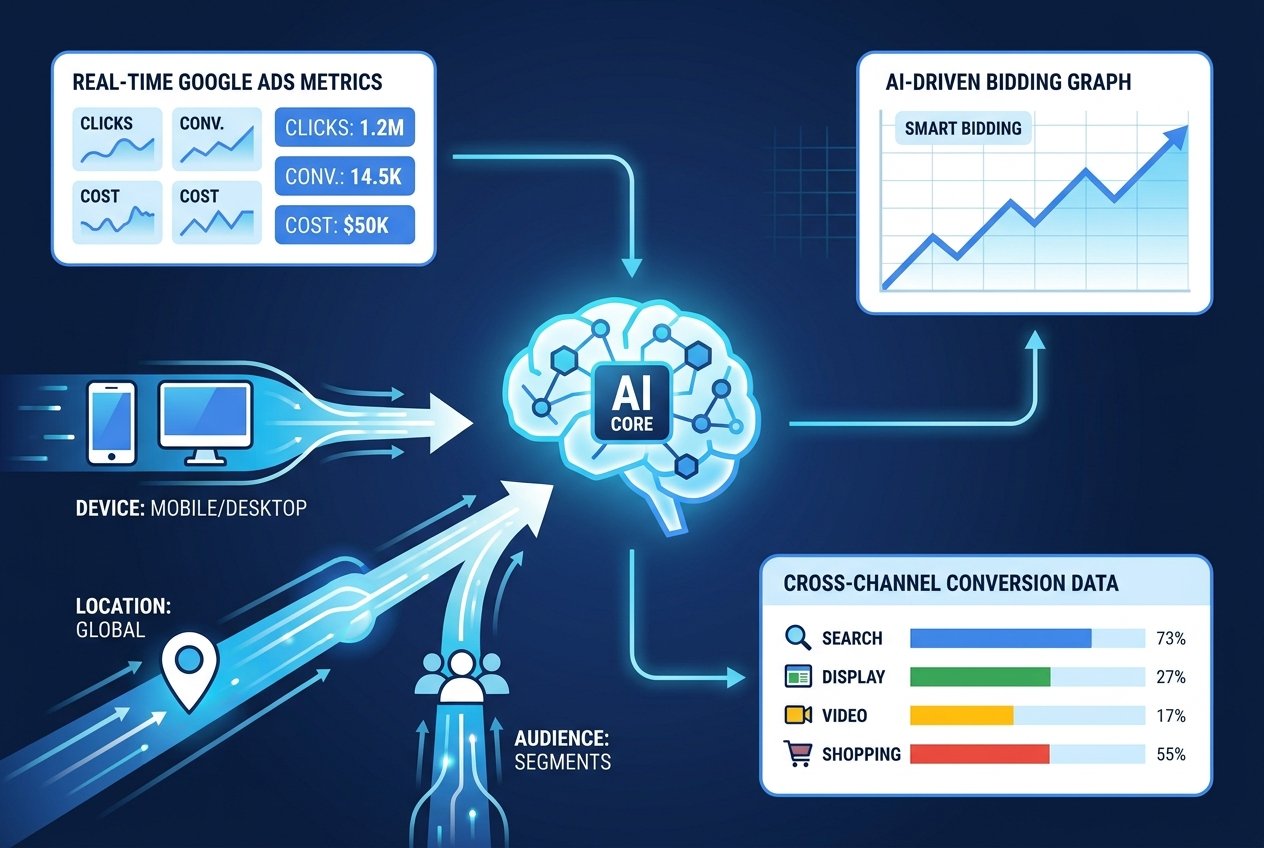
Smart Bidding is the foundational AI layer running beneath most modern Google Ads campaigns, and over 80% of Google Search campaigns now use some form of automated bidding. Strategies such as Target CPA, Target ROAS, Maximise Conversions, and Maximise Conversion Value use real-time auction signals including device, location, time of day, audience membership, and search context to set bids at the individual auction level.
A newer addition, Smart Bidding Exploration, takes this further by temporarily testing slightly wider bid ranges to discover higher-value users that your existing strategy may be excluding. Think of it as a controlled experiment that sacrifices a small degree of short-term efficiency to identify long-term growth opportunities. For UK businesses in competitive sectors such as financial services, legal, or retail, this feature can be the difference between plateauing campaign performance and consistent incremental growth.
The key principle to remember is that Smart Bidding is only as effective as your conversion data. Campaigns with fewer than 30 to 50 conversions per month often see erratic automated bidding behaviour because the AI lacks sufficient signal to learn from. In these cases, starting with Maximise Clicks or a manual CPC strategy before graduating to value-based bidding tends to produce more reliable outcomes.
AI-Powered Ad Copy: Efficiency Without Sacrificing Brand Voice
Google invested in over 60 AI-powered features across its ads products in 2025, and generative ad copy tools were among the most widely adopted. Responsive Search Ads have been the only available text format for some time, and they now lean heavily on AI to identify which headline and description combinations drive the strongest performance for each query.
For UK advertisers, the practical implication is that providing a wide variety of high-quality, brand-consistent asset inputs is now one of the most important levers available. Rather than writing one perfect ad, your role has shifted to becoming a creative director: providing a rich library of headlines, descriptions, calls to action, and USPs from which AI can construct the optimal combination in real time.
At Kaizen AI Consulting, we work with UK businesses to build robust asset libraries and campaign structures that give AI-powered ad formats the strongest possible foundation to learn from, ensuring that automation enhances your brand rather than diluting it. Our approach combines deep platform expertise with a clear understanding of the commercial objectives that matter to your business.
First-Party Data: The Competitive Moat That AI Amplifies
As third-party cookies continue their gradual decline and privacy regulations evolve post-Brexit, first-party data has become the single most valuable asset a UK advertiser can bring to their Google Ads campaigns. When you feed Customer Match lists, CRM data, and Enhanced Conversion signals into your campaigns, you are giving Google’s AI a far richer picture of what a high-value customer actually looks like, dramatically improving the accuracy of its bidding and targeting decisions.
Research consistently shows that campaigns with strong first-party data signals outperform those relying on platform defaults. For UK ecommerce and lead generation businesses in particular, integrating your CRM with Google Ads via the Customer Match feature and enabling offline conversion imports can meaningfully shift the efficiency curve of your entire account.
This integration layer is often where significant gains are left on the table. Many UK businesses have excellent CRM data but lack the technical setup to connect it meaningfully to their paid search activity, creating a gap between the customer insight they possess and the campaign performance they achieve.
Where Automation Still Requires Human Oversight
For all its capabilities, ad optimisation AI is not infallible. Google’s own Ads Advisor feature, which can autonomously make campaign changes, has been flagged by industry experts as potentially dangerous without active human oversight. Auto-generated video assets in Demand Gen campaigns, broad keyword expansion in AI Max without negative keyword management, and Performance Max campaigns lacking brand exclusions are all scenarios where automation can quickly erode profitability.
The most successful UK paid search practitioners in 2026 are not those who have handed campaigns entirely to AI, nor those who refuse to engage with automation at all. They are the ones who understand which decisions AI makes better than humans (auction-level bidding, real-time creative testing, audience signal analysis) and which decisions still require human strategic thinking (brand positioning, budget allocation philosophy, commercial prioritisation).
This hybrid intelligence model, where human expertise directs AI execution, is the approach that consistently delivers the strongest returns. If your current PPC strategy is either fully manual or entirely automated, there is almost certainly untapped performance available. Our AI consulting services are specifically designed to help UK businesses find and exploit that gap, building paid search strategies that use automation intelligently rather than unconditionally.
Building a Practical AI-Optimised Google Ads Strategy for UK Businesses
Bringing this all together, here is a structured approach for UK advertisers looking to use AI to cut wasted spend and improve campaign performance in 2026:
Step 1: Audit Your Conversion Tracking
Before enabling any AI-driven bidding or asset features, ensure your conversion tracking is accurate, comprehensive, and set up to pass the right signals back to Google. Include micro-conversions such as phone calls, form completions, and key page engagement events alongside primary goals. Without clean data, AI will optimise for the wrong outcomes.
Step 2: Upgrade to AI Max Before September 2026
Do not wait for the forced automatic upgrade of your Dynamic Search Ads. Transition manually now so you can configure brand controls, review initial AI-matched search terms, and make informed adjustments before the algorithm matures within your account.
Step 3: Connect Your First-Party Data
Upload Customer Match lists, enable Enhanced Conversions, and import offline conversion data from your CRM. This investment in data infrastructure pays dividends across every AI-powered feature in your account.
Step 4: Build a Rich Asset Library
For Responsive Search Ads and AI Max, provide at least 10 to 15 diverse headlines and four to five descriptions per campaign. Include clear USPs, pricing signals, geographical relevance for UK audiences, and varied calls to action. Avoid repetition and ensure all assets are brand-compliant.
Step 5: Monitor Weekly, Not Monthly
AI-powered campaigns can shift spending patterns quickly. Review search term reports weekly to add negative keywords, check asset performance labels in Responsive Search Ads, and monitor impression share and auction insights to spot competitive changes early.
Take Your Google Ads Performance to the Next Level
The UK paid search landscape in 2026 rewards those who combine platform knowledge with strategic clarity. AI Google Ads tools are genuinely transformative when configured correctly, but they require the right foundations, the right data, and the right human expertise steering the strategy.
Whether you are looking to reduce wasted spend, improve conversion rates, or scale your paid search investment with confidence, Kaizen AI Consulting can help. Our team specialises in helping UK businesses implement intelligent PPC automation strategies that deliver real, measurable returns. Get in touch with us today to discuss how we can help you get more from every pound you invest in Google Ads.