The way UK businesses build internal tools is undergoing a remarkable transformation. Where once custom software required months of development time and substantial budgets, forward-thinking organisations are now leveraging Claude Code to create bespoke solutions in hours rather than weeks. According to Anthropic’s 2026 State of AI Agents Report, 57% of organisations now deploy AI agents for multi-stage workflows, with coding leading adoption at nearly 90%.
For UK businesses navigating the competitive landscape of 2026, understanding how to harness Claude Code for internal tool development represents a significant competitive advantage. With government research from DSIT showing only 16% of UK businesses currently using AI technologies, early adopters stand to gain substantial productivity improvements before their competitors catch up.
What Makes Claude Code Different for Internal Business Tools
Unlike traditional coding assistants that offer simple autocomplete suggestions, Claude Code operates as a repo-aware CLI assistant capable of reasoning across entire codebases, planning multi-file changes, and executing complex workflows through natural language instructions. This represents a fundamental shift in how businesses approach internal tool development.
The practical implications for UK businesses are substantial. Research from DataNorth indicates that Claude Sonnet 4.5 achieves 77.2% accuracy on the SWE-bench Verified benchmark in standard configuration, demonstrating genuine capability for real-world software engineering tasks. This level of performance means business professionals can describe problems in plain English and receive working solutions within minutes.
Example 1: Automated Invoice Processing System
One of the most impactful Claude Code examples for UK businesses involves automating document processing workflows. A common pain point across industries is the manual handling of invoices, receipts, and financial documents.
The Challenge
Finance teams typically spend hours each week manually extracting data from PDF invoices, cross-referencing supplier information, and entering details into accounting systems. For growing businesses, this administrative burden scales proportionally with transaction volume.
The Claude Code Solution
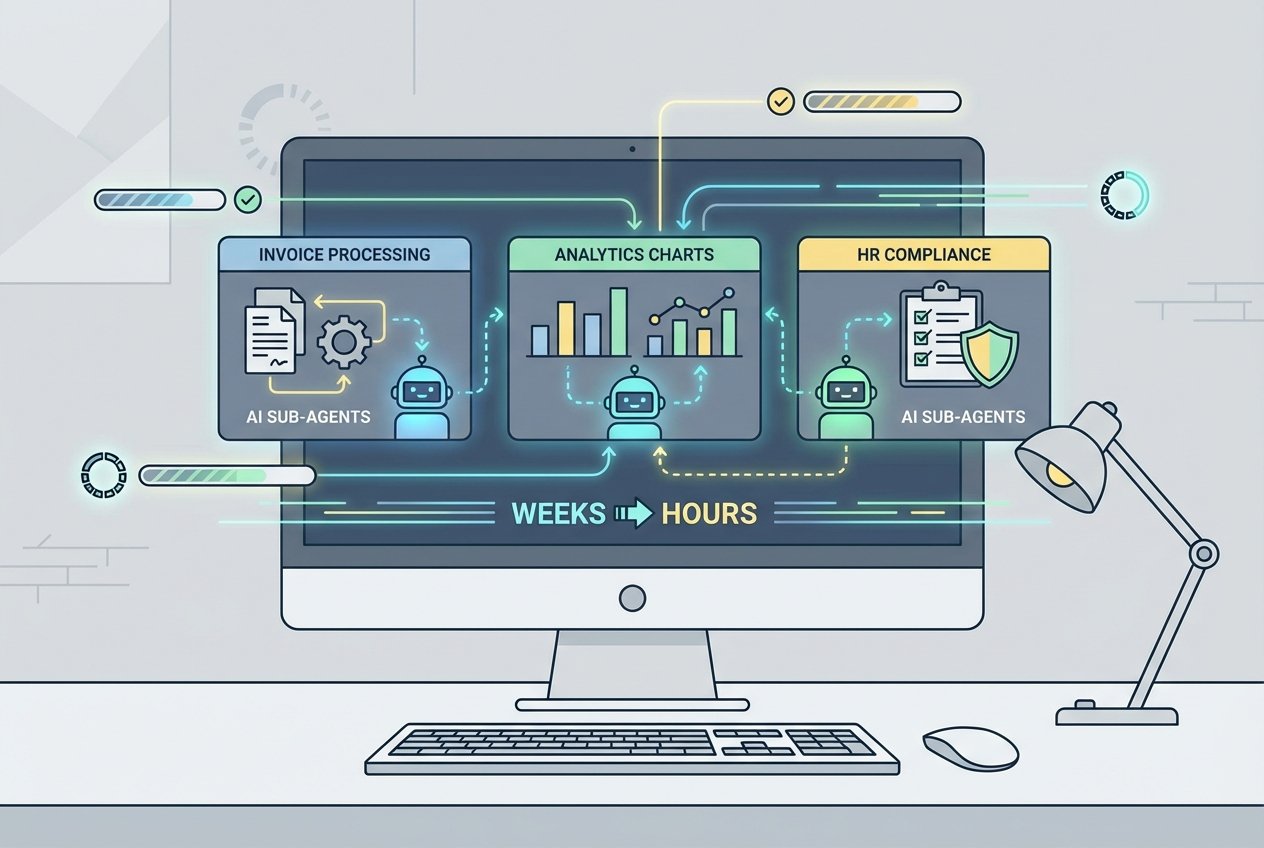
Using Claude Code, businesses can build custom invoice processing tools that automatically extract key information from PDF documents, validate data against existing supplier records, and prepare entries for accounting software integration. The system can process bulk documents using sub-agents that work in parallel, dramatically improving throughput.
According to documented case studies from 9x, such systems can process 54 PDF invoices simultaneously by spawning different sub-agents for each document, each agent focusing on a single invoice to improve accuracy and performance. For UK businesses managing Making Tax Digital compliance requirements, this type of business automation coding proves invaluable.
Example 2: Customer Data Analysis Dashboard
Business intelligence tools often require expensive subscriptions or significant development resources. Claude Code enables businesses to create custom analytics solutions tailored to their specific requirements.
Real-World Implementation
Data science and machine learning teams have found Claude Code particularly useful for bridging the gap between exploratory research and production deployment. One documented example involves researchers converting Jupyter notebook experiments into scalable data pipelines, with reported time savings of 1-2 days per model.
For UK SMEs, this capability transforms how they approach data analysis. Rather than relying on generic dashboard solutions, businesses can upload CSV files containing customer churn data, sales figures, or operational metrics and prompt Claude Code to analyse the information and provide actionable insights. The system can generate detailed reports with specific recommendations, functioning like an on-demand consultant.
This is precisely the type of AI development project where professional guidance can maximise results. At Kaizen AI Consulting, we help UK businesses identify high-impact use cases for Claude Code and develop implementation strategies that deliver measurable ROI.
Example 3: Internal Knowledge Base and Documentation System
Technical documentation often sits scattered across wikis, code comments, and team members’ heads. Claude Code can consolidate this knowledge into accessible formats, making expertise available to everyone who needs it.
How Anthropic Teams Use This Approach
According to Anthropic’s internal documentation, their Security Engineering team has Claude ingest multiple documentation sources to create markdown runbooks and troubleshooting guides. These condensed documents become context for debugging real production issues, proving more efficient than searching through full knowledge bases.
For UK businesses, this internal tools AI approach addresses a critical challenge: institutional knowledge loss. When experienced staff members leave or when new team members join, having AI-generated documentation that captures processes, procedures, and best practices ensures continuity and reduces onboarding time.
Practical Implementation Steps
Building such a system involves feeding Claude Code your existing documentation, process guides, and standard operating procedures. The AI can then create structured knowledge bases, generate FAQ documents, and even build interactive query systems where employees can ask questions in natural language and receive accurate, context-aware responses.
Example 4: Automated Marketing Campaign Generator
Marketing teams face overwhelming demands for content across multiple channels. Claude Code enables the creation of sophisticated content generation systems that maintain brand consistency whilst dramatically increasing output.
The Business Case
According to research from Push Group, 36% of UK business leaders use AI in marketing operations, making it the most prevalent business application. Claude Code takes this further by enabling businesses to build custom content pipelines rather than relying on generic tools.
Practical Application
Anthropic’s Growth Marketing team built an agentic workflow that processes CSV files containing hundreds of ads, identifies underperformers, and generates new variations within strict character limits. Using two specialised sub-agents, the system generates hundreds of new ads in minutes instead of hours.
For UK businesses, similar systems can be created for email campaigns, social media content, product descriptions, and blog articles. The key advantage over off-the-shelf solutions is customisation: Claude Code can be trained on your specific brand voice, product terminology, and audience preferences.
Example 5: HR Compliance and Onboarding Automation
Human resources departments face complex compliance requirements, particularly in the UK with its specific employment legislation. Claude Code enables the creation of HR automation tools that ensure compliance whilst reducing administrative burden.
Addressing UK-Specific Requirements
With 76% of HR departments now using AI tools according to industry analysis, the HR function represents a prime opportunity for internal tool development. Claude Code can build systems that handle right-to-work checks, generate compliant employment contracts, manage holiday calculations, and create onboarding documentation.
Implementation Considerations
A practical HR automation system built with Claude Code might include automated contract generation based on role parameters, compliance checklist management, and integration with existing HR platforms. The system can ensure that all documentation meets current employment law requirements and flag potential compliance issues before they become problems.
Getting Started with Claude Code for Your Business
The examples above demonstrate the breadth of possibilities, but successful implementation requires a strategic approach. Government research indicates that lack of identified need and limited AI expertise represent the primary barriers to adoption for UK businesses.
Recommended Approach
Start with a single high-impact use case where the potential for time savings is clear and measurable. Document your current process, identify repetitive elements that could be automated, and describe the desired outcome clearly. Claude Code works best when you can articulate the problem precisely, even if you cannot specify the technical solution.
For businesses new to AI development projects, partnering with experienced consultants can accelerate results and avoid common pitfalls. Kaizen AI Consulting offers tailored training programmes that help teams build confidence with Claude Code whilst developing practical skills applicable to their specific business challenges.
Common Success Factors
Organisations seeing the best results from Claude Code share several characteristics: they start with clearly defined problems, maintain human oversight of AI outputs, invest in staff training, and scale gradually from proven wins. The most effective teams treat Claude Code as a thought partner rather than a replacement for human judgement.
The Competitive Advantage for UK Businesses
The productivity gains available through Claude Code are substantial. IBM’s research indicates that 66% of UK enterprises are experiencing significant AI-driven productivity improvements, with 63% of senior leaders citing increased operational efficiency. However, 62% of organisations have yet to tap into the full potential of AI.
For businesses willing to invest in internal tools AI development, the opportunity is clear. The 2025 UK SME AI Adoption Report suggests that a full embrace of AI could boost UK productivity by 1.5% annually, adding up to 47 billion pounds to the economy over the next decade.
Taking the Next Step
Building internal business tools with Claude Code represents a genuine opportunity for UK businesses to improve efficiency, reduce costs, and create competitive advantages. Whether you are automating financial processes, creating custom analytics dashboards, or streamlining HR operations, the technology is now accessible to organisations of all sizes.
The key is starting with clear objectives and building expertise progressively. If your organisation is ready to explore how Claude Code can transform your internal operations, contact Kaizen AI Consulting to discuss your specific requirements and develop an implementation roadmap tailored to your business goals.
The businesses that master these tools today will be the ones setting the pace for their industries tomorrow. The question is not whether AI will transform internal business operations, but whether your organisation will be leading that transformation or following it.