From Idea to Launched App for Under £100: The 2026 Vibe Coding Playbook
The landscape of software development has shifted dramatically. In 2026, the term vibe coding 2026 has moved from a buzzy Twitter trend popularised by Andrej Karpathy into a legitimate professional workflow. Developers and non-technical founders alike now describe their intent in plain English and let AI agents generate, debug, and iterate on the code. The result? You can take an app idea to launch for a fraction of the traditional cost — often under £100 in tooling spend.
According to the Collins English Dictionary, vibe coding was named Word of the Year in November 2025, cementing its place in the tech lexicon [1]. By mid-2026, the workflow has matured into what Red Hat calls “Agentic Software Creation” — where humans focus on intent, flow, and outcome while AI handles implementation [2].
This guide walks you through the practical playbook for building and launching your MVP using the latest AI tools — specifically Claude Code Canva Lovable and their peers — while keeping your budget firmly under £100. We will cover tool selection, a step-by-step workflow, real-world case studies, UK-specific pricing, and when to bring in professional help.
The Modern Vibe Coding Stack: Two Categories You Need to Know
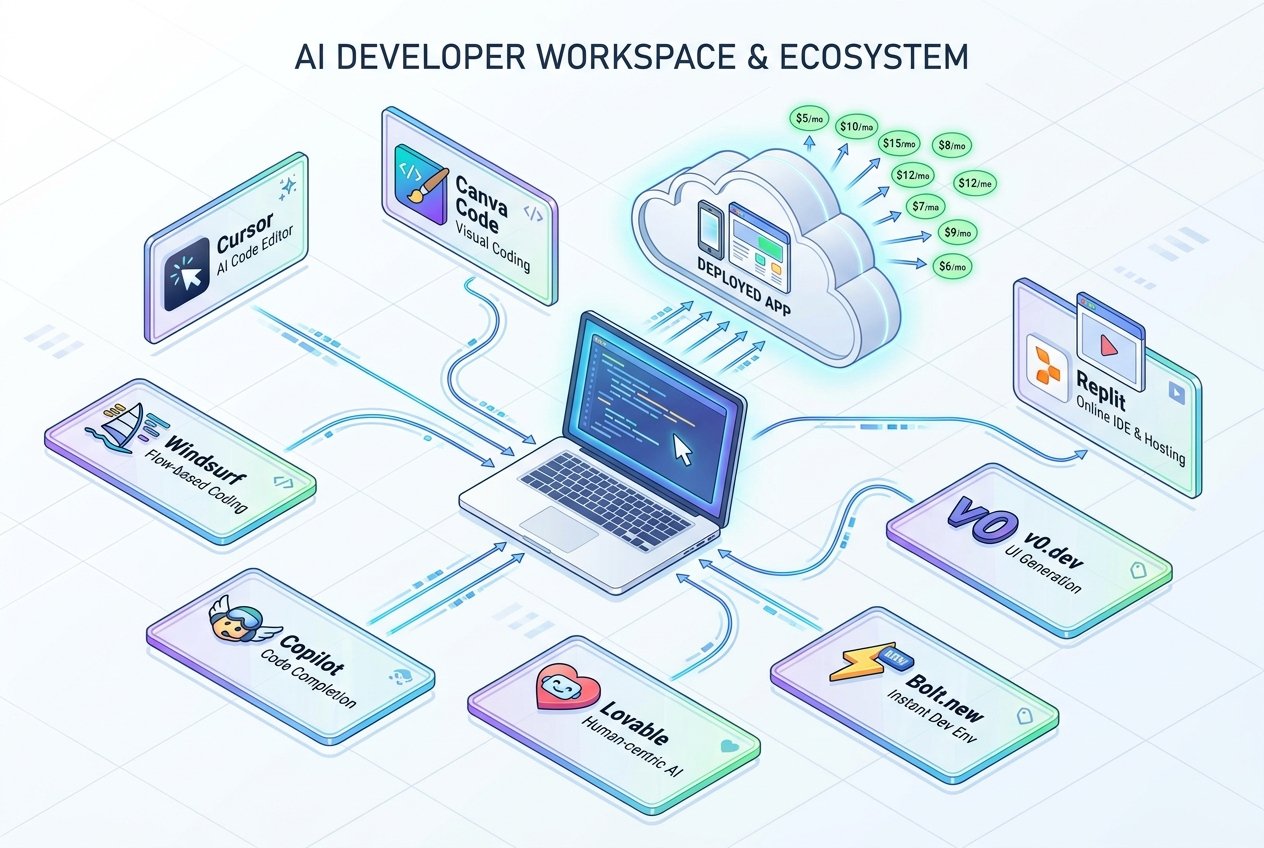
The 2026 vibe coding ecosystem splits cleanly into two categories. Understanding this distinction saves you weeks of trial and error.
AI Code Editors (For Developers & Control)
These tools sit inside your development environment, offering deep codebase awareness, multi-file editing, and terminal access. They are ideal if you want to own the code, customise heavily, or have some technical confidence.
| Tool | Monthly Cost (UK) | Key Strength | Best For |
|---|---|---|---|
| Cursor | ~£16 (Pro, $20) | Deep codebase understanding, multi-file edits, terminal access | Professional developers wanting the de facto standard |
| Windsurf | ~£12 (Pro, $15) | “Cascade” agent for multi-step reasoning; learns project architecture | Value-focused devs; acquired by OpenAI |
| Claude Code | Usage-based | Terminal-native; benchmark leader for refactoring and cross-file changes | Power users who prefer command-line workflows |
| GitHub Copilot | ~£8 (Pro, $10) | Most affordable; deep GitHub integration; 20M+ users | Teams already on GitHub; junior developers |
Source: Dev.to analysis and Hashnode state of vibe coding [3][4]
AI App Builders (For Non-Technical & Rapid MVPs)
These platforms generate full-stack applications from prompts, allowing you to “describe and build” instantly without managing local files. They are the fastest route to a working AI MVP build.
| Tool | Monthly Cost (UK) | Key Strength | Best For |
|---|---|---|---|
| Lovable | ~£20 (Pro, $25) | Polished React apps with Supabase integration; two-way GitHub sync; EU data residency | UK/EU teams needing GDPR compliance; non-technical founders |
| Bolt.new | ~£20 (Pro, $25) | Rapid full-stack app generation; excellent for validating ideas quickly | Speed-first prototyping; mobile-web apps |
| v0.dev (Vercel) | ~£13 (Pro, $16) | Production-ready React/Next.js UIs with Tailwind and shadcn/ui | Front-end prototypes; UI component factories |
| Replit | ~£20+ | Dedicated vibe-coding platform with built-in hosting; projected $1B revenue | End-to-end build and deploy in one place |
Source: ICE AI UK tool comparison and Lovable official guide [5][6]
Where Canva Fits in 2026
Canva’s 2026 AI suite — specifically Canva Code 2.0 and Magic Studio — generates interactive widgets, front-end prototypes, and landing pages (pricing calculators, mini-games, forms) that embed into designs or websites [7]. However, it does not build backend databases, APIs, or deploy standalone apps. Use Canva for visual prototyping and design systems, then hand off to Lovable or Bolt.new for functional code. Canva Pro costs ~£12/month ($15) with the full AI suite included [8].
Step-by-Step: The Under-£100 Launch Playbook
Phase 1: Define Scope Ruthlessly (Day 1)
The single biggest budget killer is scope creep. Define your Minimum Viable Product with three criteria:
- One core user problem
- One primary user flow
- Zero custom integrations (use built-in auth, payments, database)
Write a one-page PRD (Product Requirements Document) in plain English. This becomes your primary prompt.
Phase 2: Choose Your Tool Stack (Day 1)
For an affordable software development path under £100, we recommend two routes:
Route A — Non-technical founder (Fastest to demo):
- Lovable Pro (~£20/month) — includes 100 credits/month + 5 daily
- Supabase free tier (database, auth, storage)
- Vercel free tier (hosting)
- Canva Pro (~£12/month) for design assets
- Total: ~£32/month
Route B — Technical confidence (Maximum control):
- Cursor Pro (~£16/month) — flat rate, no credit overages
- GitHub Copilot (~£8/month) — inline suggestions
- Supabase + Vercel free tiers
- Total: ~£24/month
Both routes stay comfortably under £100 for a three-month build window.
Phase 3: The Vibe Coding Workflow (Days 2–30)
The modern workflow follows three stages [9]:
- Describe Intent: Paste your PRD into the tool. Example: “Build a responsive task management app with user authentication, project boards, drag-and-drop tasks, and email notifications. Use React, Tailwind, Supabase auth and database.”
- Accept & Iterate: The AI generates the full scaffold. You accept suggestions without reviewing every line, then nudge via prompts: “Make the board columns sortable”, “Add dark mode toggle”, “Fix the date picker on mobile”.
- Automated Testing: Modern stacks include AI-generated tests. Prompt: “Write Playwright tests for the auth flow and board CRUD operations.”
Expect 3–5 major iteration cycles. Lovable’s new Visual Edits feature (launched 2026) lets you click UI elements to change text, colours, and layouts without spending credits [10].
Phase 4: Deploy & Launch (Day 30–45)
Connect your custom domain (included in Lovable Pro). Enable Supabase email auth. Set up Stripe test mode if you need payments. Deploy to Vercel. Run your Playwright suite. Ship.
Real-World Case Studies: What £100 Actually Buys
Verified 2026 examples of apps built via vibe coding under budget [11]:
| Project | Tool | Cost | Build Time | Outcome |
|---|---|---|---|---|
| Marketing site (replaced Squarespace) | Bolt.new | $36/month | 3 hours | Static 5-page site on Vercel free tier |
| Event registration system (non-profit) | Bolt.new | $0 | 1 week | 2,000+ registrations across 12 events |
| Personal finance tracker | Cursor | $0 | Not specified | Replaced $120/year paid app |
| Plywood cutting visualiser | Claude Code | $0 | Not specified | Educational tool for non-tech users |
| SEO calculator lead magnet | Cursor | $0 | Not specified | Marketing tool for Animalz agency |
Key insight: most under-£100 projects are micro-tools, static sites, or internal dashboards. Full SaaS with payments, complex auth, and scaling typically exceeds £100 in API and hosting costs once you move beyond free tiers. Production-grade success rate sits around 60%; failures cluster around authentication, payments, scaling, and security [11].
UK-Specific Considerations: Compliance, VAT, and Data Residency
Building in the UK adds three critical factors:
GDPR & Data Residency
Lovable leads with ISO 27001 certification and EU data residency via Supabase — essential for UK GDPR compliance [5]. Bolt.new lacks formal EU certification and stores data in the US. If your app handles personal data, Lovable is the safer default.
VAT Impact
UK purchases include 20% VAT. A £20/month tool becomes £24/month unless you register as a business and reclaim VAT. Factor this into your £100 budget.
Professional Remediation Costs
When AI code breaks — and it will — UK remediation costs are significant [12]:
- AI Code Audit: £500–£1,500
- Remediation/Finishing: £3,000–£15,000+
- Full Production Rebuild (Simple Web MVP): £12,000–£25,000+
This is where Kaizen AI Consulting helps UK founders avoid expensive rebuilds. Our team audits AI-generated codebases, secures databases, implements proper error handling, and ensures UK GDPR compliance — turning a fragile prototype into a scalable product.
Common Pitfalls & How to Avoid Them
1. Credit Overruns on Lovable/Bolt
Complex iterations burn credits fast. Founders report £50–£150/month when pushing to production [13]. Fix: Prototype in Bolt.new free tier, migrate to Cursor for heavy lifting.
2. Security Blind Spots
AI often misses row-level security policies, CORS configuration, and rate limiting. Always prompt: “Add Supabase RLS policies for all tables. Implement rate limiting on API routes.”
3. Technical Debt Accumulation
Vibe coding produces working code, not necessarily maintainable code. Schedule a “code hygiene” sprint every two weeks: refactor duplicate components, add TypeScript strict mode, document API contracts.
4. Scaling Beyond Free Tiers
Vercel and Supabase free tiers are generous but have limits (bandwidth, database rows, function execution time). Monitor usage from day one. Set alerts at 70% capacity.
When to Bring in the Experts
You have a working prototype. Users love it. But you are hitting:
- Authentication edge cases (magic links not sending, session handling)
- Payment webhook failures
- Database performance issues
- UK GDPR compliance gaps
- Team collaboration needs (code reviews, CI/CD)
This is the inflection point. Continuing to vibe-code through production hardening often costs more in lost time and technical debt than a focused professional engagement.
Kaizen AI Consulting specialises in taking AI-generated MVPs from “it works on my machine” to production-ready, compliant, and scalable. We bridge the gap between vibe coding speed and enterprise-grade reliability.
Your 90-Day Budget Breakdown
| Month | Focus | Tools | Cost (UK) |
|---|---|---|---|
| Month 1 | Prototype & Validate | Bolt.new Free + Canva Pro | £12 |
| Month 2 | Build Core MVP | Lovable Pro + Supabase Free + Vercel Free | £24 |
| Month 3 | Launch & Iterate | Lovable Pro + Custom Domain + Stripe Test | £24 |
| Total | £60 |
Remaining £40 buffer covers: domain renewal (~£10), potential credit top-ups, or a one-off security audit.
Conclusion: The Democratisation of Building
Vibe coding in 2026 has genuinely democratised software creation. A non-technical founder with a clear problem statement, a disciplined scope, and ~£60 in tooling can launch a functional, user-tested MVP in 90 days. The tools — Claude Code Canva Lovable, Bolt.new, Cursor, and the wider ecosystem — have matured to the point where “affordable software development” is no longer an oxymoron.
But the gap between “launched” and “scalable, secure, compliant” remains real. The smartest founders use vibe coding to validate fast, then bring in targeted expertise to productionise.
Ready to turn your app idea into a launched product without the six-figure price tag? Book a free 30-minute strategy call with Kaizen AI Consulting and we will map your fastest path from concept to launch — tailored to your budget, timeline, and compliance needs.
Disclaimer: Tool pricing and features accurate as of July 2026. Always verify current pricing on vendor websites. VAT rates subject to UK government policy.