The legal profession is undergoing a remarkable transformation, with artificial intelligence reshaping how solicitors and legal teams approach contract review and document analysis. At the forefront of this revolution is Claude, Anthropic’s powerful AI assistant, which is helping UK law firms and in-house legal departments streamline their workflows, reduce costs, and deliver faster results for clients.
With 96% of UK law firms now integrating AI into their operations and lawyers projecting savings of 140 hours per person annually through AI-assisted work, understanding how to leverage Claude for legal documents has become essential for any forward-thinking legal practice.
Understanding Claude’s Capabilities for Legal Document Analysis
Claude AI represents a significant advancement in document review automation for the legal sector. Unlike general-purpose chatbots, Claude offers sophisticated natural language processing capabilities specifically suited to the nuanced requirements of contract analysis AI and legal document review.
The platform excels in several key areas that make it particularly valuable for legal professionals:
Extended Context Window for Complex Documents
One of Claude’s standout features is its substantial context window, capable of processing up to 200,000 tokens in a single session. This translates to approximately 500 pages of text, making it ideal for reviewing lengthy contracts, merger agreements, and comprehensive due diligence packages without losing track of interconnected clauses and terms.
This capability is transformative for UK solicitors handling complex commercial transactions, where understanding the relationship between different contractual provisions is crucial for identifying risks and opportunities.
Constitutional AI Design for Reliability
Anthropic built Claude with what they call Constitutional AI principles, designed to reduce hallucinations and maintain ethical alignment. For legal professionals, where accuracy is paramount, this approach helps ensure more reliable outputs that can be trusted as a starting point for human review.
Practical Applications of Claude for Contract Review
The document review automation capabilities of Claude span the entire contract lifecycle. Here is how UK legal teams are putting this technology to work:
Clause-by-Clause Contract Analysis
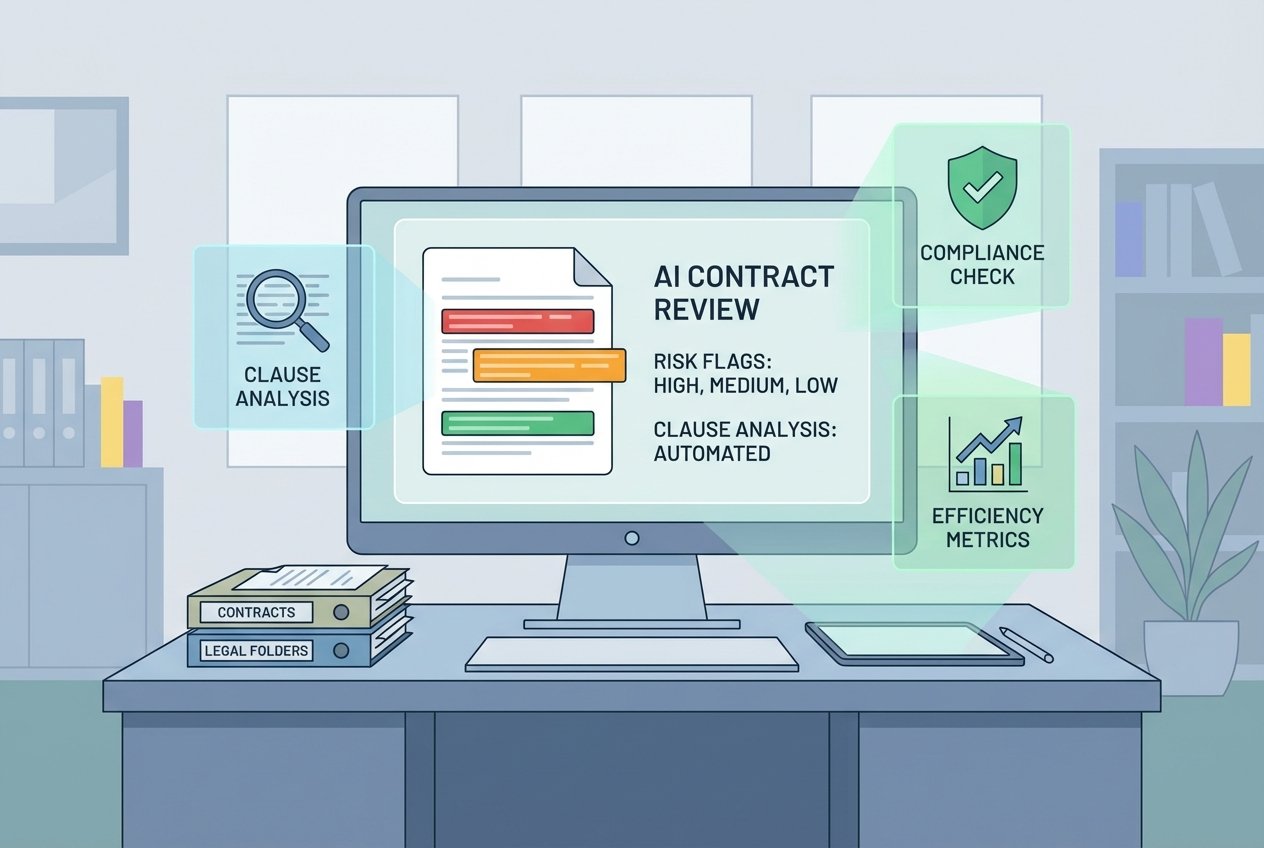
Claude can systematically review contracts and provide colour-coded risk assessments:
- Green flags: Clauses that align with standard terms and require no action
- Yellow flags: Provisions that deviate from preferred terms and warrant review
- Red flags: High-risk clauses requiring immediate attention or negotiation
For each flagged clause, Claude can provide the contract language, compare it against standard positions, explain deviations, assess business impact, and suggest specific redline language for negotiation.
NDA Triage and Classification
With many UK law firms processing high volumes of non-disclosure agreements, Claude offers rapid NDA screening capabilities. The AI can classify incoming NDAs by type (mutual, one-way, or multilateral), assess duration and territorial coverage, and categorise them for standard approval, counsel review, or full legal review.
Research indicates that AI-powered contract review can reduce processing times by 50 to 80%, with some firms reporting average review times dropping from 4 hours to 55 minutes per contract.
Due Diligence Support
For mergers, acquisitions, and corporate transactions, Claude can process thousands of contracts to identify risks and opportunities in days rather than weeks. The AI excels at extracting key terms, identifying change of control provisions, flagging potential liabilities, and summarising obligations across large document sets.
Step-by-Step Guide to Using Claude for Legal Documents
Implementing Claude for contract analysis AI requires a structured approach to achieve optimal results:
Step 1: Prepare Your Documents
Before engaging Claude, ensure your documents are in machine-readable formats. Claude processes DOCX, PDF, RTF, and HTML files effectively. For scanned documents, consider running optical character recognition (OCR) first to improve accuracy.
Step 2: Craft Effective Prompts
The quality of Claude’s output depends significantly on prompt clarity. Rather than vague instructions like “review this contract,” provide specific guidance such as:
“Review this commercial lease agreement and identify all clauses relating to rent reviews, break options, and service charges. Flag any provisions that deviate from standard commercial terms in England and Wales, and suggest alternative language aligned with tenant-friendly positions.”
Step 3: Establish Your Playbook
Claude performs best when given context about your organisation’s standards. Upload your preferred clause libraries, negotiation playbooks, and standard templates. This enables the AI to compare incoming contracts against your established benchmarks.
Step 4: Implement Human-in-the-Loop Review
While Claude dramatically accelerates the review process, human oversight remains essential. Use Claude’s output as a comprehensive first draft, then apply professional judgement to validate findings, assess strategic implications, and make final decisions.
At Kaizen AI Consulting, we help UK law firms and legal departments implement these AI workflows effectively, ensuring proper integration with existing systems and establishing governance frameworks that maintain professional standards.
The UK Legal AI Market: Current Landscape and Opportunities
The adoption of legal AI in the United Kingdom has reached a critical inflection point. According to Grand View Research, the UK legal AI market generated USD 81.7 million in 2024 and is projected to reach USD 206.9 million by 2030, growing at a compound annual growth rate of 16%.
Key statistics highlighting the transformation include:
- 96% of UK law firms now integrate AI into their operations
- 62% of solicitors plan to expand AI use over the next year
- 43% of UK solicitors report improved productivity through AI tools
- Over 20% cite better mental health and work-life balance from reduced administrative burden
The most common applications driving this adoption include document drafting and automation (36%), contract review and analysis (29%), e-discovery solutions (20%), and legal research (17%).
Benefits of Document Review Automation for UK Practices
Implementing Claude for legal document analysis delivers measurable benefits across multiple dimensions:
Time and Cost Savings
UK lawyers anticipate saving 140 hours per person annually through AI-assisted work, equivalent to approximately 12,000 pounds per solicitor in time savings. Across the profession, this represents potential productivity gains of 2.4 billion pounds in 2026 alone.
Document review times can be reduced by up to 70%, with some AI-powered tools processing documents in 26 seconds that previously required 92 minutes of manual review.
Enhanced Accuracy and Consistency
Human fatigue inevitably leads to inconsistencies when reviewing large document sets. AI maintains consistent attention across thousands of pages, reducing the risk of missed clauses or overlooked risks. Firms report over 90% accuracy in clause recognition and summarisation when using properly configured AI tools.
Improved Client Service
Faster turnaround times and more thorough analysis translate directly to enhanced client satisfaction. Firms using AI report 10 to 15% improvements in client retention rates, attributed to speedier responses and more comprehensive risk assessments.
Competitive Advantage
With 29% of UK lawyers fearing their firms are falling behind AI-adopting competitors, early adoption provides meaningful market differentiation. Corporate clients increasingly evaluate law firms based on technology capabilities and efficiency metrics.
Best Practices and Considerations for Legal AI Implementation
Successfully deploying Claude for contract analysis requires attention to several critical factors:
Data Security and Confidentiality
Legal documents contain highly sensitive information. Ensure your AI implementation complies with professional conduct rules, data protection regulations including UK GDPR, and client confidentiality requirements. Review Anthropic’s data handling policies and consider enterprise deployments that offer enhanced privacy controls.
Professional Responsibility
The Solicitors Regulation Authority expects solicitors to maintain competence and exercise proper judgement. AI outputs should always be reviewed by qualified legal professionals before being relied upon or shared with clients. The AI serves as a powerful assistant, not a replacement for professional expertise.
Workflow Integration
For maximum benefit, Claude should integrate smoothly with existing practice management systems, document management platforms, and matter workflows. This may require API connections and customisation to align with your firm’s established processes.
This is where partnering with specialists like Kaizen AI Consulting proves invaluable. Our team helps legal practices navigate the technical and operational complexities of AI implementation, ensuring solutions are tailored to your specific requirements and integrated effectively with your existing technology infrastructure.
Future Developments in Legal AI
The capabilities of AI for legal document analysis continue to evolve rapidly. Recent developments include Anthropic’s release of a dedicated legal plugin for Claude, designed specifically for in-house legal workflows including contract review, NDA triage, and compliance monitoring.
Looking ahead, UK lawyers project even greater productivity gains, with expectations of saving 240 hours annually within three years and 370 hours within five years. The cumulative value could exceed 6 billion pounds across the profession by 2029.
Emerging applications include:
- Regulatory compliance monitoring and automated gap analysis
- Predictive analytics for litigation outcomes and settlement values
- Automated brief preparation and legal research synthesis
- Real-time contract negotiation support
Getting Started with Claude for Your Legal Practice
Whether you operate a high street solicitor’s practice, a mid-market firm, or an in-house legal department, implementing Claude for document review automation can deliver substantial benefits. The key is starting strategically:
- Begin with lower-risk documents such as NDAs and standard vendor agreements to build confidence and refine your approach
- Develop clear prompting guidelines that reflect your firm’s standards and client requirements
- Establish governance frameworks for AI usage that maintain professional standards and regulatory compliance
- Track metrics including time savings, accuracy improvements, and client satisfaction to demonstrate return on investment
- Invest in training to ensure your team can effectively leverage AI capabilities
The legal profession stands at a transformative moment. Firms that embrace AI-powered contract analysis and document review will be better positioned to serve clients efficiently, compete effectively, and thrive in an increasingly technology-driven market.
Ready to transform your legal document workflows with AI? Contact Kaizen AI Consulting today for a consultation on implementing Claude and other AI solutions tailored to your practice’s specific needs. Our team of experts will guide you through every step, from initial assessment to full deployment, ensuring you maximise the benefits of legal AI while maintaining the highest professional standards.