The digital landscape is evolving at breakneck speed, and for UK small businesses, staying ahead of SEO trends in 2025 has become more critical than ever. With Google commanding over 90% of the UK search market, understanding the latest ranking trends and search marketing strategies is essential for survival in an increasingly competitive online environment.
This comprehensive guide explores the current state of SEO from a UK small business perspective, examining what’s working now, what’s changing, and how you can position your business for success in 2025 and beyond.
The UK Digital Landscape: A 2025 Snapshot
The UK digital landscape has undergone significant transformation over the past few years. According to Ofcom’s latest research, 96% of UK adults now use the internet regularly, with mobile devices accounting for the majority of search queries. For small businesses, this means your SEO strategy must be mobile-first, or you’re already behind the curve.
What’s particularly interesting for small business SEO is the rise of local search intent. Google reports that searches containing “near me” or local qualifiers have grown by over 200% in recent years, creating unprecedented opportunities for UK businesses that optimise for local visibility.
Core SEO Trends Shaping the UK Market in 2025
AI and Machine Learning Integration
Artificial intelligence has fundamentally changed how search engines understand and rank content. Google’s latest algorithm updates prioritise content that demonstrates genuine expertise and helpfulness rather than keyword-stuffed pages. For UK small businesses, this means focusing on quality over quantity.
The integration of AI tools in search marketing has also levelled the playing field. Small businesses can now access sophisticated SEO analysis and content optimisation tools that were once reserved for enterprises. At Kaizen AI Consulting, we help UK small businesses leverage these AI-powered tools to compete effectively against larger competitors without requiring massive marketing budgets.
Experience, Expertise, Authoritativeness, and Trustworthiness (E-E-A-T)
Google’s emphasis on E-E-A-T has intensified in 2025, particularly for businesses in sensitive sectors like finance, health, and legal services. UK small businesses must demonstrate genuine expertise through author credentials, customer reviews, case studies, and transparent business information.
This ranking trend rewards businesses that build authentic online reputations. According to BrightLocal’s Consumer Review Survey, 87% of consumers read online reviews for local businesses, making reputation management a critical component of modern SEO strategy.
Core Web Vitals and User Experience
Page speed and user experience metrics have become non-negotiable ranking factors. Google’s Core Web Vitals, measuring loading performance, interactivity, and visual stability, directly impact your search rankings. UK small businesses with slow-loading websites are losing customers before they even see your content.
Research from Google’s Think with Google shows that 53% of mobile users abandon sites that take longer than three seconds to load. For small businesses operating on tight margins, every lost visitor represents lost revenue.
Search Marketing Strategies That Work for UK Small Businesses
Hyper-Local SEO Optimisation
One of the most effective SEO trends UK small businesses can capitalise on is hyper-local targeting. This goes beyond simply listing your business address. It involves creating location-specific content, optimising for local keywords, and building relationships with other local businesses and organisations.
Claiming and optimising your Google Business Profile remains crucial. Businesses with complete and regularly updated profiles receive 70% more location visits than those with incomplete listings. Include high-quality photos, respond to reviews promptly, and post regular updates to maximise visibility.
Content Clusters and Topic Authority
Gone are the days of creating isolated blog posts targeting single keywords. Modern search marketing requires building topic authority through comprehensive content clusters. This involves creating pillar content on broad topics and supporting it with detailed cluster content addressing specific subtopics.
For example, a Manchester-based accounting firm might create a pillar page about “Small Business Finances in the UK” with cluster content covering tax planning, bookkeeping software, VAT registration, and Making Tax Digital compliance. This structure helps search engines understand your expertise whilst providing genuine value to potential customers.
Voice Search and Conversational Queries
With smart speakers in millions of UK homes, voice search optimisation has become essential for small business SEO. Voice searches tend to be longer and more conversational than typed queries. Optimising for question-based keywords and natural language patterns can help capture this growing search segment.
Structure your content to answer specific questions your customers ask. Use FAQ sections, featured snippet optimisation, and conversational language that mirrors how people actually speak. According to Pew Research, voice-activated search is growing annually, making this a trend you cannot ignore.
Technical SEO: The Foundation of Success
Whilst content is crucial, technical SEO provides the foundation upon which all other efforts rest. UK small businesses must ensure their websites are technically sound to compete in the UK digital landscape.
Mobile-First Indexing
Google now uses the mobile version of your website for indexing and ranking. If your site isn’t mobile-responsive or offers a poor mobile experience, you’re severely handicapping your search visibility. Test your site using Google’s Mobile-Friendly Test tool and address any issues immediately.
Structured Data and Schema Markup
Implementing schema markup helps search engines understand your content better and can result in rich snippets in search results. For UK small businesses, local business schema, product schema, and FAQ schema are particularly valuable. Rich snippets can significantly improve click-through rates, even without changing your ranking position.
Website Security and HTTPS
Security is both a ranking factor and a trust signal. All UK small business websites should use HTTPS encryption. With government statistics showing cyber attacks affecting 32% of UK businesses annually, security cannot be an afterthought.
Link Building in 2025: Quality Over Quantity
Link building remains a cornerstone of SEO, but the strategies that work have evolved significantly. Modern link building for UK small businesses focuses on earning genuine, relevant links rather than manipulative tactics that risk penalties.
Effective strategies include creating link-worthy content like original research or comprehensive guides, engaging with local media and bloggers, participating in industry associations, and building partnerships with complementary businesses. A single high-quality link from a respected UK business publication or industry website carries far more weight than dozens of low-quality directory links.
Measuring SEO Success: Key Metrics for Small Businesses
Understanding which metrics matter helps UK small businesses focus their efforts effectively. Whilst rankings are important, they’re not the only measure of success in search marketing.
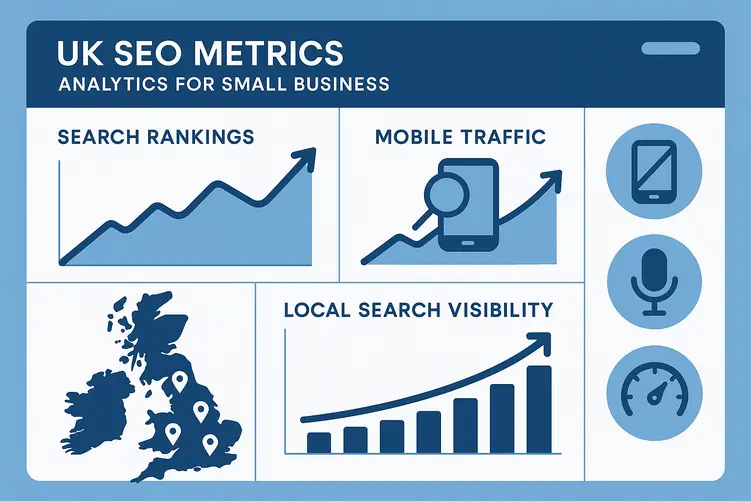
Focus on organic traffic growth, conversion rates from organic traffic, local pack visibility for priority keywords, and keyword rankings for high-intent search terms. Tools like Google Analytics 4 and Google Search Console provide invaluable insights into how users find and interact with your website.
Many small business owners find SEO analytics overwhelming. This is where working with specialists like Kaizen AI Consulting can make the difference between guesswork and data-driven strategy. Professional guidance helps you interpret the data correctly and make informed decisions about where to invest your marketing resources.
Common SEO Mistakes UK Small Businesses Must Avoid
Understanding what not to do is as important as knowing best practices. Common mistakes include neglecting mobile optimisation, ignoring local SEO opportunities, creating thin or duplicate content, and expecting overnight results.
SEO is a marathon, not a sprint. According to research from Ahrefs, pages that rank in the top 10 search results are typically over two years old. Consistency and patience are essential virtues in search marketing.
Another critical mistake is attempting to handle complex SEO challenges without proper expertise. Whilst basic optimisation is accessible to most business owners, advanced technical SEO, comprehensive competitor analysis, and strategic planning often require professional assistance to maximise return on investment.
The Future of SEO for UK Small Businesses
Looking ahead, several trends will shape the future of small business SEO in the UK. Artificial intelligence will continue transforming how search works, with Google’s Search Generative Experience already changing how results are displayed. Video content is becoming increasingly important for search visibility, whilst sustainability and ethical business practices are emerging as factors that influence consumer search behaviour.
Adaptation will be key to survival in the UK digital landscape. Small businesses that stay informed about ranking trends, remain flexible in their approach, and focus on providing genuine value to customers will thrive regardless of algorithm changes.
Taking Action: Your SEO Roadmap for 2025
Understanding SEO trends UK small businesses face is valuable, but action drives results. Start by auditing your current website performance, identifying technical issues, and prioritising improvements based on potential impact.
Focus on creating high-quality, locally relevant content that addresses your customers’ questions and concerns. Optimise your Google Business Profile and encourage satisfied customers to leave reviews. Build genuine relationships within your local business community and online industry networks.
Remember that effective search marketing requires ongoing effort and adjustment. What works today may need refinement tomorrow as algorithms evolve and competitor strategies change.
Partner with SEO Experts Who Understand UK Small Business Challenges
Navigating the complexities of modern SEO whilst running a small business can feel overwhelming. You’re managing operations, serving customers, and handling finances, making it challenging to stay current with constantly changing ranking trends and best practices.
Kaizen AI Consulting specialises in helping UK small businesses develop and implement effective SEO strategies without the enterprise-level price tags. Our approach combines cutting-edge AI tools with human expertise to deliver measurable results tailored to your specific industry and local market.
Whether you need a comprehensive SEO audit, ongoing optimisation support, or strategic guidance to compete more effectively in your market, we’re here to help. Our team understands the unique challenges facing UK small businesses and creates practical, actionable strategies that fit your budget and goals.
Ready to improve your search visibility and attract more customers through organic search? Contact Kaizen AI Consulting today for a free consultation. Let’s discuss how we can help your business thrive in the competitive UK digital landscape of 2025 and beyond.
The state of SEO in 2025 presents both challenges and opportunities for UK small businesses. Those who embrace best practices, stay informed about emerging trends, and invest strategically in search marketing will position themselves for sustainable growth in an increasingly digital economy.