Every business owner dreams of sustainable growth, but knowing where to focus your efforts can feel overwhelming. With limited resources and countless opportunities, understanding growth strategy basics is essential for making informed decisions that drive real results. In this comprehensive guide, we’ll explore the fundamental principles of strategic planning and help you identify where your business should concentrate its development efforts.
What Is a Growth Strategy and Why Does It Matter?
A growth strategy is a detailed plan that outlines how your business will expand and achieve specific objectives over time. According to Office for National Statistics data, approximately 60% of UK businesses fail within their first five years, often due to poor strategic planning and unfocused growth efforts.
For SME growth specifically, having a clear direction prevents the common pitfall of spreading resources too thin. Rather than pursuing every opportunity that appears, successful businesses identify their core strengths and build upon them systematically. This focused approach to business development allows you to allocate time, budget, and personnel more effectively.
The Four Primary Growth Strategy Directions
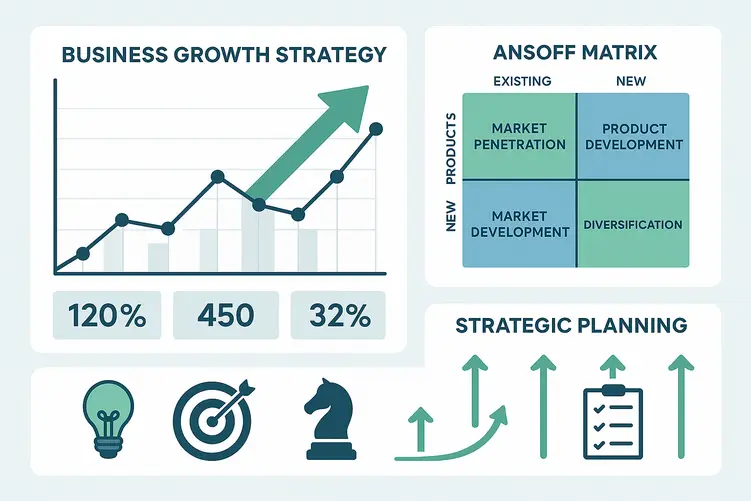
When considering business growth, most organisations can pursue four fundamental strategic directions, known as the Ansoff Matrix. Understanding these options helps you evaluate which path aligns best with your current capabilities and market position.
Market Penetration: Dominating Your Current Space
Market penetration involves selling more of your existing products or services to your current customer base. This is often the lowest-risk growth strategy because you’re working with known quantities. Research from British Chambers of Commerce indicates that increasing customer retention rates by just 5% can boost profits by 25% to 95%.
Consider these market penetration tactics:
- Implement loyalty programmes that encourage repeat purchases
- Optimise pricing strategies to gain competitive advantage
- Increase marketing efforts to raise brand awareness within your existing market
- Improve product quality or customer service to win customers from competitors
Market Development: Finding New Audiences
Market development means taking your existing products to new markets or customer segments. This could involve geographical expansion, targeting different demographic groups, or entering new distribution channels. For UK businesses, this might mean expanding from regional operations to national coverage, or even exploring international markets.
The Department for Business and Trade reports that UK SMEs engaging in export activities grow 20% faster than those focused solely on domestic markets. However, market development requires careful research to understand new customer needs and competitive landscapes.
Product Development: Innovation Within Your Market
Product development focuses on creating new offerings for your existing customer base. This strategy leverages your current market knowledge and customer relationships whilst introducing innovation. According to industry research, 84% of executives believe innovation is critical to their growth strategy.
Successful product development requires understanding your customers’ evolving needs and pain points. At Kaizen AI Consulting, we help businesses identify innovation opportunities through data analysis and customer insight research, ensuring new products align with genuine market demand.
Diversification: Venturing Into New Territory
Diversification involves developing new products for new markets simultaneously. Whilst this carries the highest risk, it can also provide significant rewards and protect against market volatility. This growth strategy requires substantial resources and careful strategic planning to execute successfully.
Assessing Your Current Business Position
Before determining where to focus your growth strategy, you must understand your starting point. This assessment forms the foundation of effective business development and helps prevent costly missteps.
Conduct a Thorough Market Analysis
Understanding your market landscape is crucial for informed decision-making. Analyse your competitors, identify market trends, and recognise gaps your business could fill. The Federation of Small Businesses reports that 67% of UK small business owners cite increased competition as their primary challenge.
Key questions to address include:
- Who are your main competitors and what are their strengths and weaknesses?
- What market trends are emerging in your industry?
- Are there underserved customer segments you could target?
- What regulatory or economic factors might impact your growth plans?
Evaluate Your Internal Capabilities
Honest self-assessment is essential for growth strategy basics. Examine your organisation’s strengths, weaknesses, available resources, and core competencies. This internal audit should cover financial capacity, team skills, operational processes, and technological infrastructure.
Many SMEs struggle with this objective evaluation. Professional guidance from specialists like Kaizen AI Consulting can provide the external perspective needed to identify hidden strengths and address blind spots in your strategic planning.
Choosing Your Focus: Key Decision Factors
With a clear understanding of your position and potential directions, you can now determine where to focus your growth efforts. Several critical factors should influence this decision.
Resource Availability and Constraints
Your available resources directly impact which growth strategies are viable. Market penetration typically requires the least investment, whilst diversification demands significant financial and human capital. Statistics show that 82% of small businesses fail due to cash flow problems, making resource management crucial for sustainable growth.
Consider not just your current resources but also your ability to secure additional funding if needed. UK businesses have various funding options, from traditional bank loans to government-backed schemes and venture capital, depending on your growth ambitions.
Risk Tolerance and Timeline
Different growth strategies carry varying risk levels and timelines for returns. Market penetration and product development for existing customers generally offer quicker returns and lower risk compared to entering entirely new markets or developing revolutionary products.
Your business’s stage of development also matters. Early-stage companies might focus on market penetration to establish a solid foundation, whilst mature businesses might pursue diversification to maintain growth momentum.
Competitive Advantage and Differentiation
Focus on growth strategies that leverage your unique strengths and competitive advantages. If you have superior technology, product development might be your best path. If you excel at customer relationships, market penetration could yield the highest returns.
Research from Harvard Business Review indicates that companies focusing on their core competencies achieve 30% higher growth rates than those pursuing unfocused expansion strategies.
Creating Your Growth Strategy Roadmap
Once you’ve identified your focus area, translate this into a concrete action plan with measurable objectives and clear timelines.
Set SMART Goals for Business Growth
Effective strategic planning requires Specific, Measurable, Achievable, Relevant, and Time-bound goals. Rather than vague ambitions like “increase sales,” aim for precise targets such as “achieve 25% revenue growth in the North West region within 18 months through market development.”
Break larger goals into quarterly or monthly milestones to maintain momentum and enable course correction. Regular progress reviews ensure your growth strategy remains aligned with changing market conditions.
Allocate Resources Strategically
Map out the budget, personnel, and time required for each initiative within your growth strategy. Prioritise activities that offer the highest potential return on investment whilst maintaining operational stability.
Many growing businesses find that working with experienced consultants accelerates their progress whilst avoiding common pitfalls. The strategic planning expertise and implementation support provided by professionals can dramatically improve success rates for SME growth initiatives.
Establish Key Performance Indicators
Define metrics that accurately reflect progress towards your growth objectives. These might include revenue growth, market share expansion, customer acquisition costs, customer lifetime value, or new product adoption rates.
According to research, businesses that regularly track and analyse performance metrics are 46% more likely to achieve their growth targets than those relying on intuition alone.
Common Growth Strategy Mistakes to Avoid
Understanding potential pitfalls helps you navigate the business development journey more successfully.
Pursuing Too Many Opportunities Simultaneously
The most common strategic planning error is attempting everything at once. This dilutes resources and prevents any initiative from receiving adequate attention. Focus on one or two primary growth strategies rather than spreading efforts across multiple directions.
Neglecting Existing Customers
Whilst pursuing new markets or products, never forget your current customer base. They provide the stable revenue foundation that funds growth initiatives. Maintaining existing relationships whilst expanding ensures sustainable business growth.
Failing to Adapt
Markets evolve, competitors emerge, and customer needs shift. Your growth strategy must remain flexible enough to accommodate change. Schedule regular strategy reviews, at least quarterly, to assess effectiveness and make necessary adjustments.
Taking Action: Your Next Steps
Understanding growth strategy basics is the first step; implementation determines success. Start by conducting a thorough assessment of your current position, then identify which growth direction aligns best with your capabilities and ambitions.
Document your strategy clearly, communicate it throughout your organisation, and establish accountability for specific outcomes. Remember that growth strategy isn’t a one-time exercise but an ongoing process requiring regular refinement.
If you’re feeling uncertain about where to focus your business development efforts or how to create a robust strategic plan, professional guidance can make all the difference. Contact Kaizen AI Consulting today for a complimentary strategy consultation. Our team specialises in helping UK SMEs develop and implement focused growth strategies that deliver measurable results. We combine strategic expertise with practical implementation support to ensure your business growth ambitions become reality.
The difference between businesses that achieve sustainable growth and those that stagnate often comes down to strategic focus. By understanding where to concentrate your efforts and building a systematic approach to business development, you position your organisation for long-term success in an increasingly competitive marketplace.