Managing stock levels has always been one of the most costly and complex challenges facing UK businesses. Order too much and you are sitting on tied-up capital, paying for warehouse space, and watching perishables expire. Order too little and you face empty shelves, frustrated customers, and lost revenue. For decades, inventory managers have relied on spreadsheets, gut instinct, and rudimentary reorder triggers to walk this tightrope. In 2026, artificial intelligence is changing that equation entirely.
The Scale of the Inventory Problem in the UK
The true cost of poor inventory management is staggering. Excess stock ties up working capital that could be deployed elsewhere, while stockouts directly erode customer trust and sales. According to research by Open Sky Group, AI-enabled supply chain optimisation delivers between 5% and 20% logistics cost reduction and a 20% to 30% reduction in overall inventory holding. For UK businesses operating in an environment where margins are increasingly tight, those numbers represent transformative gains.
The urgency is further underscored by broader adoption trends. The UK AI market surpassed £21.7 billion in 2025 and is forecast to reach £28.3 billion by the end of 2026, with supply chain and logistics identified as one of the fastest-growing segments. Yet despite this momentum, fewer than one in four businesses currently has a formal AI strategy in place. That gap between aspiration and implementation is exactly where competitive advantage is being won or lost.
What Is Inventory AI and How Does It Work?
Inventory AI refers to the application of machine learning, predictive analytics, and automation to stock management processes. Rather than relying on static par levels or historical averages, AI systems ingest vast quantities of real-time and historical data to make dynamic, continuously updated decisions about what to order, when to order it, and in what quantities.
The core components of a modern inventory AI system typically include:
- Demand forecasting engines that analyse sales history, seasonality, promotional calendars, weather patterns, and even social media sentiment to predict future demand with far greater accuracy than traditional methods.
- Automated replenishment triggers that generate purchase orders or production requests the moment stock dips below dynamically calculated thresholds.
- Multi-location optimisation that balances stock across warehouses, retail outlets, and distribution hubs to minimise both surplus and shortfall.
- Supplier lead time intelligence that factors in supplier performance variability and adjusts safety stock calculations accordingly.
- Anomaly detection that flags unusual demand spikes, data entry errors, or supply disruptions before they cascade into costly problems.
The result is a system that learns continuously from outcomes, refining its own accuracy over time and removing the manual burden from inventory teams so they can focus on strategic decisions rather than data entry.
The Business Case: Real Figures from the Field
The financial case for inventory AI is compelling and increasingly well-documented. The global AI in inventory management market is growing from $9.54 billion in 2025 to $12.36 billion in 2026, a compound annual growth rate of 29.6%, driven primarily by businesses that have seen direct returns on their investment.
A UK-based FMCG company that implemented AI-driven demand forecasting reported a 15% reduction in stockouts and a 12% decrease in excess inventory holding costs in its first year of deployment. Meanwhile, research from Cloud Switched highlights that AI predictive inventory modelling reduced overstock by 31% for a UK retail operator. In logistics and supply chain specifically, early adopters are seeing a 4.6x return on investment within the first year, with average payback periods of just five months.
PwC’s 2026 Digital Trends in Operations Survey confirms that 66% of operations leaders are now applying AI tools to planning and forecasting functions, recognising this as the single highest-impact use case available to them.
Supply Chain Automation: Beyond the Warehouse Floor
Supply chain automation powered by inventory AI extends well beyond simply counting boxes on shelves. Modern systems integrate across the entire procurement-to-delivery lifecycle, creating a connected intelligence layer that responds to change in real time.
Consider how agentic AI, one of the most significant emerging trends identified by NetSuite’s 2026 inventory management report, is reshaping this space. Agentic AI systems do not merely provide recommendations – they take action. They can autonomously raise purchase orders, reroute deliveries, adjust pricing in response to stock levels, and communicate directly with supplier systems, all without human intervention. For UK businesses managing complex, multi-channel operations, this level of supply chain automation represents a step change in operational efficiency.
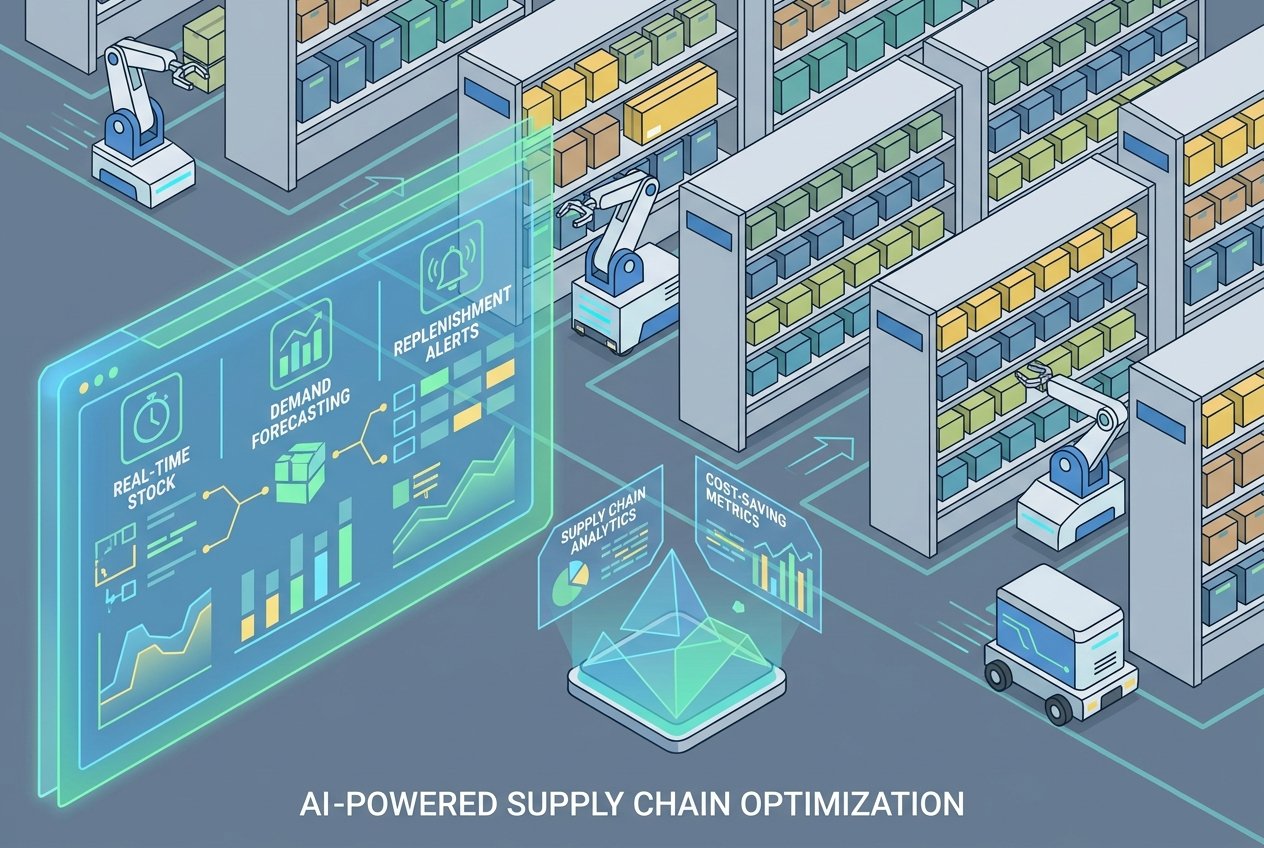
Equally significant is the rise of unstructured data processing within inventory management. AI systems can now analyse product images from autonomous mobile robots in warehouses, sensor data from refrigeration units, and video feeds from fulfilment centres to identify defective stock, monitor storage conditions, and flag discrepancies that would take human operators hours to detect.
At Kaizen AI Consulting, we work with UK businesses to design and implement exactly these kinds of end-to-end AI solutions, connecting your inventory systems with your wider operational and commercial data to create a genuinely intelligent supply chain. Whether you are a growing e-commerce business or an established manufacturer, the right implementation approach makes all the difference between a system that delivers ROI and one that gathers dust.
Right-Sizing Stock: The Concept of Dynamic Safety Stock
One of the most practically valuable applications of inventory AI is the move from static to dynamic safety stock calculation. Traditional safety stock models apply a fixed buffer based on average demand and average lead time. The problem is that neither demand nor lead time is ever truly average. They fluctuate constantly in response to market conditions, supplier performance, promotional activity, and external events.
AI-driven inventory optimisation replaces fixed safety stock with a continuously recalculated buffer that accounts for current variability in both demand and supply. When demand is stable and supplier lead times are reliable, the system reduces safety stock to free up capital. When volatility increases, it automatically raises the buffer to maintain service levels. This dynamic approach means you are never holding more stock than you need, nor less than is safe.
For UK retailers navigating the seasonal peaks of Christmas, Easter, and bank holiday weekends, alongside the unpredictable demand spikes driven by social media trends and news events, this capability is particularly valuable. An AI system that recalibrates safety stock daily based on live data will consistently outperform one built on last year’s spreadsheet.
Inventory Optimisation Across Multiple Channels
The growth of omnichannel retail has created an entirely new inventory challenge. Stock must now be managed simultaneously across physical stores, online fulfilment centres, third-party marketplaces, and click-and-collect hubs, all with different demand profiles, lead times, and cost structures. Getting this right manually is virtually impossible at scale.
Inventory AI excels in exactly this environment. By treating the entire network as a single optimisation problem, AI systems can make intelligent allocation decisions that minimise total holding cost while maximising product availability wherever the customer chooses to shop. They can identify when transferring stock between locations is more cost-effective than placing a new supplier order, and they can predict which fulfilment nodes are most likely to run short before it becomes a service failure.
According to the UK Government’s AI Adoption Research, 56% of businesses using AI reported an increase in overall employee productivity, with supply chain and operations teams among the greatest beneficiaries. Freeing your inventory managers from reactive firefighting and giving them AI-powered tools that anticipate problems before they occur is one of the most immediate productivity gains available.
Getting Started: A Practical Roadmap for UK Businesses
For many UK businesses, the journey to inventory AI can feel daunting. Where do you begin? The good news is that you do not need to replace your existing systems overnight. A phased approach, starting with your most valuable or most volatile product categories, allows you to build internal confidence and demonstrate ROI before scaling across the full product range.
A typical implementation roadmap looks something like this:
- Data audit and cleansing – AI systems are only as good as the data they consume. Ensuring your sales, stock, and supplier data is accurate, consistent, and accessible is the essential first step.
- Pilot category selection – Identify two or three product categories where inventory challenges are most acute and where AI-driven improvements would deliver the clearest measurable benefit.
- System integration – Connect your AI inventory engine to your ERP, warehouse management system, and e-commerce platform so that data flows automatically and recommendations can be acted upon without manual re-entry.
- Model training and validation – Run the AI system in parallel with your existing processes for a period, comparing its recommendations against actual outcomes to validate accuracy before full deployment.
- Automation and scaling – Once confidence is established, enable automated replenishment for routine orders and roll out across additional product categories and locations.
If you are unsure where to start with your own inventory AI journey, the team at Kaizen AI Consulting offers a free initial consultation to help you assess your current data infrastructure, identify the highest-impact opportunities, and build a practical roadmap tailored to your business. Our experience working with UK businesses across retail, manufacturing, and logistics means we understand the specific challenges and opportunities you face.
The Competitive Landscape Is Shifting Fast
Perhaps the most important reason to act now is the pace of adoption among your competitors. 94% of supply chain companies plan to use AI for decision support within two years. The businesses that implement inventory AI today will have built up months of model training data and operational experience by the time their competitors begin. In a world where demand forecasting accuracy directly determines margin performance, that head start compounds rapidly.
Companies with AI-mature supply chains are already 23% more profitable than their peers, according to ABI Research. That gap will only widen as AI capabilities continue to advance and early adopters continue to refine their systems. The question for UK business leaders is not whether to adopt inventory AI, but how quickly they can do so effectively.
Conclusion: From Reactive to Predictive Stock Management
The era of reactive inventory management – ordering more when shelves look bare and slashing orders when the warehouse is full – is drawing to a close. Inventory AI enables a fundamentally different operating model: one that anticipates demand, automates routine decisions, and continuously optimises stock levels across every location and channel in your network.
For UK businesses facing the twin pressures of rising operational costs and increasingly demanding customers, the move to AI-driven stock management is not simply an efficiency improvement. It is a strategic imperative. The technology is proven, the ROI is documented, and the implementation pathways are clearer than ever. The only remaining question is when you will start.
To learn more about how AI can transform your approach to inventory and supply chain management, get in touch with Kaizen AI Consulting today and speak with one of our specialists about your specific situation.