
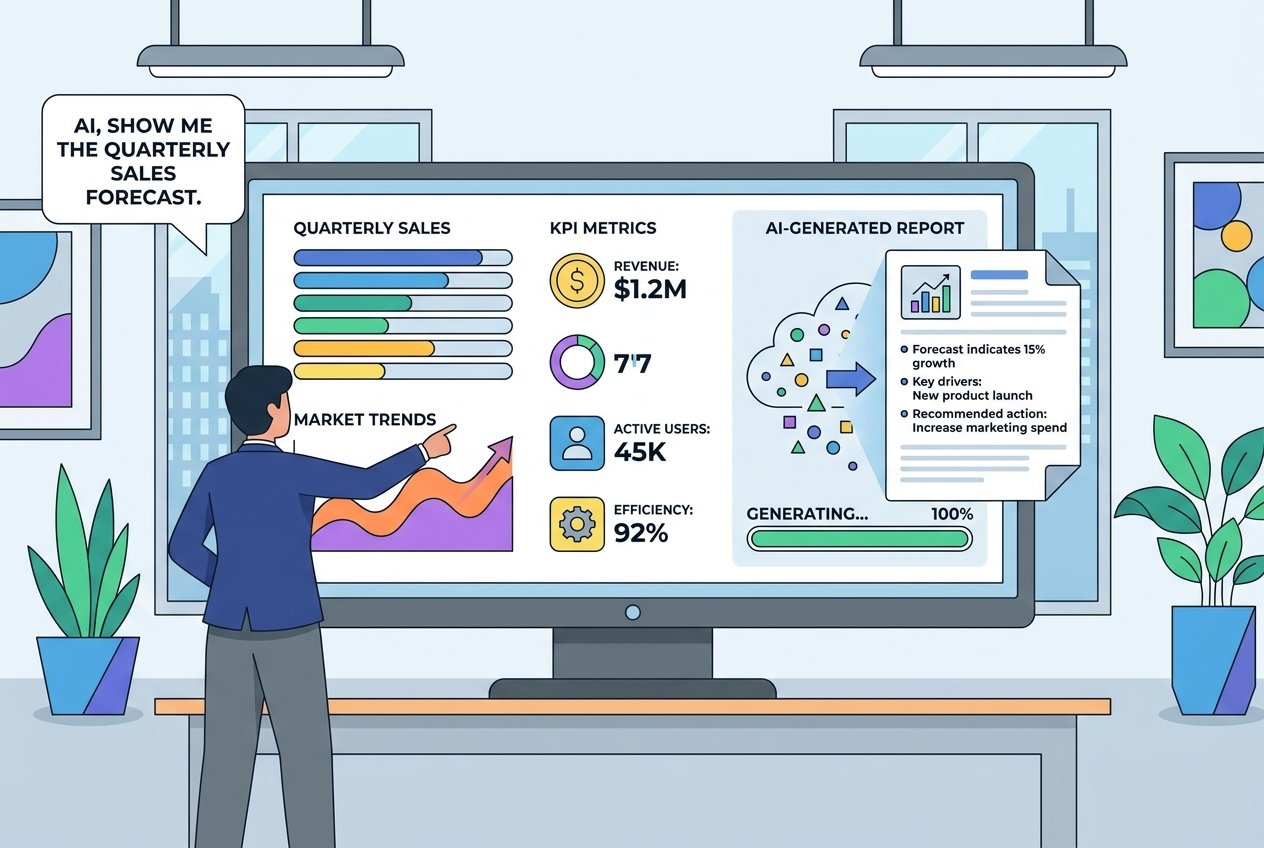
In an era where data is described as the new oil, UK businesses are sitting on vast reserves of untapped insight. Yet for many organisations, the process of turning raw figures into meaningful reports remains painfully manual, time-consuming, and riddled with human error. Enter AI reporting: a transformative approach that uses artificial intelligence to automatically analyse your business data, generate clear narratives, and produce dynamic visual dashboards in a fraction of the time it once took.
Whether you run a growing e-commerce brand, a professional services firm, or a multi-site retail operation, AI-generated reports are reshaping how decisions get made, and how fast. This guide walks you through what AI reporting actually is, why it matters for UK businesses right now, which tools are leading the way, and how to get started with automation in your own organisation.
What Are AI-Generated Reports?
AI-generated reports are automated outputs produced when artificial intelligence analyses structured or unstructured business data and converts it into readable summaries, charts, graphs, and recommendations. Unlike traditional reporting, which requires analysts to manually pull data, clean it, and format findings, AI reporting platforms handle this entire pipeline autonomously.
Modern AI reporting tools draw on a combination of machine learning, natural language processing (NLP), and data visualisation AI to produce outputs that are not only accurate but genuinely readable by non-technical stakeholders. Tools like Microsoft Power BI Copilot, Tableau with Einstein AI, and ThoughtSpot allow business owners and managers to ask plain English questions such as “What were my top-performing products last quarter?” and receive instant, visually rich answers without writing a single line of code.
Why UK Businesses Cannot Afford to Ignore AI Reporting in 2026
The business case for switching to automated reports has never been stronger. According to a Stanford HAI 2026 AI Index Report, overall organisational AI adoption has reached 88%, and worker access to AI expanded by 50% across 2025 alone. The number of companies deploying 40% or more of their projects using AI in production is set to double within 2026.
Closer to home, a May 2026 UK AI and B2B Market Report found that 54% of UK SMEs are now actively using AI, and a QuickBooks survey cited in Spicy Advisory’s 2026 UK SMB AI Adoption Guide revealed that 70% of UK SMEs use AI regularly when embedded tools such as Microsoft 365 and accounting software are included. Meanwhile, Brookings Institution research from March 2026 confirmed that UK worker AI adoption sits at 36%, the highest in Europe.
The economic climate makes this even more pressing. ONS data from February 2026 shows that 30% of UK trading businesses cite economic uncertainty as their top challenge affecting turnover, while the cost of labour remains the leading operational pressure for businesses with more than 10 employees, reported by 36% of firms. In this environment, automating time-intensive tasks like report generation is not a luxury; it is a competitive necessity.
The Hidden Cost of Manual Reporting
Before exploring the solutions, it is worth understanding the scale of the problem that manual business reporting creates. Most business owners are so accustomed to the process of manually pulling data from spreadsheets, CRM systems, and accounting platforms that they rarely stop to quantify what it is actually costing them.
Consider a typical weekly or monthly reporting cycle in a UK SME. A manager or analyst might spend several hours collating data from disparate sources, formatting it into a readable document, double-checking figures, and preparing a presentation for leadership. Multiply that across a year, factor in the risk of human error, and you begin to see the true cost.
Manual processes also create another problem: reporting latency. By the time a report is compiled and reviewed, the data may already be days or even weeks old. In a fast-moving commercial environment, this delay can mean missed opportunities, slow responses to emerging trends, and decisions based on outdated information. Automated reports solve all of these issues by delivering insights in real time, on demand.
Key Benefits of AI Reporting for UK Businesses
Speed and Efficiency
AI-powered reporting tools can generate in minutes what used to take a team of analysts hours or even days to produce. Platforms like Power BI Copilot allow users to type a natural language query and receive a fully formatted, visualised report instantly. This dramatically reduces reporting lead times and frees up your team to focus on higher-value strategic work.
Accuracy and Consistency
Human error is an unavoidable risk in manual data processes. Transposed figures, miscalculated formulas, and inconsistent formatting all undermine the reliability of your reports. AI business analytics tools apply the same logic consistently every time, pulling data directly from source systems to eliminate the risk of transcription errors.
Actionable Insights Through Data Visualisation AI
Raw numbers rarely tell a compelling story on their own. Data visualisation AI tools transform figures into clear, interactive charts, heat maps, trend lines, and dashboards that non-technical stakeholders can immediately understand and act upon. According to Domo’s 2026 analysis of AI data visualisation tools, leading platforms now include real-time alerts, predictive analytics, and auto-generated visualisations that surface patterns humans might otherwise miss.
Scalability Without Additional Headcount
As your business grows, so does the volume and complexity of your data. Hiring additional analysts to keep pace is both expensive and slow, particularly given the UK’s tight 4% unemployment rate and fierce competition for data talent. AI reporting platforms scale effortlessly alongside your business, handling ten times the data volume without requiring any additional resource.
Better Decision-Making
Ultimately, the value of any report lies in the quality of the decisions it enables. Research from Adobe’s 2026 Digital Trends Report found that 70% of organisations reported AI has somewhat or significantly improved their personalisation metrics, 64% cited improvements in lead generation, and 59% reported gains in customer retention. These are outcomes driven not just by AI tools themselves, but by the quality of the insights those tools surface from business data.
Leading AI Reporting and Data Visualisation Tools in 2026
The market for AI reporting tools has matured significantly, with several platforms now offering genuinely enterprise-grade capabilities accessible to businesses of all sizes. Here is a comparison of the leading options available to UK businesses:
Microsoft Power BI Copilot
Power BI remains the dominant choice for businesses already operating within the Microsoft ecosystem. Its Copilot feature enables natural language queries, automated report generation, and DAX query assistance. It integrates seamlessly with Microsoft 365, SharePoint, and Azure, making it the logical starting point for most UK organisations. Pricing starts at approximately £11 per user per month on the Pro tier, often included within Microsoft 365 E5 licences. According to Find Anomaly’s 2026 data visualisation tool review, Power BI is rated best-in-class for Microsoft ecosystem integration and AI-assisted reporting.
Tableau with Einstein AI
Tableau continues to lead for businesses requiring highly sophisticated visual analysis. Its Einstein AI and Ask Data features detect patterns, recommend visualisations, and enable conversational analytics directly within the platform. Tableau Agent, integrated into Tableau Desktop and Prep, supports complex predictive reporting. Pricing begins at $75 per user per month, positioning it more firmly in the mid-market and enterprise space.
Google Looker and Looker Studio
For businesses heavily invested in the Google ecosystem, Looker provides a robust semantic layer for data governance, while the free Looker Studio tool offers accessible automated dashboards directly connected to Google Analytics and Google Ads data. It is an excellent starting point for smaller UK businesses looking to begin their AI reporting journey without significant upfront investment.
ThoughtSpot
ThoughtSpot specialises in natural language search for business data, allowing users to type plain English questions and receive instant visual answers. Its Ask Zia feature and predictive analytics capabilities make it particularly well-suited to self-service reporting environments where non-technical users need direct access to business intelligence.
Qlik Sense
Qlik’s associative analytics engine sets it apart by allowing users to explore relationships across datasets that other tools might miss. Its AI-driven insights and interactive dashboards are highly regarded for industries such as retail, finance, and logistics, all of which are significant sectors for UK businesses.
What Types of Business Data Work Best with AI Reporting?
AI reporting tools deliver the greatest value when applied to high-volume, structured datasets. The following data types are particularly well-suited to automated analysis and visualisation:
- Sales and Revenue Data: Monthly, weekly, and daily revenue figures, product performance, and sales pipeline data from CRM systems such as Salesforce or HubSpot.
- Financial and Accounting Data: Profit and loss statements, cash flow, expense tracking, and accounts receivable data from platforms such as Xero, Sage, or QuickBooks.
- Marketing Performance Data: Campaign analytics, website traffic, conversion rates, social media metrics, and paid advertising ROI from platforms such as Google Analytics and Meta Ads.
- Operational and Supply Chain Data: Stock levels, order fulfilment rates, supplier performance, and logistics metrics.
- HR and Workforce Data: Headcount, staff turnover, recruitment pipeline, and payroll costs.
- Customer Experience Data: Net Promoter Scores, customer satisfaction surveys, support ticket resolution times, and churn rates.
The common thread across all of these is regularity and volume. The more consistently your data is captured and the larger the dataset, the more powerful and accurate your AI-generated reports will be.
How to Implement AI Reporting in Your Business: A Step-by-Step Approach
Transitioning from manual reporting to an AI-powered model does not have to be complex or disruptive. The following framework provides a practical roadmap for UK businesses at any stage of their data journey.
Step 1: Audit Your Current Reporting Landscape
Begin by mapping out every report your business currently produces: what data goes into it, who produces it, how long it takes, and who uses it. Identify the reports that are most time-consuming, most frequently used, and most critical to decision-making. These are your priority automation candidates.
Step 2: Assess Your Data Infrastructure
AI reporting tools are only as good as the data feeding into them. Evaluate the quality, consistency, and accessibility of your current data sources. Are your sales figures in one system, your marketing data in another, and your financial data in a third? You may need to invest in data integration or a centralised data warehouse before automation can deliver its full potential.
Step 3: Choose the Right Tool for Your Needs
Match the tool to your existing technology stack, budget, and the technical capability of your team. Power BI is the natural first choice for Microsoft-centric businesses. Google Looker Studio suits Google-first environments. Tableau and ThoughtSpot are better suited to organisations with larger data science ambitions. If you are unsure where to start, working with a specialist AI consultant can save considerable time and cost.
This is where the team at Kaizen AI Consulting can add significant value. With deep expertise in AI implementation for UK businesses, Kaizen AI Consulting helps organisations assess their data readiness, select the right reporting stack, and configure tools so they deliver actionable insight from day one, without the common pitfalls of poorly planned AI deployments.
Step 4: Start Small and Iterate
Resist the temptation to automate everything at once. Choose one or two reports to begin with, configure your chosen tool, and measure the time savings and quality improvements achieved. Use these early wins to build internal confidence and stakeholder buy-in before scaling the programme across the business.
Step 5: Train Your Team and Embed Reporting into Workflows
AI reporting tools are most effective when they are genuinely embedded into day-to-day decision-making, not treated as standalone projects. Provide training to ensure team members know how to access, interpret, and act on the reports generated. The goal is to create a culture of data-driven decision-making throughout the organisation.
Governance, Compliance, and Data Security Considerations
For UK businesses, any AI implementation involving business data must also address governance and compliance. The UK Government’s DSIT AI Adoption Research report highlights data security and governance as key barriers to AI adoption. Additionally, the European Union’s AI Act, which has been progressively applying obligations since 2025 with full enforcement scheduled for August 2026, introduces significant compliance considerations for any AI system handling sensitive commercial data.
When selecting AI reporting tools, ensure they are compliant with UK GDPR, that data processed within them remains within approved jurisdictions, and that your organisation maintains clear audit trails for any AI-assisted decisions. Only one in five companies currently has a mature governance model for autonomous AI agents, according to Deloitte’s State of AI in the Enterprise report, making this an area where professional guidance is strongly recommended.
The Competitive Advantage of Acting Now
The gap between businesses that have embraced AI business analytics and those still relying on manual processes is widening rapidly. As AI reporting tools become more capable and accessible, the organisations that invest in them now will build structural advantages in speed, accuracy, and insight that competitors will find increasingly difficult to close.
According to the NVIDIA State of AI Report 2026, organisations prioritising AI workflow optimisation represent 42% of enterprise AI spending, with a further 31% investing in new AI use cases. The message is clear: AI is no longer a future consideration for progressive UK businesses. It is a present-tense competitive requirement.
If your business is ready to move beyond manual reporting and unlock the power of your data, the expert team at Kaizen AI Consulting is here to guide you through every stage of the journey, from initial data audit through to full AI reporting deployment and team training. Get in touch today to arrange a consultation and discover how AI-generated reports can transform the way your business makes decisions.