
Success Story: Small Consultancy Doubled Revenue with Financial Planning
When Manchester-based HR consultancy Meridian Partners approached the brink of their fifth year in business, they faced a challenge familiar to many small UK consulting firms: stagnant revenue despite a growing client base. Their transformation from barely breaking even to doubling their annual revenue in just 18 months demonstrates the powerful impact of strategic financial planning. This success story offers valuable lessons for consultancy growth and highlights why financial planning success isn’t just about spreadsheets, it’s about strategic thinking that drives sustainable business expansion.
The Challenge: Growth Without Profitability
Meridian Partners had built a respectable portfolio of 23 regular clients and maintained positive cash flow, yet their profits remained stubbornly flat. According to Federation of Small Businesses research, approximately 60% of small UK consulting firms experience similar plateaus between years three and five of operation. The consultancy’s founders, Sarah and James Mitchell, recognised they were working harder but not smarter.
Their primary issues included:
- Inconsistent pricing structures across different client types
- No clear understanding of which services generated the highest margins
- Limited cash reserves for business development or strategic investments
- Reactive rather than proactive financial decision-making
- Unclear financial forecasting that hindered growth planning
This scenario is remarkably common in the UK consulting sector, where technical expertise often overshadows business acumen. The UK government’s Business Population Estimates show that whilst consulting firms represent one of the fastest-growing sectors, many struggle with financial sustainability beyond the startup phase.
The Turning Point: Embracing Strategic Finance
The Mitchells’ breakthrough came when they committed to comprehensive financial planning, moving beyond basic bookkeeping to strategic finance management. They engaged external expertise to conduct a thorough financial audit and develop a 24-month revenue increase roadmap. This decision mirrors the approach that Kaizen AI Consulting takes with clients, combining data-driven analysis with practical implementation strategies tailored to each business’s unique circumstances.
Phase One: Financial Assessment and Analysis
The first 90 days focused on understanding the true financial picture. This involved:
Service Profitability Analysis: By calculating the actual time investment, overhead allocation, and revenue for each service line, Meridian discovered that their signature leadership development programme generated 40% higher margins than their recruitment services, despite recruitment bringing in more total revenue. This insight proved transformative.
Client Segmentation by Value: Not all clients contributed equally to profitability. Analysis revealed that 30% of their client base consumed 60% of administrative time whilst generating only 15% of revenue. Research from the Institute of Chartered Accountants in England and Wales indicates that proper client segmentation can improve consultancy profitability by 25-35% on average.
Cost Structure Optimisation: Fixed versus variable costs were mapped comprehensively. The consultancy discovered they were spending £18,000 annually on software subscriptions with less than 40% utilisation, alongside missed opportunities to negotiate better terms with suppliers.
Phase Two: Strategic Planning Implementation
Armed with accurate financial data, Meridian Partners developed a strategic finance plan focused on three core objectives:
1. Service Mix Rebalancing: They gradually shifted focus towards higher-margin leadership development services, increasing prices by 18% whilst reducing lower-value recruitment work. This wasn’t about abandoning existing clients but strategically managing capacity and pricing to reflect true value delivered.
2. Cash Flow Management: Implementation of robust invoicing processes reduced average payment times from 47 days to 28 days, significantly improving working capital. They introduced upfront retainer models for ongoing clients, creating predictable monthly revenue streams. According to Xero’s UK small business insights, improved cash flow management is the single most impactful factor in small business sustainability.
3. Investment in Growth: With clearer financial forecasting, Meridian confidently invested £35,000 in marketing and business development, knowing precisely what return on investment they needed to achieve. This calculated approach to growth investment replaced their previous ad-hoc spending patterns.
The Results: Tangible Consultancy Growth
Within 18 months of implementing their strategic financial planning approach, Meridian Partners achieved remarkable results:
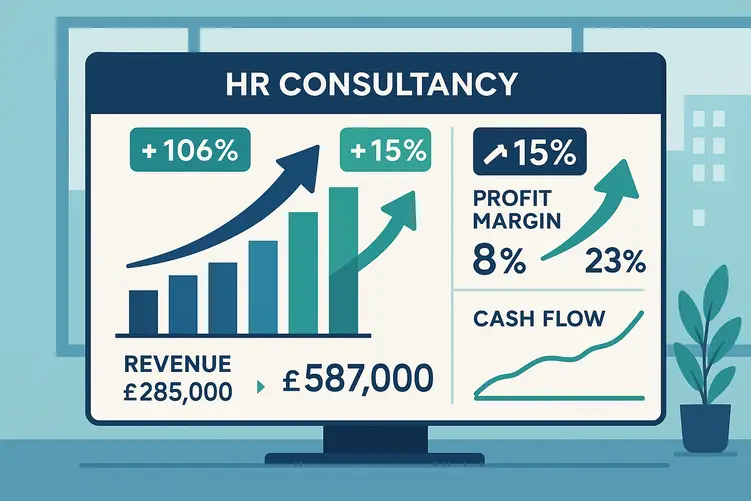
- Revenue increased from £285,000 to £587,000 annually (106% growth)
- Net profit margins improved from 8% to 23%
- Client base refined from 23 to 19 clients, with higher average contract values
- Staff headcount grew from 2 to 5, including a dedicated business development role
- Cash reserves increased from £12,000 to £94,000
Perhaps most significantly, the Mitchells reported reduced stress and improved work-life balance, despite running a significantly larger operation. Financial clarity enabled better decision-making and reduced the constant anxiety of uncertain cash positions.
Key Lessons for UK Consulting Firms
1. Financial Planning Is Strategic, Not Just Administrative
Many consultancy owners view financial planning as compliance-driven bookkeeping rather than strategic business intelligence. Meridian’s experience demonstrates that strategic finance transforms how you understand and grow your business. When you know which services, clients, and activities drive profitability, you can make informed decisions about where to focus energy and resources.
2. Data-Driven Decisions Outperform Intuition
The Mitchells initially believed recruitment services were their most valuable offering because they generated the most revenue. Detailed financial analysis revealed the opposite. This highlights the importance of looking beyond top-line revenue to understand true profitability. Office for National Statistics data shows that UK consulting firms making data-driven strategic decisions grow 3.2 times faster than those relying primarily on intuition.
3. Professional Expertise Accelerates Results
Whilst Meridian’s founders were HR experts, they recognised their limitations in financial strategy. Engaging external expertise provided objectivity, specialist knowledge, and accountability that accelerated their transformation. This is precisely the value that Kaizen AI Consulting provides to growing businesses, combining strategic planning with practical implementation support.
4. Cash Flow Management Enables Strategic Investment
Before implementing proper financial planning, Meridian couldn’t confidently invest in growth because they lacked visibility of future cash positions. Improved invoicing, retainer models, and financial forecasting created the foundation for strategic investment in marketing, staff, and systems that drove their revenue increase.
5. Regular Financial Review Creates Agility
Meridian now conducts monthly financial reviews comparing actual performance against forecasts. This discipline enables rapid response to emerging trends, whether opportunities to pursue or problems to address. Research from the British Chambers of Commerce indicates that businesses conducting regular financial reviews are 47% more likely to achieve their growth targets.
Applying These Principles to Your Consultancy
If your UK consulting firm faces similar challenges to Meridian Partners before their transformation, consider these actionable steps:
Conduct a Comprehensive Service Profitability Analysis: Calculate the true cost of delivering each service, including direct time, overhead allocation, and opportunity costs. You may discover that your most promoted services aren’t your most profitable.
Segment Your Client Base: Evaluate clients not just by revenue but by profitability, growth potential, and strategic fit. Consider whether certain clients should be transitioned to different service models or pricing structures.
Implement Robust Cash Flow Management: Move from reactive to proactive cash flow management with clear invoicing processes, payment terms that protect your business, and forecasting tools that provide visibility of future positions.
Develop Rolling Financial Forecasts: Create 12-month rolling forecasts updated monthly. This provides the visibility needed for confident decision-making about investments, hiring, and strategic initiatives.
Create Financial Dashboards: Develop simple dashboards tracking key metrics such as revenue per consultant, average project margin, cash runway, and client acquisition costs. Regular visibility drives better decisions.
Invest in Financial Expertise: Whether through training, software tools, or external consultants, investing in financial planning capabilities delivers substantial returns. The cost of not understanding your finances typically far exceeds the investment in getting it right.
The Broader Impact of Financial Planning Success
Meridian Partners’ story illustrates that strategic finance isn’t about restricting growth or cutting costs; it’s about enabling sustainable, profitable expansion. Their revenue increase came not from working longer hours or undercutting competitors but from understanding their business deeply and making strategic choices based on solid financial intelligence.
For UK consulting firms, this approach addresses one of the sector’s most persistent challenges: converting professional expertise into sustainable business success. According to the Chartered Institute of Personnel and Development, approximately 40% of consulting startups fail within five years, often due to financial mismanagement rather than lack of technical skills.
The consultancy has continued to grow since their initial transformation, now employing 12 staff and targeting £1 million in annual revenue. More importantly, they’ve built a business model that’s sustainable, scalable, and aligned with their personal goals. The Mitchells now spend more time on strategic leadership and business development rather than firefighting financial crises.
Getting Started with Your Financial Planning Success
The journey from stagnant revenue to doubling turnover doesn’t happen overnight, but it begins with commitment to strategic financial planning. Whether your consultancy is facing the plateau that Meridian experienced or you’re proactively planning for sustainable growth, the principles remain consistent: understand your numbers deeply, make data-driven decisions, and view financial planning as strategic rather than administrative.
Many consulting firms find that whilst they understand the importance of financial planning, implementing it effectively requires external expertise and accountability. Kaizen AI Consulting specialises in helping UK consulting and professional services firms develop and implement strategic financial plans that drive consultancy growth and deliver measurable revenue increases. Our approach combines comprehensive financial analysis with practical implementation support, ensuring that insights translate into action and results.
If your consultancy is ready to move beyond basic bookkeeping to strategic finance that drives growth, we invite you to explore how tailored financial planning can transform your business. Contact Kaizen AI Consulting today to discuss your specific challenges and discover how strategic financial planning can unlock your consultancy’s full potential. Like Meridian Partners, you don’t have to navigate this journey alone, and the right expertise can dramatically accelerate your path to financial planning success.
The difference between consultancies that merely survive and those that thrive often comes down to financial clarity and strategic planning. Your expertise deserves a business model that rewards it appropriately and sustainably. That transformation begins with understanding your numbers and using them to drive smart, strategic decisions about your consultancy’s future.