In today’s competitive business landscape, understanding which sales metrics to track can mean the difference between stagnation and exponential growth. According to a Salesforce study, high-performing sales teams are 2.8 times more likely to use analytics and performance tracking than underperforming teams. Yet many UK businesses still struggle to identify which sales KPIs truly matter.
Whether you’re a growing SME or an established enterprise, implementing robust sales analytics isn’t just about collecting data; it’s about transforming that data into actionable insights that drive revenue growth. This comprehensive guide explores the essential sales metrics every business should monitor and explains why they matter for your bottom line.
Understanding the Foundation: Why Sales Metrics Matter
Sales metrics provide the quantifiable evidence needed to make informed business decisions. Rather than relying on gut feelings or anecdotal evidence, performance tracking enables you to identify trends, spot problems early, and capitalise on opportunities before your competitors do.
Research from Harvard Business Review shows that data-driven organisations are 23 times more likely to acquire customers and six times more likely to retain them. For UK businesses navigating post-Brexit economic challenges and increasing digital competition, these advantages are invaluable.
Core Revenue Metrics: The Financial Heartbeat
Monthly Recurring Revenue (MRR) and Annual Recurring Revenue (ARR)
For subscription-based businesses, MRR and ARR are fundamental revenue metrics that predict future income. These figures help you understand growth velocity and business sustainability. Tracking MRR allows you to segment revenue by new customers, expansions, and churn, providing clarity on where your growth is coming from.
Average Deal Size
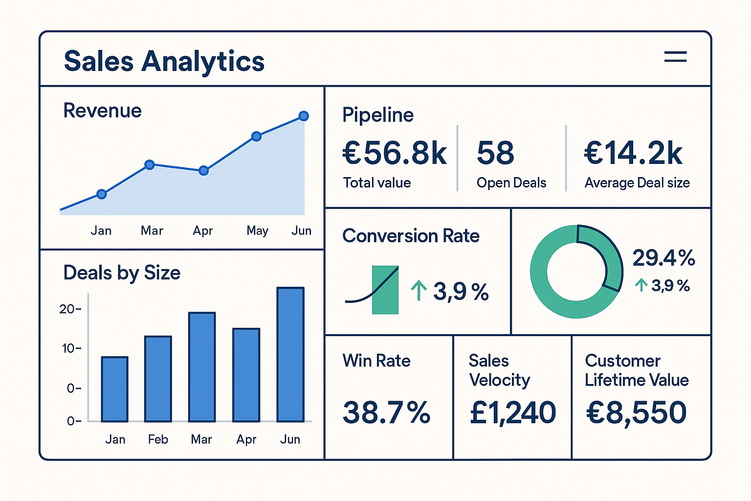
Your average deal size reveals the typical value of closed opportunities. Monitoring this metric helps you understand whether your sales team is moving upmarket or downmarket, and whether your pricing strategy is effective. According to McKinsey research, companies that actively manage deal size see 15-20% higher revenue growth than those that don’t.
Customer Lifetime Value (CLV)
CLV calculates the total revenue you can expect from a single customer account throughout the business relationship. This sales metric is crucial for determining how much you should invest in customer acquisition and retention. UK businesses with strong CLV tracking report 25% higher profitability, as they can allocate resources more effectively across the customer journey.
Pipeline Performance Metrics: Forecasting Your Future
Sales Pipeline Velocity
Pipeline velocity measures how quickly prospects move through your sales funnel and convert into paying customers. The formula combines number of opportunities, average deal value, win rate, and sales cycle length. This metric is particularly valuable for forecasting, as it helps predict when deals will close and revenue will arrive.
At Kaizen AI Consulting, we help businesses implement AI-powered pipeline tracking systems that provide real-time velocity calculations, enabling more accurate forecasting and resource allocation.
Win Rate
Your win rate is the percentage of opportunities that convert to closed deals. Industry benchmarks suggest that high-performing sales teams achieve win rates of 30% or higher, though this varies significantly by sector. Tracking win rates by lead source, product line, or sales representative can reveal valuable insights about what’s working and what needs improvement.
Sales Cycle Length
The average time from first contact to closed deal is a critical efficiency metric. Longer sales cycles tie up resources and delay revenue recognition. By analysing cycle length across different deal sizes, customer segments, and sales reps, you can identify bottlenecks and implement targeted improvements. Data from Gartner indicates that reducing sales cycle length by just 10% can increase annual revenue by 15-25%.
Activity-Based Sales KPIs: Measuring Effort and Efficiency
Calls, Emails, and Meetings Booked
These activity metrics track the volume of outreach efforts. While activity alone doesn’t guarantee results, consistent tracking reveals whether your team is doing enough prospecting. The key is balancing quantity with quality and understanding the correlation between activities and outcomes.
Lead Response Time
Speed matters in sales. Research shows that companies responding to leads within five minutes are 100 times more likely to connect with decision-makers than those waiting 30 minutes. This performance tracking metric is especially critical for inbound leads, where competitors are often vying for the same prospects.
Sales Activities per Opportunity
This metric measures how many touchpoints are required to move opportunities through each pipeline stage. Understanding the optimal number of interactions helps you coach sales teams and set realistic activity targets. Insufficient touches may indicate poor follow-up, whilst excessive activities might signal qualification issues or ineffective messaging.
Customer Acquisition and Retention Metrics
Customer Acquisition Cost (CAC)
CAC calculates the total cost of acquiring a new customer, including marketing expenses, sales salaries, technology costs, and overheads. For sustainable growth, your CLV should be at least three times your CAC. UK businesses often overlook hidden acquisition costs, leading to unprofitable growth that looks healthy on the surface.
Churn Rate
Customer churn rate measures the percentage of customers who stop doing business with you over a given period. Even small reductions in churn can dramatically impact long-term revenue. A Bain & Company study found that increasing customer retention rates by just 5% can increase profits by 25-95%.
Net Revenue Retention (NRR)
NRR measures revenue growth from existing customers through upsells and cross-sells, minus any revenue lost to churn or downgrades. An NRR above 100% indicates your existing customer base is growing in value, which is a powerful indicator of product-market fit and customer satisfaction.
Sales Team Performance Metrics
Quota Attainment
The percentage of sales representatives meeting or exceeding their targets provides insight into both individual performance and whether quotas are realistic. If fewer than 60% of reps hit quota, it may indicate targets are too aggressive, insufficient training, or poor lead quality.
Sales Per Representative
Average revenue per sales representative helps you understand productivity levels and identify top performers. This revenue metric is essential for capacity planning, as it indicates when you need to hire additional salespeople to support growth targets.
Time Spent Selling
Studies suggest sales representatives spend only 35-40% of their time actually selling, with the remainder consumed by administrative tasks, meetings, and data entry. Maximising selling time through automation and process optimisation can dramatically improve results without increasing headcount.
Implementing Effective Sales Analytics in Your Organisation
Understanding which metrics to track is only the first step. Successful implementation requires the right technology infrastructure, clear processes, and organisational buy-in.
Choose the Right Tools
Modern CRM systems like Salesforce, HubSpot, and Microsoft Dynamics offer robust sales analytics capabilities, but they require proper configuration to deliver meaningful insights. Many UK businesses invest in sophisticated tools but fail to leverage their full potential due to poor setup or inadequate training.
Establish Regular Review Cadences
Sales metrics should be reviewed at multiple frequencies. Daily metrics might include activity levels and pipeline changes, whilst weekly reviews focus on pipeline health and forecast accuracy. Monthly and quarterly reviews should examine trends in revenue metrics, conversion rates, and strategic performance against targets.
Create Accountability and Transparency
Make key sales KPIs visible to the entire team through dashboards and regular communications. Transparency drives accountability and enables peer learning when high performers share their approaches. However, ensure you’re fostering healthy competition rather than creating a toxic environment.
How AI is Transforming Sales Analytics
Artificial intelligence is revolutionising how businesses approach performance tracking and sales metrics. Machine learning algorithms can now predict which leads are most likely to convert, identify at-risk customers before they churn, and recommend optimal next actions for sales representatives.
AI-powered tools analyse patterns across thousands of interactions to provide insights that would be impossible for humans to discern manually. They can predict deal closure probabilities, suggest ideal contact times, and even recommend pricing strategies based on historical data.
Kaizen AI Consulting specialises in helping UK businesses implement AI-driven sales analytics solutions that transform raw data into strategic advantages. Our approach combines cutting-edge technology with practical business expertise to ensure you’re not just collecting metrics, but actually using them to drive growth.
Common Pitfalls to Avoid
Tracking Too Many Metrics
Whilst comprehensive data is valuable, tracking dozens of sales KPIs can create analysis paralysis. Focus on the 8-12 metrics that most directly impact your business objectives. These core indicators should align with your growth strategy and be actionable.
Ignoring Leading Indicators
Many organisations focus exclusively on lagging indicators like revenue and closed deals. Whilst these are important, leading indicators such as pipeline coverage, meeting bookings, and proposal submissions provide early warning signals and opportunities for course correction.
Failing to Benchmark
Understanding your metrics in isolation provides limited value. Compare your performance tracking results against industry benchmarks, historical trends, and competitor intelligence. This context helps you understand whether your numbers represent success or highlight areas needing improvement.
Taking Action: Your Next Steps
Now that you understand which sales metrics matter and why they’re important, the question becomes: how do you implement effective tracking in your organisation?
Start by auditing your current measurement capabilities. Which of the metrics discussed are you already tracking? Where are the gaps? What technology investments or process changes would be required to close those gaps?
Next, prioritise based on your business model and growth stage. Early-stage companies might focus heavily on pipeline velocity and customer acquisition costs, whilst established businesses may prioritise retention metrics and sales efficiency.
Finally, recognise that implementing sophisticated sales analytics isn’t something you need to tackle alone. The right partner can accelerate your journey, helping you avoid common mistakes and ensuring you extract maximum value from your data investments.
If you’re ready to transform your approach to sales metrics and unlock data-driven growth, contact Kaizen AI Consulting today. Our team of experts will work with you to design and implement a customised sales analytics framework that delivers measurable results for your business. Let’s turn your sales data into your competitive advantage.
Conclusion
Effective performance tracking through the right sales metrics is no longer optional in today’s data-driven business environment. From fundamental revenue metrics like CLV and deal size to operational KPIs like win rate and pipeline velocity, each measurement provides valuable insights into your sales engine’s health and efficiency.
The businesses that thrive are those that not only collect these metrics but actively use them to make smarter decisions, coach their teams more effectively, and allocate resources where they’ll generate the greatest return. With the right approach to sales analytics, you can transform your sales organisation from reactive to proactive, from intuition-based to insight-driven, and from good to exceptional.