In today’s competitive business landscape, having a solid growth strategy isn’t just beneficial – it’s essential for survival. Yet, research from the Federation of Small Businesses reveals that over 60% of UK businesses fail within their first three years, often due to a lack of strategic planning and clear growth roadmap. The difference between thriving businesses and those that stagnate lies not in luck, but in the quality and execution of their growth strategy development.
Whether you’re a startup looking to gain market traction or an established business seeking new avenues for business expansion, developing a growth strategy that actually delivers results requires careful consideration, data-driven insights, and systematic implementation. This comprehensive guide will walk you through the proven frameworks and practical steps needed to create a robust growth strategy that drives sustainable success.
Understanding Growth Strategy Development: Beyond the Basics
Growth strategy development is more than simply setting ambitious revenue targets. It’s a comprehensive process that aligns your business objectives with market opportunities, available resources, and competitive advantages. A well-crafted growth strategy serves as your organisation’s north star, guiding decision-making and resource allocation whilst ensuring every team member works towards common goals.
According to McKinsey research, companies with clearly defined growth strategies are 33% more likely to achieve above-average profitability compared to their peers. This statistic underscores why strategic planning shouldn’t be an afterthought or an annual box-ticking exercise.
The most effective growth strategies address four fundamental questions: Where are we now? Where do we want to be? How will we get there? How will we measure success? Answering these questions requires honest self-assessment, market analysis, and the courage to make difficult decisions about resource prioritisation.
The Five Pillars of Effective Growth Strategy Development
1. Market Analysis and Positioning
Before embarking on business scaling efforts, you must thoroughly understand your market landscape. This includes identifying your target customer segments, analysing competitor strategies, and spotting emerging trends that could impact your business. Data from the Office for National Statistics shows that businesses conducting regular market analysis are 2.5 times more likely to successfully enter new markets.
Your market analysis should examine both macro factors (economic conditions, regulatory changes, technological disruption) and micro factors (customer behaviour shifts, competitive movements, supply chain dynamics). This intelligence forms the foundation upon which all strategic planning decisions should rest.
2. Identifying Your Growth Vectors
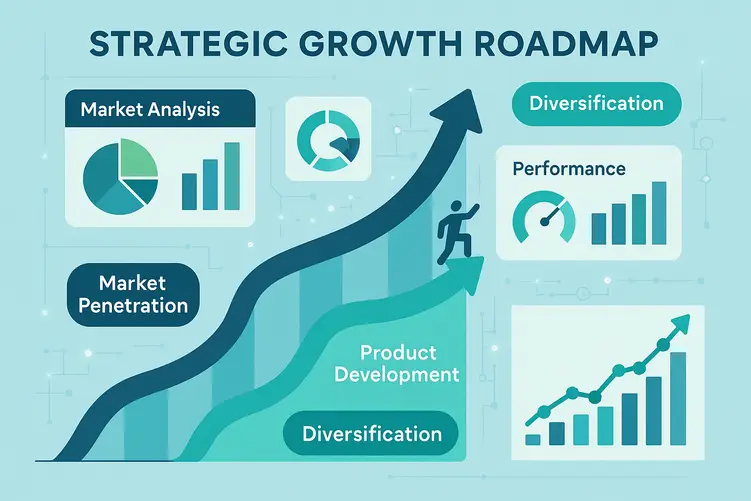
Growth can come from multiple directions, and successful businesses typically pursue a combination of vectors simultaneously. The Ansoff Matrix provides a useful framework, outlining four primary growth strategies: market penetration (selling more existing products to current markets), market development (entering new markets with existing products), product development (creating new offerings for existing markets), and diversification (new products in new markets).
Each vector carries different risk profiles and resource requirements. Market penetration typically represents the lowest risk but may offer limited growth potential if your market is saturated. Conversely, diversification offers exciting opportunities but demands significant investment and expertise. Your growth roadmap should carefully balance ambition with pragmatism, selecting vectors that align with your capabilities and risk tolerance.
3. Resource Allocation and Capability Building
A brilliant strategy becomes meaningless without proper execution, and execution depends on having the right resources in place. This includes financial capital, human talent, technological infrastructure, and operational processes. The British Chambers of Commerce reports that 47% of UK businesses cite resource constraints as the primary barrier to business expansion.
Strategic planning must therefore include a honest assessment of current capabilities versus those needed to achieve your growth objectives. Where gaps exist, you’ll need to decide whether to build capabilities internally, acquire them through hiring or partnerships, or outsource specific functions. This is where partnering with specialists like Kaizen AI Consulting can prove invaluable, bringing expertise in growth strategy development and providing the guidance needed to make optimal resource allocation decisions.
4. Revenue Model Optimisation
Your revenue model determines how your business captures value from the market. As part of your growth strategy, examine whether your current pricing structure, sales channels, and customer acquisition approach remain optimal. Research indicates that businesses regularly reviewing and optimising their revenue models achieve 23% higher growth rates than those using static models.
Consider diverse revenue streams that could complement your primary income source. Subscription models, for instance, provide predictable recurring revenue that facilitates business scaling. Likewise, strategic partnerships can open new distribution channels without proportional increases in overhead costs. Your growth roadmap should explicitly address how you’ll evolve your revenue model to support expansion objectives.
5. Scalable Systems and Processes
Many businesses hit growth ceilings not because of market limitations, but because their internal systems can’t handle increased volume. Scalability must be baked into your operations from the outset. This means investing in technology that automates repetitive tasks, documenting processes so they can be easily replicated, and building organisational structures that support delegation and distributed decision-making.
The implementation of AI and automation technologies has become increasingly critical for business scaling. According to TechUK, businesses leveraging artificial intelligence in their operations report 40% faster scaling compared to traditional approaches. These technologies enable you to handle growth without proportionally increasing headcount or operational complexity.
Creating Your Strategic Growth Roadmap: A Step-by-Step Process
Step 1: Conduct a Comprehensive Business Audit
Begin with brutal honesty about your current position. Analyse financial performance, operational efficiency, customer satisfaction metrics, and competitive positioning. Use frameworks like SWOT analysis (Strengths, Weaknesses, Opportunities, Threats) to identify where you have advantages and where vulnerabilities exist. This baseline assessment provides the starting point for your growth roadmap.
Step 2: Define Clear, Measurable Objectives
Vague aspirations like “grow the business” lead to diffused efforts and disappointing results. Instead, establish SMART objectives (Specific, Measurable, Achievable, Relevant, Time-bound). For example, “Increase annual recurring revenue by 35% within 18 months through geographic expansion and product line extension” provides clarity and enables progress tracking.
Your objectives should cascade throughout the organisation, with departmental and individual goals aligning with overarching growth targets. This ensures everyone understands how their work contributes to strategic priorities.
Step 3: Develop Your Strategic Initiatives
Strategic initiatives are the major projects and programmes that will drive your growth strategy forward. Each initiative should directly support one or more of your strategic objectives. For a business expansion strategy, initiatives might include entering new geographic markets, developing strategic partnerships, launching new product lines, or implementing advanced CRM systems.
Prioritise initiatives based on expected impact, resource requirements, and interdependencies. Not everything can be done simultaneously, so sequencing matters enormously. Quick wins that build momentum and generate cash flow should typically precede longer-term, capital-intensive projects.
Step 4: Create Detailed Action Plans
Each strategic initiative needs breaking down into specific actions with assigned owners, deadlines, and success criteria. This level of detail transforms strategic planning from abstract thinking into concrete activity. Action plans should also identify key milestones where progress will be reviewed and strategies adjusted if necessary.
Step 5: Establish KPIs and Monitoring Systems
What gets measured gets managed. Identify the key performance indicators (KPIs) that will track progress towards your growth objectives. These should include both leading indicators (metrics that predict future performance, like sales pipeline growth) and lagging indicators (metrics that reflect outcomes already achieved, like revenue growth).
Implement dashboard systems that provide real-time visibility into these KPIs, enabling quick identification of problems and opportunities. Modern business intelligence tools make this easier than ever, though many businesses struggle with data integration and interpretation. Working with experts in business strategy and AI implementation like Kaizen AI Consulting can accelerate your ability to leverage data for strategic decision-making.
Common Pitfalls in Growth Strategy Development (And How to Avoid Them)
Pitfall 1: Strategy Without Execution Focus
Beautiful strategy documents that gather dust on shelves help nobody. The implementation gap – the disconnect between strategic plans and actual execution – undermines countless growth initiatives. Combat this by building execution accountability into your planning process, with regular review sessions, clear ownership, and consequences for missed milestones.
Pitfall 2: Pursuing Growth at the Expense of Profitability
Revenue growth means little if it’s not economically sustainable. Many businesses make the mistake of acquiring customers at any cost or expanding into markets that will never generate acceptable returns. Your growth roadmap must include unit economics analysis, ensuring that your business scaling efforts ultimately improve rather than erode profitability.
Pitfall 3: Ignoring Organisational Culture and Change Management
Strategy execution happens through people, and people resist change when they don’t understand it or feel threatened by it. Research from CIPD indicates that 70% of change initiatives fail due to employee resistance and poor change management. Your strategic planning process must therefore include communication strategies and change management programmes that bring your team along on the growth journey.
Pitfall 4: Failing to Adapt as Conditions Change
No strategy survives first contact with reality unchanged. Market conditions shift, competitors respond, and unexpected obstacles emerge. Treating your growth strategy as a static document rather than a living framework guarantees disappointment. Build flexibility into your approach, conducting quarterly strategy reviews that allow for course corrections whilst maintaining focus on core objectives.
Measuring Success: Beyond Revenue Metrics
Whilst revenue growth provides the most visible measure of strategic success, comprehensive evaluation requires a broader perspective. Customer lifetime value, market share gains, brand recognition improvements, operational efficiency increases, and employee engagement scores all provide important signals about whether your business expansion efforts are creating sustainable value.
Leading businesses use balanced scorecard approaches that track performance across multiple dimensions: financial results, customer outcomes, internal processes, and organisational learning and growth. This holistic view prevents the tunnel vision that comes from focusing exclusively on short-term financial metrics.
Taking Action: Your Next Steps in Growth Strategy Development
Developing a growth strategy that actually works isn’t a one-time project but an ongoing discipline. It requires combining analytical rigour with creative thinking, strategic patience with operational urgency, and confidence with humility. The most successful businesses treat strategic planning as a continuous conversation rather than an annual event, regularly testing assumptions and adapting to new information.
For many UK businesses, particularly small and medium enterprises, the challenge lies not in understanding what needs to be done but in finding the time, expertise, and objectivity to do it well. Business leaders consumed by daily operational demands often struggle to step back and think strategically. This is precisely where external expertise becomes transformative.
If you’re ready to develop a growth strategy that delivers real results, Kaizen AI Consulting specialises in working with ambitious UK businesses to create and implement comprehensive growth roadmaps. Our approach combines proven strategic frameworks with cutting-edge AI and data analytics, providing the insights and execution support needed to accelerate your business scaling journey. We don’t just hand you a strategy document – we partner with you through implementation, ensuring your plans translate into tangible results.
Ready to transform your growth aspirations into reality? Contact Kaizen AI Consulting today for a complimentary strategy consultation. Let’s discuss how we can help you develop and execute a growth strategy that actually works for your unique business context.
The difference between businesses that achieve breakthrough growth and those that plateau often comes down to the quality of strategic thinking and the discipline of execution. With the right framework, expert guidance, and commitment to action, your business can move from ambition to achievement. The question isn’t whether you can grow – it’s whether you’re ready to commit to the strategic planning and focused execution that sustainable business expansion requires.