In the competitive landscape of digital marketing, understanding the return on investment of your search engine optimisation efforts has become crucial for UK businesses. While many companies invest substantial resources into SEO, surprisingly few can accurately measure the actual value it delivers. This comprehensive guide explores how to calculate SEO ROI, track meaningful search marketing value, and demonstrate the tangible impact of your optimisation efforts.
Understanding SEO ROI: More Than Just Rankings
When business leaders discuss SEO ROI, they often focus solely on keyword rankings. However, true return on investment encompasses much more. According to BrightEdge research, organic search drives 53% of all website traffic, making it the single largest traffic source for most businesses. This statistic alone highlights why measuring SEO performance accurately matters for your bottom line.
SEO ROI fundamentally represents the revenue generated from organic search activities minus the costs of those activities, divided by the costs. The formula appears straightforward: (Revenue from Organic Search – Cost of SEO) / Cost of SEO x 100. Yet implementing this calculation requires sophisticated tracking systems and attribution models that many organisations struggle to establish properly.
At Kaizen AI Consulting, we help businesses implement comprehensive tracking frameworks that capture the full spectrum of SEO value, from direct conversions to assisted conversions and brand awareness metrics that ultimately drive revenue growth.
Key SEO Metrics That Drive Business Value
Measuring SEO requires monitoring multiple interconnected metrics that collectively paint a picture of your search marketing value. Here are the essential indicators every business should track:
Organic Traffic Growth
Organic traffic serves as the foundation metric for SEO success. However, not all traffic holds equal value. Segment your organic visitors by landing page, user intent, and conversion potential. Research from Statista shows that businesses with strategic SEO approaches see 14.6% close rates from organic search, compared to just 1.7% from outbound marketing methods.
Monitor these traffic-related metrics specifically: total organic sessions, organic traffic growth rate month-over-month, organic traffic by device type, landing page performance, and bounce rates for organic visitors. These indicators reveal whether your SEO efforts attract genuinely interested prospects to your website.
Keyword Rankings and Visibility
Whilst rankings alone do not pay the bills, they significantly influence the traffic and conversions you receive. Track your positions for target keywords across search engines, with particular attention to featured snippets and local pack appearances for UK-based businesses. Backlinko analysis reveals that the first organic result in Google receives 27.6% of all clicks, whilst the second position captures just 15.8%.
Focus on visibility metrics including: average ranking position for priority keywords, share of voice in your industry, featured snippet ownership, and local search visibility for location-based queries. These measurements help you understand your competitive positioning in search results.
Conversion Metrics
Ultimately, return on investment depends on conversions. Track organic conversion rates across different user journeys, from simple newsletter signups to completed purchases. Assign monetary values to each conversion type to calculate actual revenue attribution. According to SEMrush data, organic search delivers conversion rates around 2.4%, outperforming many paid advertising channels.
Essential conversion metrics include: organic conversion rate, goal completions from organic traffic, revenue per organic visitor, assisted conversions from organic touchpoints, and customer lifetime value of organic-acquired customers. These figures directly connect your SEO activities to business outcomes.
Calculating Your True SEO Investment
Before calculating return on investment, you must accurately account for all SEO-related expenses. Many businesses underestimate their true investment by overlooking indirect costs.
Your total SEO investment includes: in-house staff salaries and time allocated to SEO activities, agency or consultant fees (if applicable), SEO tools and software subscriptions, content creation costs including writing and design, technical development for site improvements, and link building or outreach expenses. For UK businesses, the average monthly SEO investment ranges from £500 for small businesses to £10,000+ for enterprise organisations, according to industry benchmarks.
Professional agencies like Kaizen AI Consulting provide transparent reporting on all activities and costs, ensuring you have complete visibility into your SEO investment and can accurately measure returns.
Attribution Models for Measuring SEO
Search engine optimisation rarely produces immediate conversions. Customers typically interact with your brand multiple times before purchasing, making attribution modelling essential for accurate ROI calculation.
Last-Click Attribution
This model credits the final touchpoint before conversion. Whilst simple to implement, it significantly undervalues SEO’s role in customer journeys. If someone discovers your brand through organic search, then returns directly to purchase, SEO receives no credit under last-click attribution.
First-Click Attribution
This approach credits the initial touchpoint, recognising SEO’s crucial role in brand discovery. However, it ignores the nurturing required to convert prospects. For businesses with longer sales cycles, first-click attribution provides valuable insights into acquisition channels.
Multi-Touch Attribution
Advanced models distribute credit across all touchpoints in the customer journey. Time-decay models give more credit to recent interactions, whilst position-based models emphasise first and last touchpoints. Google research suggests multi-touch attribution provides the most accurate picture of marketing effectiveness, though it requires sophisticated tracking implementation.
Calculating Lifetime Value from Organic Search
Short-term ROI calculations miss a critical component: customer lifetime value (CLV). Organic search often attracts high-quality customers who return repeatedly and recommend your business to others.
Calculate CLV from organic search by tracking: average purchase value from organic customers, purchase frequency over time, customer retention rates by acquisition channel, and referral rates from organic-acquired customers. Research indicates that customers acquired through organic search typically demonstrate 25-40% higher lifetime values compared to paid advertising customers, as they discover your business through genuine intent rather than interruption.
Benchmark SEO ROI in UK Industries
Context matters when evaluating your SEO performance. Industry benchmarks help you understand whether your returns meet, exceed, or fall short of typical results.
E-commerce businesses typically see ROI ranging from 200-500%, with mature SEO programmes delivering £2-£5 for every £1 invested. B2B service companies often experience 300-700% returns, though longer sales cycles delay realisation. Local service businesses including solicitors, accountants, and tradespeople frequently achieve 400-1000% ROI from local SEO efforts, as high-intent local searches convert exceptionally well. SaaS and technology companies generally see 250-600% returns, with compounding benefits as domain authority grows.
These figures represent established programmes running for 12+ months. New SEO initiatives typically require 6-12 months before delivering measurable ROI, making patience and consistent investment crucial for success.
Tools and Technologies for Tracking SEO ROI
Accurate measurement requires robust analytics infrastructure. Essential tools include:
Google Analytics 4 provides comprehensive traffic and conversion tracking with advanced attribution modelling. Google Search Console delivers search performance data, keyword rankings, and technical issue identification. SEO platforms like SEMrush, Ahrefs, or Moz offer keyword tracking, competitor analysis, and backlink monitoring. Call tracking software attributes phone conversions to organic search sources. CRM integration connects organic leads to closed deals and revenue.
The technical implementation of these systems determines your measurement accuracy. Many businesses collect data but struggle to transform it into actionable ROI insights. Kaizen AI Consulting specialises in creating integrated analytics frameworks that connect SEO activities directly to revenue outcomes, providing the clarity needed for confident decision-making.
Common Pitfalls in Calculating SEO ROI
Even sophisticated organisations make mistakes when measuring search marketing value. Avoid these common errors:
Ignoring brand search traffic inflates apparent SEO success. Separate branded from non-branded organic traffic to understand true acquisition performance. Overlooking assisted conversions undervalues SEO’s role in multi-touch customer journeys. Review assisted conversion reports regularly. Using inadequate time frames leads to premature judgements. SEO requires minimum 6-month evaluation periods. Failing to account for seasonality distorts month-over-month comparisons. Compare year-over-year performance instead. Neglecting technical SEO costs creates incomplete investment calculations. Include development time for site improvements.
Demonstrating SEO Value to Stakeholders
Calculating ROI matters little if you cannot communicate it effectively. Business leaders need clear, compelling presentations of search marketing value.
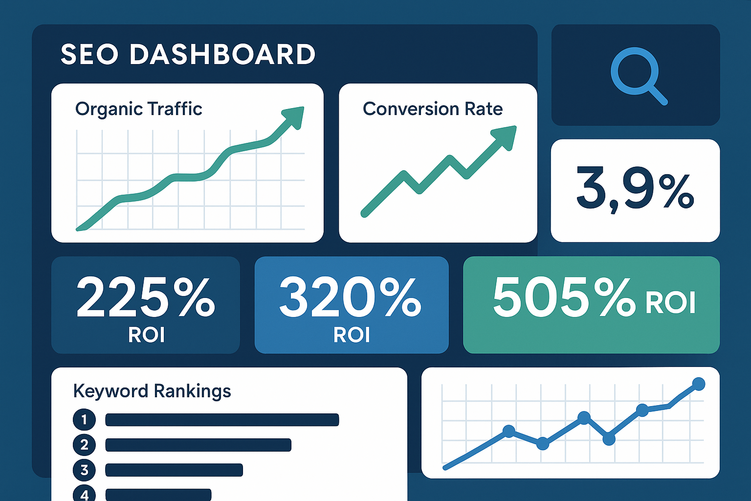
Create executive dashboards highlighting revenue attributed to organic search, ROI percentages with trend lines, organic traffic growth visualisations, and competitive positioning metrics. Use revenue figures rather than vanity metrics. Directors care about pounds generated, not merely rankings achieved.
Compare SEO performance against paid search and other marketing channels to provide context. Often, organic search delivers superior ROI with compounding benefits over time, whilst paid advertising costs increase continuously.
Future-Proofing Your SEO Measurement Strategy
The digital landscape evolves rapidly. Privacy regulations, AI-driven search, and changing consumer behaviour all impact measurement approaches.
Prepare for cookieless tracking by implementing server-side tagging and first-party data strategies. Adapt to AI overviews and zero-click searches by tracking brand awareness and assisted conversions beyond direct traffic. Monitor engagement metrics including time on site, pages per session, and return visitor rates as indicators of SEO quality even when attribution becomes challenging.
Taking Action: Improving Your SEO ROI
Understanding ROI calculation represents just the beginning. Apply these insights to enhance your returns:
Prioritise high-converting keywords rather than chasing volume alone. Improve conversion rate optimisation on top organic landing pages. Invest in content that targets buyer-intent queries. Build authoritative backlinks that drive referral traffic alongside SEO value. Optimise for featured snippets and rich results to increase organic click-through rates. Enhance technical performance with faster page speeds and mobile optimisation.
Each improvement compounds over time, creating exponential growth in organic search value.
Partner with SEO ROI Experts
Calculating and improving SEO ROI requires specialised expertise, technical implementation skills, and continuous optimisation. Whilst this guide provides the framework, implementing sophisticated measurement systems and executing high-return SEO strategies demands dedicated focus.
If you are ready to unlock the full potential of organic search for your business, Kaizen AI Consulting offers comprehensive SEO services built on data-driven ROI measurement. Our team implements tracking systems that provide complete visibility into your search marketing value, executes strategies proven to deliver exceptional returns, and provides transparent reporting that demonstrates exactly how SEO drives business growth.
Do not let unmeasured SEO investment continue. Contact Kaizen AI Consulting today to discover how we can transform your organic search performance into a measurable, profitable growth engine for your UK business. Let us show you exactly what SEO ROI looks like when executed with precision and measured with accuracy.