The UK business landscape is experiencing a remarkable transformation as companies navigate post-Brexit realities, digital acceleration, and evolving consumer expectations. Understanding the growth trends UK businesses are leveraging to scale successfully has never been more critical for ambitious entrepreneurs and established enterprises alike.
Recent British Business Bank research reveals that 68% of UK SMEs have ambitious growth plans for the next three years, yet only 34% feel they have the right strategies in place to achieve them. This gap represents both a challenge and an opportunity for businesses ready to adopt proven scaling strategies.
The Current State of UK SME Growth
UK SME growth has entered a new phase characterised by strategic sophistication and technological integration. According to Office for National Statistics data, small and medium-sized enterprises contribute over £2.3 trillion to the UK economy annually, representing 99.9% of all UK businesses. However, the path to sustainable business expansion has become increasingly complex.
The most successful UK businesses are no longer relying on traditional growth methods alone. Instead, they are combining digital transformation, data-driven decision making, and strategic partnerships to create competitive advantages that fuel sustainable expansion.
Five Dominant Scaling Strategies Driving Success
1. Digital-First Customer Acquisition
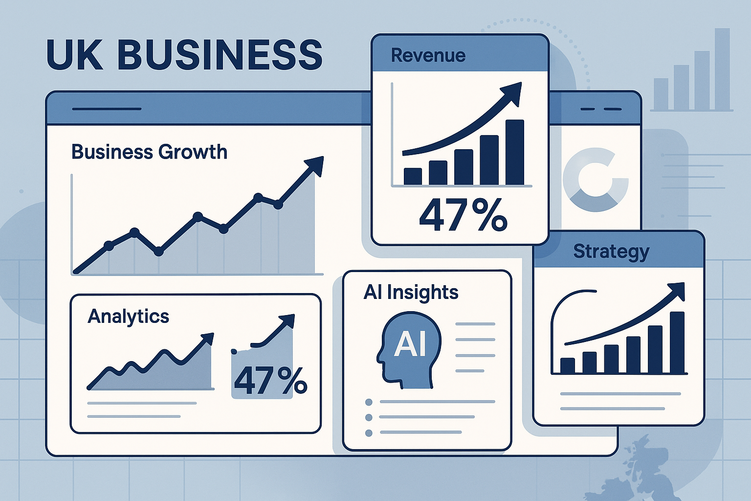
Leading UK businesses have embraced digital marketing as their primary growth engine. Google research indicates that UK businesses investing in digital channels see an average revenue increase of 47% compared to those using traditional methods alone.
This growth trend encompasses sophisticated SEO strategies, targeted social media advertising, and conversion rate optimisation. Companies are moving beyond simple online presence to create comprehensive digital ecosystems that attract, nurture, and convert prospects at scale. Kaizen AI Consulting helps businesses develop and implement data-driven digital strategies that align with these emerging patterns, ensuring your customer acquisition systems are built for scalable growth.
2. AI-Powered Operations and Decision Making
Artificial intelligence adoption represents one of the most significant success patterns among rapidly scaling UK businesses. Research from UK Government AI Sector Deal shows that businesses implementing AI see productivity gains of up to 40% within 18 months.
From predictive analytics for inventory management to AI-driven customer service, successful companies are automating routine processes whilst enhancing strategic decision-making capabilities. This technological leverage allows smaller teams to manage significantly larger operations, a critical factor in sustainable scaling strategies.
3. Strategic Partnerships and Ecosystem Building
The days of isolated business growth are ending. Today’s most successful UK businesses understand that strategic alliances multiply opportunities exponentially. Data from Federation of Small Businesses reveals that SMEs engaged in formal partnerships grow 3.2 times faster than those operating independently.
These partnerships take various forms: complementary service providers, technology integrations, co-marketing arrangements, and supply chain collaborations. The common thread is mutual value creation that accelerates business expansion for all parties involved.
4. Customer Retention and Lifetime Value Optimisation
Whilst acquisition strategies dominate headlines, the smartest UK businesses recognise that retention drives profitability. Research by Bain & Company demonstrates that increasing customer retention rates by just 5% can boost profits by 25% to 95%.
Successful scaling strategies now incorporate sophisticated customer success programmes, personalised engagement systems, and loyalty initiatives. These businesses use advanced CRM platforms combined with AI analytics to predict customer needs, prevent churn, and maximise lifetime value. This approach transforms one-time buyers into long-term advocates who fuel organic growth through referrals and repeat purchases.
5. Flexible Funding and Financial Innovation
Access to capital remains crucial, but how UK businesses fund their growth has evolved dramatically. Beyond traditional bank loans, successful companies are leveraging alternative financing including revenue-based financing, crowdfunding, angel investment, and government-backed schemes like the Recovery Loan Scheme.
This diversified approach to funding provides greater flexibility and reduces dependency on single capital sources. Companies maintaining healthy cash flow management whilst pursuing multiple funding avenues demonstrate greater resilience and faster growth trajectories.
Sector-Specific Success Patterns Emerging
Growth trends UK businesses experience vary significantly by sector, yet certain patterns transcend industry boundaries. The technology and professional services sectors lead in digital transformation adoption, whilst retail and hospitality businesses excel at omnichannel integration.
Manufacturing SMEs show remarkable success when combining traditional expertise with Industry 4.0 technologies. Meanwhile, creative industries demonstrate how intellectual property and brand building create scalable value beyond physical products.
Regional Growth Dynamics
UK business expansion is no longer London-centric. Cities like Manchester, Birmingham, Edinburgh, and Bristol have developed thriving business ecosystems with unique advantages. UK Research and Innovation data shows that regional clusters focused on specific industries achieve 22% faster growth than geographically isolated businesses.
This regionalisation creates opportunities for businesses to access specialised talent pools, benefit from local government initiatives, and tap into established supply chains whilst enjoying lower operational costs than London alternatives.
Common Pitfalls Preventing Successful Scaling
Understanding what holds UK SME growth back is equally important as knowing what drives success. Research consistently identifies these critical mistakes:
Premature scaling: Expanding operations before validating product-market fit or establishing reliable revenue streams leads to cash flow crises. Approximately 74% of high-growth startups fail due to premature scaling according to Startup Genome research.
Inadequate systems and processes: Many businesses grow beyond their operational capabilities, creating customer service failures and quality issues. Successful scaling requires infrastructure investment that anticipates future needs rather than reacting to current pressures.
Talent acquisition and retention challenges: As businesses scale, attracting and retaining the right people becomes paramount. Companies failing to develop compelling employer brands and scalable recruitment processes struggle to maintain growth momentum.
Insufficient data utilisation: Operating without robust analytics means making decisions based on intuition rather than evidence. This approach works at small scale but becomes increasingly risky as operations expand.
Building Your Scalable Growth Strategy
Translating these insights into actionable strategies requires careful planning and expert execution. Successful UK businesses approach scaling systematically, beginning with honest assessment of current capabilities and clear definition of growth objectives.
The most effective scaling strategies incorporate these elements:
Clear vision with flexible tactics: Know where you’re heading but remain adaptable in how you get there. Market conditions change rapidly, and rigid planning creates vulnerability.
Metrics-driven management: Establish KPIs that truly indicate business health beyond vanity metrics. Focus on unit economics, customer acquisition costs, lifetime value, cash conversion cycles, and operational efficiency ratios.
Technology infrastructure: Invest in scalable systems before you need them. Cloud-based platforms, integrated software ecosystems, and automation tools provide the foundation for efficient expansion.
Leadership development: As businesses grow, leadership requirements evolve. Successful scaling includes developing management capabilities that match organisational complexity.
Kaizen AI Consulting specialises in helping UK businesses develop comprehensive growth strategies that address these critical elements whilst leveraging cutting-edge AI and data analytics capabilities.
The Role of Innovation in Sustainable Growth
Innovation represents the lifeblood of sustainable business expansion. However, innovation need not mean revolutionary breakthroughs. Incremental improvements to products, services, processes, and customer experiences often deliver the most reliable growth results.
UK businesses leading their sectors dedicate resources to continuous innovation, creating cultures where experimentation is encouraged and learning from failure is normalised. This approach builds organisational resilience and maintains competitive relevance as markets evolve.
Looking Ahead: Future Growth Trends UK Businesses Must Watch
Several emerging patterns will shape the next phase of UK SME growth. Sustainability and environmental responsibility have moved from nice-to-have to essential, with consumers increasingly favouring businesses demonstrating genuine commitment to reducing environmental impact.
The continued integration of AI and machine learning will separate leaders from followers. Businesses embracing these technologies early gain compounding advantages as their systems learn and improve over time.
Remote and hybrid work models are permanently altering how businesses scale. Companies no longer limited by geographic proximity to talent can build world-class teams whilst managing costs more effectively than traditional office-based models allowed.
Taking Action on Your Growth Journey
Understanding growth trends UK businesses are leveraging is valuable, but implementation determines success. The gap between knowing what works and actually executing those strategies separates businesses that achieve their potential from those that stagnate.
Begin by honestly assessing where your business stands today. Which of these success patterns have you already adopted? Where are the gaps in your current approach? What quick wins could you implement immediately whilst developing longer-term strategic initiatives?
Most importantly, recognise that scaling a business successfully requires expertise across multiple disciplines: strategy, technology, marketing, operations, and finance. Few business owners possess deep expertise in all these areas, making external guidance invaluable.
Ready to accelerate your business growth with proven scaling strategies tailored to your unique situation? Contact Kaizen AI Consulting today for a comprehensive growth strategy assessment. Our team combines deep UK market knowledge with cutting-edge AI capabilities to help ambitious businesses achieve sustainable, profitable expansion. Don’t let another quarter pass without the strategic clarity and tactical support you need to scale successfully.
The UK business environment offers tremendous opportunities for companies ready to embrace modern scaling strategies. By learning from success patterns, avoiding common pitfalls, and implementing proven approaches systematically, your business can join the ranks of high-growth UK enterprises transforming their sectors and building lasting value.