The rise of vibecoding has transformed how businesses and developers create software in 2026. With AI-powered tools like Claude Code, Cursor, and Lovable enabling anyone to build applications through natural language prompts, the barriers to software development have never been lower. However, this democratisation comes with significant security risks that UK businesses cannot afford to ignore.
According to recent research from Veracode, a staggering 45% of AI-generated code contains security vulnerabilities. For organisations embracing vibecoding to accelerate their digital transformation, understanding and mitigating these risks is not optional – it is essential for protecting your business, your customers, and your reputation.
What is Vibecoding and Why Should UK Businesses Care?
Vibecoding, a term coined by AI researcher Andrej Karpathy, describes the practice of using AI assistants to generate code through conversational prompts rather than traditional programming. Tools like Cursor, Claude Code, and Lovable have made it possible for non-developers to create functional applications in hours rather than weeks.
The adoption statistics are remarkable. According to industry research, 92% of US developers now use AI coding tools daily, with 41% of all global code being AI-generated in 2024 alone. In the UK, this trend is driving significant economic impact, with AI efficiency projected to boost GDP by up to 10.3% by 2030.
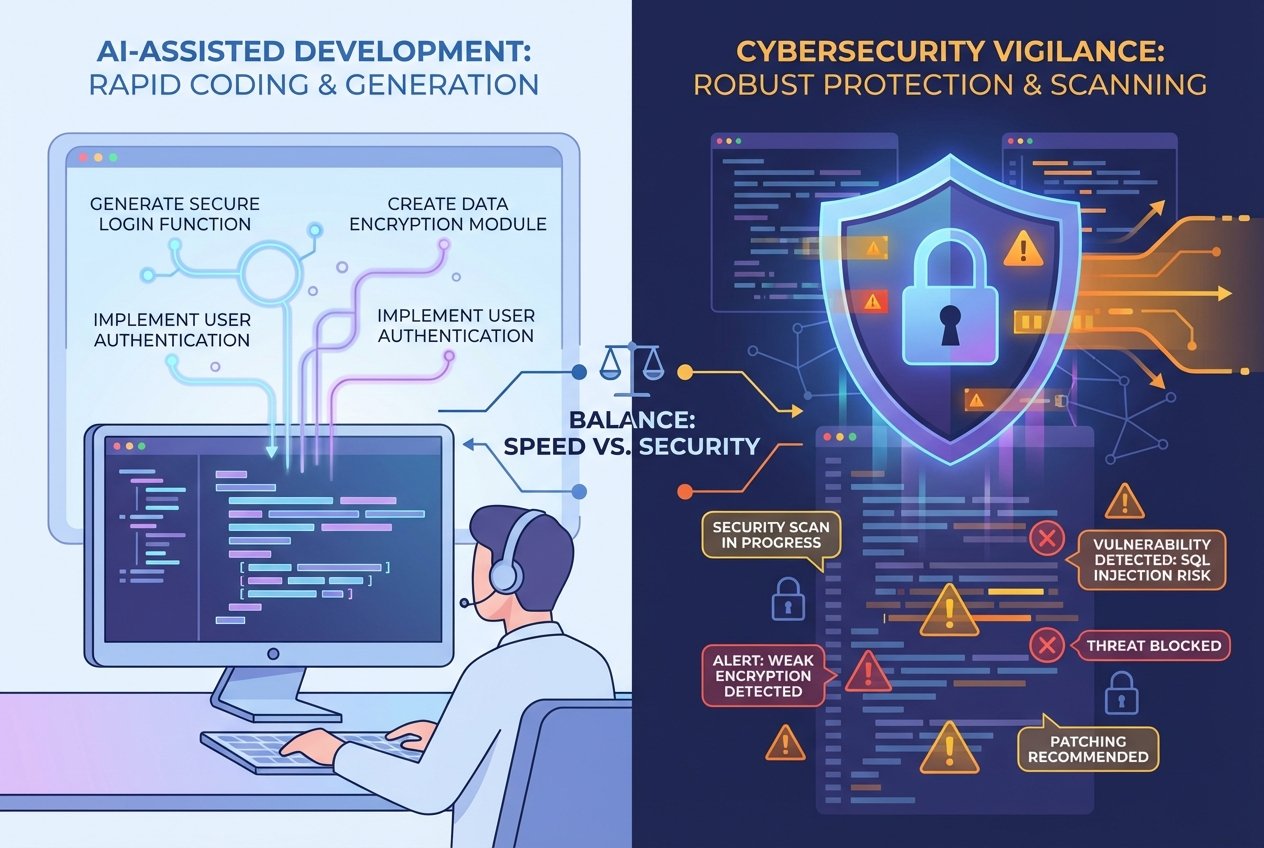
However, the speed and convenience of vibecoding can create a false sense of security. When code appears to work perfectly during testing, it is tempting to deploy it without thorough security review – a practice that has led to numerous high-profile breaches.
1. Never Trust AI-Generated Code Without Review
The most fundamental mistake vibecoding practitioners make is treating AI-generated code as production-ready. Research from Databricks demonstrates that even when code appears functional, it often contains critical vulnerabilities such as arbitrary code execution and memory corruption.
AI models are trained on vast repositories of public code – both secure and insecure. They reproduce common patterns without understanding the security implications for your specific context. A Stanford study found that developers using AI assistance actually created more security flaws whilst being more confident their code was safe.
Action point: Treat every piece of AI-generated code as untrusted input requiring the same scrutiny as a pull request from an unknown contributor.
2. Implement Security-Focused Prompts
The quality of your prompts directly impacts the security of generated code. Vague prompts like “create a login form” will produce functional but potentially insecure code. Security-conscious prompts dramatically improve outcomes.
Instead of a basic prompt, specify your security requirements explicitly. For example: “Create a Flask API that returns user data from PostgreSQL with environment variables for database credentials, parameterised queries to prevent SQL injection, role-based access control, and audit logging for all data access.”
According to USCS Institute research, organisations that provide their developers with pre-approved secure templates and prompt libraries significantly reduce vulnerability rates whilst maintaining development speed.
3. Protect Your Secrets and Credentials
One of the most common vibecoding mistakes is accidentally exposing sensitive credentials. When you paste code into AI tools, that data may be processed on external servers. Additionally, AI-generated code frequently hardcodes API keys, tokens, and database credentials directly into source files.
The risks are substantial. Test tokens can spread across Slack messages, log files, clipboard managers, bash history, and Git repositories. A security audit by AppSec Santa found that hardcoded credentials are among the most frequent vulnerabilities in vibecoded applications.
Best practices:
- Never paste real credentials into AI prompts
- Always use environment variables and secrets managers
- Enable privacy mode in tools like Cursor and Claude Code
- Review generated code for hardcoded strings before committing
4. Validate All Dependencies
When you vibecode, the AI chooses your dependencies based on patterns in its training data. This creates significant supply chain risks. Socket.dev research identified 205,000 unique hallucinated package names across 576,000 code samples – packages that do not actually exist but could be registered by attackers.
This attack vector, known as slopsquatting, has already been exploited. The huggingface-cli malicious package was downloaded over 30,000 times before detection. Nearly 20% of AI-suggested packages do not exist, creating massive attack surfaces for organisations that deploy without verification.
Action point: Run pip-audit or npm audit on every project. Verify package authenticity, check last update dates, and review download counts before installing AI-suggested dependencies.
5. Implement Proper Authentication from the Start
Authentication code is the highest-risk code in any application, yet it is frequently vibecoded without adequate review. AI-generated authentication systems commonly feature weak password hashing algorithms, missing authorisation checks, predictable session tokens, and insecure password reset flows.
Research from Vidoc Security found that 71% of AI-generated authentication code contains security flaws. The typical vibecoding session produces login forms that work perfectly in testing but fail basic security requirements.
Never vibecode these components without expert review: authentication systems, payment processing, sensitive data handling, and access control features. These should always receive additional scrutiny, whether written by humans or AI. At Kaizen AI Consulting, we help UK businesses implement secure authentication frameworks that leverage AI efficiency without compromising security.
6. Use Sandboxed Development Environments
AI coding tools like Claude Code have access to your terminal and can execute commands on your system. Recent CVEs (CVE-2025-54794 and CVE-2025-54795) demonstrated serious vulnerabilities including path traversal and command injection in these tools.
Running vibecoding tools in isolated Docker containers limits potential damage. Mount only your project directory, restrict file system access to sensitive paths, and never use flags like –dangerously-skip-permissions on your local machine.
Recommended approach: Use docker run -v $(pwd):/workspace to limit AI file system access to just your current working directory, preventing access to system files and credentials stored elsewhere.
7. Integrate Automated Security Scanning
Manual code review alone cannot catch every vulnerability in AI-generated code. Automated security tools provide an essential safety net. Static Application Security Testing (SAST) tools like Semgrep can identify insecure patterns, whilst Dynamic Application Security Testing (DAST) tools like OWASP ZAP catch vulnerabilities during runtime.
However, traditional scanning tools have limitations with vibecoded applications. Research from Tenzai found that pattern-matching tools like Semgrep achieve only 35.7% accuracy on real-world vibecoded applications – meaning roughly 64% false positives and many missed vulnerabilities.
Integrate these tools into your CI/CD pipeline:
- Semgrep or Bandit for static analysis
- pip-audit or npm audit for dependency scanning
- OWASP ZAP for dynamic testing
- GitGuardian for secrets detection
8. Document What Was AI-Generated
Maintaining visibility into which code was generated by AI versus written by humans is crucial for security auditing and incident response. When vulnerabilities are discovered, knowing the origin of code helps prioritise remediation efforts.
Over 40% of junior developers deploy AI-generated code without understanding how it works. This knowledge gap creates problems when applications fail unexpectedly or require security patches. Your vibecoded application becomes a black box once its creator leaves the team.
Implement documentation practices: Tag commits that contain AI-generated code, maintain a registry of components built with vibecoding tools, and ensure at least one team member understands each critical system component.
9. Establish Clear Governance Policies
With 87% of Fortune 500 companies now using at least one vibecoding platform, enterprise governance has become essential. According to the OWASP Agentic AI Top 10 (2026), organisations need specific frameworks addressing AI coding agent risks.
Your governance framework should define what can and cannot be vibecoded, establish mandatory review requirements for different risk levels, and ensure compliance with regulations like GDPR. For UK businesses handling personal data, Article 25 requires privacy by design in AI-generated code, whilst Article 32 mandates security of AI processing.
Developing comprehensive AI governance policies can be challenging without specialist expertise. Contact Kaizen AI Consulting to discuss how we can help your organisation establish robust vibecoding security frameworks aligned with UK regulatory requirements.
10. Invest in Security Training for Your Team
The cultural shift required for secure vibecoding cannot be underestimated. Traditional security tools catch vulnerabilities in code that developers can read and understand. Vibecoding creates a class of builders who may not be able to evaluate the security implications of what they have generated.
Training should cover secure prompting techniques, common vulnerability patterns in AI-generated code, how to use security scanning tools effectively, and when to escalate to security specialists. Organisations that invest in cybersecurity training see significantly reduced vulnerability rates in their vibecoded applications.
Key training areas:
- Recognising OWASP Top 10 vulnerabilities in generated code
- Writing security-focused prompts
- Interpreting SAST and SCA tool outputs
- Understanding when AI-generated code is inappropriate
The Future of Secure Vibecoding in the UK
Vibecoding is not going away. GlobalData predicts it will become mainstream throughout 2026, with deeper integration into traditional business applications. The organisations that thrive will be those that balance AI-driven speed with robust security practices.
The key insight from security researchers is clear: the problem with vibecoding is not AI code quality – existing security tools can handle known vulnerability patterns effectively. The problem is that security review often is not part of the conversation when code is generated through natural language prompts.
By implementing these ten protective measures, UK businesses can harness the productivity benefits of vibecoding whilst maintaining the security standards their customers and regulators expect. The 30 minutes invested in security review now will save 30 hours of incident response later.
Take Action Today
Protecting your organisation from vibecoding mistakes requires a combination of technical controls, governance frameworks, and cultural change. Whether you are just beginning to explore AI-assisted development or already have teams using tools like Claude Code, Cursor, and Lovable, now is the time to establish secure practices.
Get in touch with Kaizen AI Consulting to arrange a security assessment of your vibecoding practices. Our team of AI and security specialists can help you develop policies, implement technical safeguards, and train your team to build securely with AI – ensuring your organisation captures the benefits of this transformative technology without exposing yourself to unnecessary risk.