AI Agents for Small Business: What’s Coming in 2026 and How to Prepare
We are officially in the year of the AI agent. After years of hype, experimentation, and cautious dipping of toes into the waters of automation, 2026 has arrived as the moment when agentic AI moves from buzzword to business reality for UK small and medium-sized enterprises (SMEs). Whether you run a boutique e-commerce brand, a local accountancy practice, or a fast-growing B2B consultancy, the rise of autonomous AI tools is no longer a distant trend to monitor. It is an operational shift that is happening right now.
The question is not whether AI agents will reshape how small businesses operate. The question is whether your business will be ready when they do. This guide breaks down what AI agents actually are, what is coming in the months ahead, and the practical steps you can take today to prepare.
What Are AI Agents and Why Do They Matter for SMEs?
Before diving into 2026 predictions, it is worth being precise about what we mean by AI agents. Unlike traditional AI tools that respond to a single prompt and stop, AI agents are autonomous systems that can plan, execute, and verify multi-step tasks on your behalf. They read incoming information, decide what action to take, carry it out, and check their own work. Think of them less like a calculator and more like a highly capable digital employee who works around the clock.
For small businesses, this distinction matters enormously. An AI agent can, for example, receive a customer enquiry by email, check your CRM for their order history, draft a personalised response, update the support ticket, and escalate the issue if needed. All without any human intervention. That kind of end-to-end automation was previously the exclusive domain of enterprise companies with large IT budgets. In 2026, it is accessible to businesses of any size.
According to research compiled by Azumo, 40% of enterprise applications will be integrated with task-specific AI agents by the end of 2026, up from less than 5% in 2025. The pace of change is extraordinary.
The UK SME Landscape: Where Are We Right Now?
UK small businesses are accelerating their adoption of AI at a pace not seen before. The British Chambers of Commerce (March 2026) reports that 54% of UK firms are now actively using AI, a substantial jump from 35% in 2025 and just 23% in 2023. However, adoption remains uneven. Many businesses are still using AI in a shallow way, maintaining a ChatGPT subscription or a Copilot licence without any structured workflow or strategy behind it.
The more telling statistic comes from the UK SME AI Adoption Report 2026, which found that only 11% of SMEs use AI to a great extent to automate or streamline their operations. The gap between surface-level usage and genuine operational transformation represents both the challenge and the opportunity for forward-thinking UK businesses.
Crucially, the fear that AI will destroy jobs appears largely unfounded at SME level. Lloyds Banking Group’s March 2026 research found that half of firms which saw a profit boost from AI recorded an 11% uplift, and two thirds have already invested in AI, with most spending less than £25,000. Separately, BCC research confirms that 95% of SMEs using AI reported no impact on workforce size, and 86% said job roles remained unchanged. AI is augmenting people, not replacing them.
The Five Key AI Agent Trends Shaping 2026
1. From Single Tools to Multi-Agent Systems
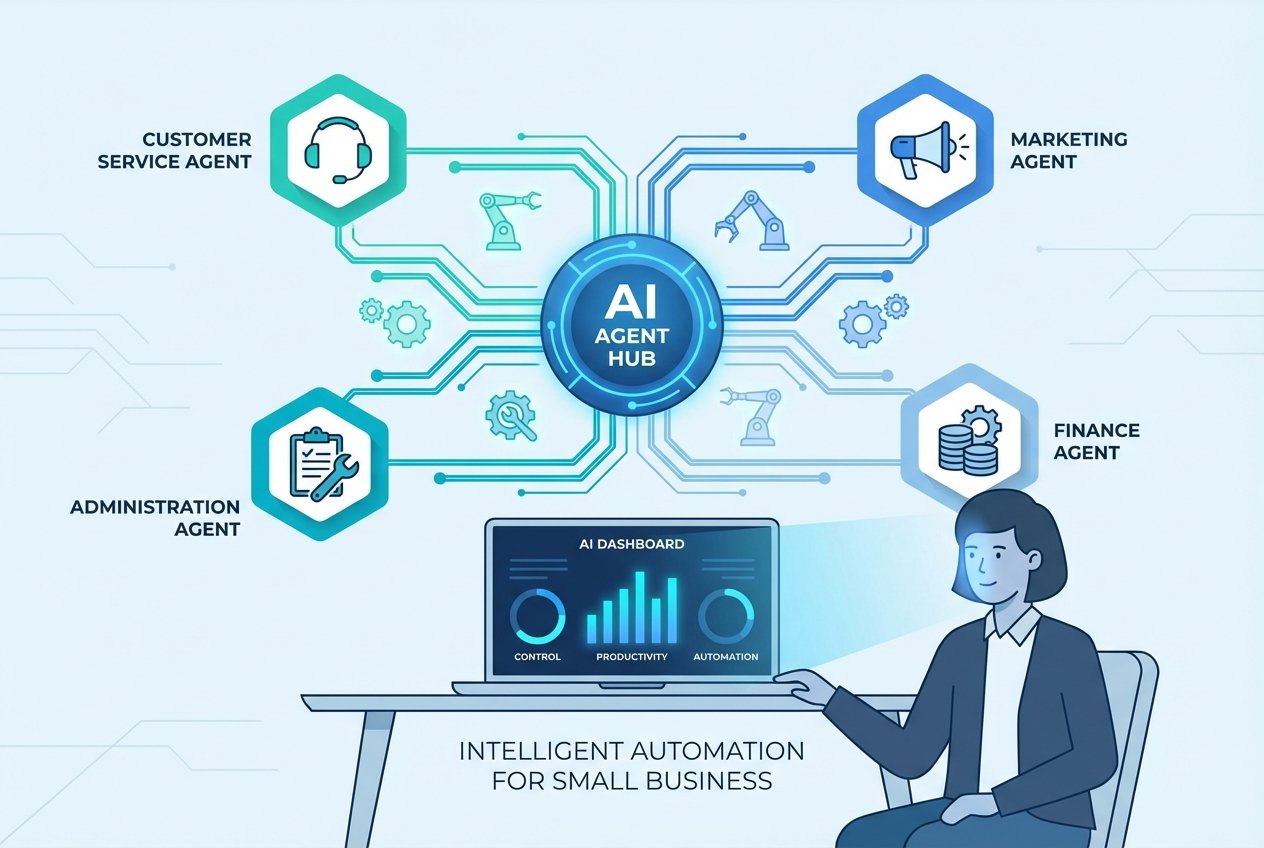
One of the most significant shifts identified in Salesforce’s 2026 AI predictions is the end of the isolated AI tool. In 2026, single AI agents are giving way to coordinated fleets of specialist agents that communicate with each other, divide tasks between them, and deliver outcomes that no single tool could manage alone. One agent handles customer communication, another manages your inventory data, a third updates your finance platform. Together, they function like an autonomous back office.
For UK SMEs, this means the real competitive advantage in the near future will not come from adopting one AI product. It will come from building or deploying a cohesive agentic AI strategy where multiple tools work in concert.
2. The Agent-as-a-Service Economy
As Goldman Sachs noted in January 2026, AI models are becoming the new operating system, with an emerging economy of specialist agents available on a subscription basis. Rather than building bespoke software, SMEs will increasingly be able to subscribe to pre-built agents tailored to their sector. Hospitality businesses can deploy reservation agents. Professional services firms can deploy compliance monitoring agents. Retail businesses can deploy customer loyalty agents. The barrier to entry is dropping fast.
3. Smarter, Domain-Tuned Models
The age of the all-purpose, one-size-fits-all AI is being complemented by a new generation of smaller, domain-specific models that are cheaper to run, faster to deploy, and more accurate for specialist work. For UK SMEs, this is particularly relevant in areas such as legal compliance, accountancy, and healthcare, where precision matters more than breadth. These models can handle tasks like HMRC-aligned bookkeeping, industry-specific customer queries, and regulatory reporting with greater consistency than generic tools.
4. Autonomous AI Workflows Entering the Mainstream
The shift from human-triggered AI to genuinely autonomous workflows is the defining characteristic of agentic AI in 2026. North Door’s UK SME IT Trends 2026 report highlights that the defining trend is now agentic AI that does not just chat, but executes. These agents manage supply chain logistics, process invoices, respond to customer reviews, and monitor competitor pricing, all without waiting for a human to press a button.
5. Productivity Gains Are Real and Measurable
The return on investment from AI agent adoption is becoming increasingly clear. Research by the University of St Andrews and the Department for Business and Trade shows that AI implementation can deliver SME productivity gains ranging from 27% to 133%, depending on the use case and depth of integration. Meanwhile, McKinsey estimates that AI agents could add between $2.6 trillion and $4.4 trillion in value annually across business use cases globally. The opportunity is real, and for UK SMEs that act now, so is the competitive advantage.
Where AI Agents Are Making the Biggest Impact for Small Businesses
Based on the latest UK adoption data, the most impactful AI agent use cases for SMEs in 2026 fall into five clear categories:
- Customer Service: AI agents handling 24/7 enquiries, routing high-value customer emails for human follow-up, and automatically resolving routine queries. 36% of UK SMEs are now using AI for customer service on a weekly basis.
- Marketing Automation: Nearly two in five SME owners use AI weekly for content creation, social media scheduling, and campaign management. Tools like HubSpot Breeze and Canva AI are making professional-grade marketing accessible to lean teams.
- Sales and CRM: Autonomous agents scoring leads, updating pipelines, and sending personalised follow-up communications without any manual input from your sales team.
- Finance and Administration: Automated invoicing, expense processing, and compliance monitoring aligned to UK tax requirements including Making Tax Digital obligations.
- Operations: Agents managing supplier communications, monitoring stock levels, and flagging anomalies in business performance data in real time.
At Kaizen AI Consulting, we work with UK small businesses to identify which of these use cases will deliver the fastest and most meaningful return for their specific operations, designing agentic AI strategies that fit around existing workflows rather than disrupting them unnecessarily.
How to Prepare Your Small Business for the AI Agent Revolution
Step 1: Audit and Clean Your Data
AI agents are only as good as the data they have access to. Fragmented, inconsistent, or outdated data is the number one reason AI implementations fail to deliver results. Before you invest in any agentic AI tool, spend time consolidating your customer records, operational data, and financial information into clean, connected systems. This foundational step determines everything that follows.
Step 2: Map Your High-Volume, Repetitive Processes
The best candidates for AI agent automation are tasks that are high volume, rule-based, and time-consuming. Write down every process in your business that happens repeatedly and follow a predictable pattern. Answering common customer questions, processing orders, scheduling appointments, sending follow-up emails. These are your immediate AI agent opportunities. Start there.
Step 3: Start Narrow, Then Scale
The businesses seeing the best results from agentic AI in 2026 are not the ones that tried to automate everything at once. They are the ones that chose one specific, high-impact process, deployed an agent to handle it, measured the outcome, and then expanded from a position of proven success. A structured three-month programme, focusing on one use case per month, is a proven approach that delivers ROI without overwhelming your team.
Step 4: Build Governance and Human Oversight Into Every Workflow
Autonomous AI tools require guardrails. Every agentic workflow you deploy should include a mechanism for human review of decisions, a process for staff to override or challenge AI outputs, and continuous monitoring to catch errors before they become problems. GDPR compliance and data protection obligations apply to automated decision-making in the UK, so governance is not optional. It is essential.
Step 5: Invest in Skills Alongside Technology
According to Employment Hero’s 2026 research, 67% of UK businesses report that internal resistance and a lack of practical implementation skills are actively stalling AI projects. Technology alone is never the answer. Your team needs to understand how to work alongside AI agents, interpret their outputs, and know when to intervene. Investing in targeted AI literacy training is one of the highest-return activities a small business owner can undertake in 2026.
The Cost of Waiting
There is a significant economic argument for acting sooner rather than later. Research cited by Harri Digital estimates a 78 billion pound opportunity gap that UK SMEs are currently failing to capture through under-adoption of AI. Meanwhile, the businesses that are embracing agentic AI tools now are compounding their advantage every month. They are serving customers faster, reducing operational costs, and freeing their people to focus on higher-value, genuinely human work.
The global AI agent market is forecast to grow from $7.63 billion in 2025 to $182.97 billion by 2033, at a compound annual growth rate of nearly 50%. The infrastructure, the tools, and the expertise are available today, at prices UK SMEs can realistically afford, starting from as little as £69 per month for entry-level AI automation.
Ready to Take the Next Step?
Understanding the landscape is one thing. Translating that understanding into a practical, business-specific AI agent strategy is another. The team at Kaizen AI Consulting specialises in helping UK small businesses do exactly that. From conducting AI readiness assessments to designing and implementing bespoke agentic AI workflows, we bring the expertise and hands-on support that turns AI potential into measurable business outcomes.
If you are ready to move beyond experimentation and build an AI strategy that genuinely transforms your operations, get in touch with the Kaizen AI Consulting team today. Whether you are taking your first steps with autonomous AI tools or looking to scale an existing AI programme, we would love to help you find your next competitive advantage.
Contact Kaizen AI Consulting and book your free AI strategy consultation.