The way businesses connect their AI tools to everyday applications is undergoing a fundamental shift. Thanks to the Model Context Protocol (MCP), AI assistants like Anthropic’s Claude are no longer isolated chatbots locked inside a single window. Instead, they can reach directly into your CRM, your project management software, your communication platforms, and your databases, acting on real-time data and executing tasks on your behalf. For UK businesses looking to move beyond basic AI experimentation and into genuine AI integration, understanding MCP servers is now essential.
What Is the Model Context Protocol (MCP)?
Launched by Anthropic in November 2024, the Model Context Protocol is an open-source standard that acts as a universal connector between AI language models and external tools, data sources, and applications. It has been widely described as the "USB-C for AI": a single, standardised plug that allows any compatible AI model to communicate with any compatible tool, regardless of who built either system.
Before MCP, connecting an AI assistant to a business application required bespoke API integrations, custom middleware, and significant developer time. Every new connection meant a new project. MCP solves this by defining a common language that AI models and software tools can both speak fluently, dramatically reducing the technical overhead of business app automation.
The protocol operates across three layers:
- Hosts: The AI application itself (such as Claude Desktop or a custom AI agent).
- Clients: The connectors within the host that speak the MCP language.
- Servers: Lightweight programmes that expose specific tools, data, or resources to the AI.
According to the official MCP specification, the protocol uses JSON-RPC 2.0 over stateful connections, enabling AI models to access resources, execute functions, and support complex agentic workflows in a secure and auditable way.
Why MCP Servers Matter for UK Businesses in 2026
The growth of the MCP ecosystem has been nothing short of extraordinary. According to research published by Digital Applied in April 2026, the public MCP server registry expanded 7.8 times year-over-year, growing from 1,200 servers in Q1 2025 to over 9,400 by April 2026. Over 7,800 GitHub repositories now tag the term "mcp-server," and Qualys reported in March 2026 that more than 10,000 active public MCP servers were in operation within just one year of the protocol’s launch.
Major technology companies including Google, OpenAI, Atlassian, Figma, and Salesforce have all built first-party MCP servers, while London Stock Exchange Group (LSEG) announced in May 2026 that it would make its trusted financial data and analytics available via MCP connectivity, underscoring the protocol’s growing relevance in the UK financial services sector.
For UK SMEs and growing businesses, the opportunity is clear: MCP servers remove the technical barriers that previously made deep AI integration the preserve of large enterprises with dedicated IT departments. Now, a marketing agency in Manchester, a fintech startup in London, or a professional services firm in Edinburgh can connect Claude to their existing business tools in a matter of minutes.
How MCP Servers Work in Practice
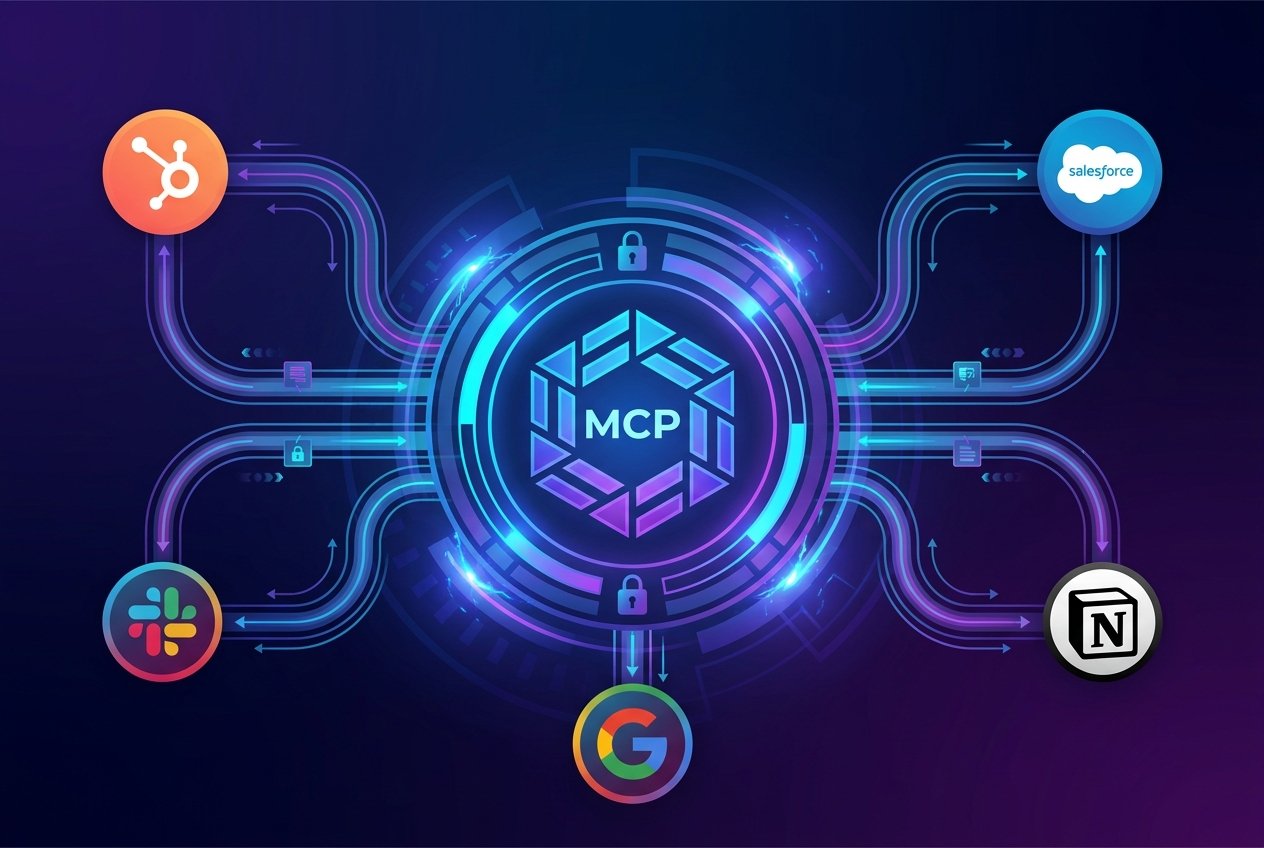
Think of an MCP server as a secure intermediary. It sits between your AI model and your business application, translating requests from the AI into actions your software can understand, and returning results the AI can then reason about and act upon. The AI never stores your data itself; it simply queries through the server in real time, respecting your existing access controls and permissions.
Here is a simplified view of how a typical MCP interaction works:
- You ask Claude: "Summarise all open deals in my CRM that are due to close this month."
- Claude sends a structured request to the HubSpot MCP server.
- The MCP server queries HubSpot using your authenticated credentials.
- The results are returned to Claude, which synthesises a clear, actionable summary for you.
The entire exchange is governed by the permissions you have set up. The AI can only access what you have explicitly allowed, making it compatible with GDPR requirements and UK data protection obligations under the Information Commissioner’s Office (ICO) framework.
Connecting Your Business Apps with Claude MCP
One of the most powerful aspects of the current MCP landscape is the breadth of tools that already have compatible servers. For UK businesses, this covers the most common productivity and sales platforms in active use today.
CRM and Sales: HubSpot and Salesforce
Both HubSpot and Salesforce offer MCP servers that allow Claude MCP to query your pipeline, summarise customer interactions, flag at-risk accounts, and even draft follow-up emails, all using natural language commands. According to MCP Bundles (updated April 2026), sales teams using these integrations are completing reporting tasks 30 to 50 per cent faster, with no manual data exports required.
Productivity and Collaboration: Slack, Notion, and Google Workspace
For remote and hybrid UK teams, MCP servers for Slack, Notion, and Google Workspace are transforming how knowledge is captured and shared. Claude can search Slack threads, extract key decisions, generate Notion documentation from them, and even create or update shared Google Docs in one continuous workflow. This kind of cross-tool automation was previously only possible with expensive workflow tools or custom development.
Marketing and Analytics
Digital marketers and agencies can connect Claude to Ahrefs, Google Ads, and analytics platforms via MCP. SegmentStream’s 2026 guide to MCP servers for marketers outlines how AI can now pull campaign performance data, identify budget inefficiencies, generate SEO content briefs, and produce client reports, all without leaving a single interface.
E-commerce and Operations
For UK online retailers, Shopify’s MCP integration allows Claude to query order statuses, identify fulfilment issues, and cross-reference customer data with your CRM, surfacing actionable insights that would otherwise require hours of manual analysis.
Setting Up Your First MCP Server: A Practical Guide
Getting started with MCP does not require a team of developers. Here is a practical approach for UK businesses exploring business app automation through MCP:
- Choose your AI host: Claude Desktop is the most accessible starting point for Claude MCP integrations, though enterprise deployments can use Claude via Anthropic’s API.
- Select a multi-tool MCP gateway: Services like Composio provide a single MCP endpoint connecting over 250 business applications, authenticated once via OAuth. This avoids managing multiple individual server configurations.
- Connect your tools: Within your chosen gateway, authorise the applications you want your AI to access. This typically takes five to fifteen minutes per application and uses your existing login credentials.
- Add the MCP endpoint to Claude: In Claude Desktop’s settings, navigate to MCP Servers and add your endpoint URL and authentication token.
- Test with simple queries: Start with read-only queries such as "Show me my five most recent HubSpot contacts" before progressing to more complex, multi-step automations.
- Review permissions and audit logs: MCP’s architecture supports detailed audit logging. Regularly review what actions your AI is taking to maintain governance and compliance with ICO guidelines.
If you are unsure where to begin or want to ensure your setup aligns with your business’s specific data governance requirements, the team at Kaizen AI Consulting works with UK businesses to design and implement MCP architectures that are both powerful and compliant. Whether you are connecting your first MCP server or building a multi-agent automation ecosystem, having expert guidance from the outset can save significant time and prevent costly configuration errors.
Security, Governance, and GDPR Considerations
Security is a legitimate concern for any UK business considering MCP servers. Qualys flagged in March 2026 that the rapid adoption of MCP has introduced a new category of "Shadow IT" risk, where employees deploy unapproved MCP connections outside of their IT department’s awareness. For businesses operating under GDPR, this presents real compliance exposure.
Mitigating this risk requires a governance-first approach to MCP deployment:
- Centralise your MCP configuration: Use a managed gateway rather than allowing individual employees to set up their own server connections.
- Apply the principle of least privilege: Ensure your MCP servers only expose the data and actions strictly necessary for the intended use case.
- Enable audit logging: MCP’s architecture supports comprehensive activity logging. These logs are essential for demonstrating compliance in the event of an ICO investigation.
- Review third-party MCP servers carefully: Not all publicly available MCP servers carry the same security standards. Prefer first-party servers published by the software vendor themselves.
The State of MCP in Financial Services 2026 report by Stacklok found that UK financial services firms strongly prefer on-premises or private cloud MCP hosting, reflecting the sector’s heightened data sensitivity. This approach is increasingly viable as the MCP ecosystem matures and enterprise-grade hosting options expand.
What to Expect from MCP in 2026 and Beyond
The official MCP roadmap outlines several significant developments on the horizon, including MCP Server Cards (a standardised way for tools to publish their capabilities), enhanced enterprise authentication, improved observability tooling, and stateless transport options designed for large-scale deployments. With projections suggesting the server registry could reach 25,000 to 38,000 entries by April 2027, the protocol is clearly evolving from an experimental standard into core business infrastructure.
For UK businesses, the window to gain a competitive advantage through early MCP adoption is open right now. Those who build well-governed, deeply integrated AI workflows today will have a meaningful head start over competitors who wait for the technology to become mainstream.
How Kaizen AI Consulting Can Help
Implementing MCP servers effectively requires more than following a setup guide. It demands a clear understanding of your business processes, your data landscape, your compliance obligations, and the specific outcomes you want AI to drive. At Kaizen AI Consulting, we specialise in helping UK businesses cut through the complexity of AI integration and build practical, scalable automation solutions grounded in real business value.
From initial discovery and MCP architecture design through to implementation, testing, and staff training, our team brings hands-on expertise in Claude MCP, business app automation, and AI governance to every engagement. If you are ready to explore what MCP servers could unlock for your business, we would love to hear from you.
Get in touch with the Kaizen AI Consulting team today to discuss how MCP servers can connect your AI tools to the business apps that matter most. Contact us here and let us help you build an AI integration strategy that delivers results.