Imagine onboarding a new team member and handing them a perfectly structured training manual, tailored to their role, written in plain English, and ready the same afternoon they accept their offer. Or picture your most experienced member of staff walking out the door, and discovering that every process they manage has already been captured, documented, and turned into a step-by-step standard operating procedure. That is the reality AI is making possible for UK businesses right now.
In 2026, AI SOP creation and training manual AI tools have matured from novelty to necessity. Whether you are scaling a growing SME, managing a distributed workforce, or simply trying to reduce the operational chaos that comes with rapid growth, AI-powered documentation is one of the highest-leverage investments your business can make this year.
Why Standard Operating Procedures Still Matter More Than Ever
Standard operating procedures have long been the backbone of well-run organisations. They ensure consistency, reduce errors, protect against key-person dependency, and form the foundation of effective employee onboarding. Yet for most small and medium-sized businesses in the UK, SOPs are either non-existent, outdated, or buried in a folder nobody can find.
The data tells a compelling story. According to BuildEmpire’s 2026 Onboarding Statistics, 36% of employers lack a structured onboarding process, contributing directly to higher staff turnover, lower morale, and reduced productivity. Meanwhile, StrongDM research found that a strong onboarding process can improve new hire retention by 82% and productivity by over 70%. The gap between those who document their processes well and those who do not is enormous, and it is growing.
The challenge, historically, has been time. Writing a single SOP manually can take hours. Creating a full library of training materials for a new department can take weeks. That is precisely where AI documentation tools are transforming the equation.
What AI SOP Creation Actually Looks Like in Practice
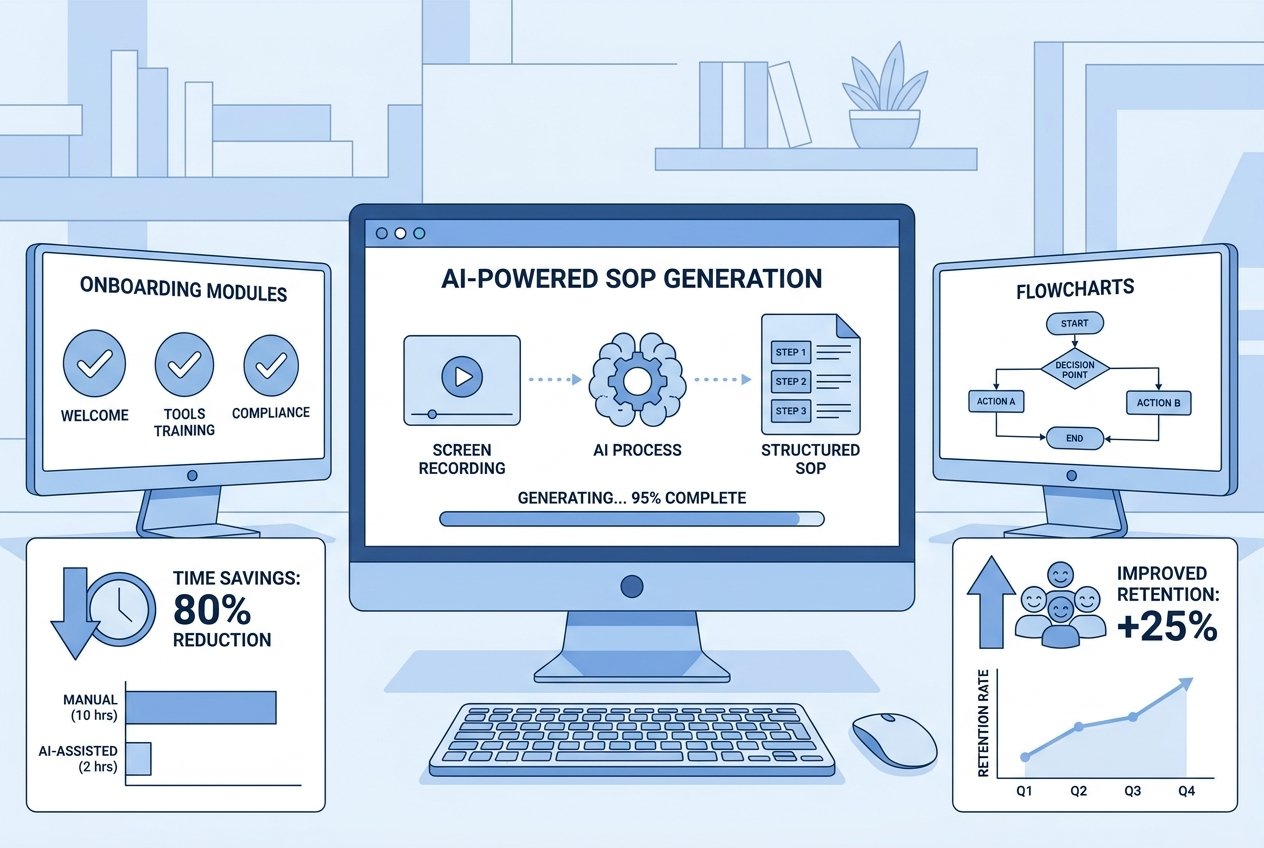
The term "AI SOP creation" covers a broad range of capabilities. In 2026, the most effective tools allow businesses to generate first-draft standard operating procedures using several different inputs:
- Screen recordings: Tools such as Scribe, Tango, and StepCapture can watch you perform a process and automatically generate a step-by-step guide with annotated screenshots.
- Video walkthroughs: Platforms like Knowby use video intelligence to convert a recorded walkthrough into a structured procedure guide within minutes.
- Written prompts: ChatGPT and similar large language models can draft a complete SOP from a detailed description of the process, including purpose, scope, decision points, and escalation paths.
- Existing documents: AI can ingest your old policies, PDFs, and process notes and reformat them into consistent, well-structured SOPs.
According to Whale’s 2026 guide to AI SOP tools, the leading platforms for SOP creation and management this year include Whale, Scribe, Tango, Process Street, ClickUp, Trainual, and Document360, each offering varying degrees of AI-assisted drafting, version control, and team delivery.
The productivity gains are significant. Iternal AI reports that businesses using AI documentation tools are experiencing 50% faster SOP creation and a 40% reduction in overall documentation time. For a business maintaining dozens or hundreds of procedures, that represents tens of hours reclaimed every month.
Building AI-Powered Training Manuals for Your Team
Beyond individual SOPs, AI is revolutionising how businesses create training manuals for new and existing employees. The traditional approach, a static Word document or a bloated PDF, is giving way to something far more dynamic and effective.
Training manual AI tools in 2026 can help you:
- Structure content by role: Rather than one generic manual, AI can help you create personalised learning paths based on job function, department, or skill level.
- Convert SOPs into interactive modules: Platforms like Disco allow businesses to transform policies and standard operating procedures into engaging training modules, complete with quizzes, assessments, and completion tracking.
- Generate scenarios and examples: AI can produce realistic worked examples, common mistakes to avoid, and decision-making scenarios that bring training materials to life.
- Auto-update documentation: When a process changes, AI tools can detect the update and refresh the relevant sections of your training manual automatically, ensuring your team always works from the most current version.
This last point is particularly valuable for UK businesses operating in regulated sectors. Whether you are managing FCA compliance in financial services, CQC standards in health and social care, or HSE requirements in manufacturing, keeping your documentation current is not optional. AI makes that process significantly more manageable.
At Kaizen AI Consulting, we work with UK businesses to design and implement AI-powered documentation systems that go beyond simply generating text. We help you build a documentation infrastructure that integrates with your existing tools, aligns with your brand and compliance requirements, and genuinely serves the people using it every day.
Employee Onboarding Automation: The Broader Picture
SOP creation and training manual development sit within a broader opportunity: full employee onboarding automation. The statistics here are striking. According to 2026 onboarding research from ElectroIQ, automating onboarding tasks can improve new hire retention by 16% and new hire performance by 18%. Businesses using templates and automated processes for onboarding can cut installation time by 49% and reduce onboarding-related admin tasks by as much as 58%.
Yet adoption remains surprisingly low. Phenom’s 2026 onboarding trends report found that 53% of employees say AI was not used in their onboarding process at all, and 60% received no AI-related training during their induction. This represents a significant competitive advantage for businesses that move now.
A well-designed employee onboarding automation system, built around clear SOPs and AI-generated training materials, can compress the time it takes for a new starter to become productive by weeks. It also creates a consistent, professional first impression that directly impacts long-term retention.
A Step-by-Step Framework for Getting Started
If you are ready to begin using AI for SOP creation and training documentation, here is a practical framework to follow:
- Audit your existing documentation: Before generating anything new, take stock of what you already have. Identify which processes are undocumented, which have outdated materials, and which are critical priorities.
- Choose the right tools for your context: A small team might start with a general-purpose AI like ChatGPT combined with a screen-capture tool. A growing business will benefit from a dedicated platform like Trainual or Process Street that handles version control, assignment, and tracking.
- Record before you write: For operational SOPs, the fastest approach is often to record yourself or a team member performing the process, then use AI to convert the recording or transcript into a structured document.
- Use a consistent structure: Every SOP should include a purpose, scope, roles and responsibilities, step-by-step procedure, decision points, exceptions and escalations, and a version history. AI can draft all of these sections; your job is to review and validate them.
- Involve subject matter experts: Always have the relevant team member or department head review AI-generated content before it is published. AI drafts quickly; humans ensure accuracy.
- Test with real users: Before rolling out a training manual to your whole team, test it with one or two people who are unfamiliar with the process. Note where they hesitate or ask questions. Revise accordingly.
- Store centrally and control versions: Publish your SOPs and training materials in a single, searchable repository with clear version numbers, review dates, and ownership. Platforms like SharePoint, Confluence, or dedicated SOP tools all work well for this.
- Set a review cycle: AI makes it easier to keep documentation current, but only if you build review cycles into your workflow. Quarterly reviews for high-activity processes and annual reviews for stable ones are a sensible starting point.
UK Compliance Considerations for AI-Generated Documentation
For UK businesses, there are several important considerations when using AI to create documentation that governs employee behaviour or operational processes.
UK GDPR and the Data Protection Act 2018: If you feed personal data into AI tools to generate documentation, you need to ensure those tools are compliant with UK data protection law. Use anonymised examples where possible, confirm where your data is being processed, and consider whether a Data Protection Impact Assessment (DPIA) is required.
Employment law alignment: AI-generated employee manuals must align with UK employment law, including your obligations around equality, flexible working, disciplinary procedures, and statutory rights. Be careful that automatically generated wording does not inadvertently create contractual obligations you did not intend.
Health and safety: Any SOP covering operational, manufacturing, construction, or field-based processes must be reviewed against Health and Safety at Work Act 1974 requirements and relevant HSE guidance. AI should support your safety documentation process, not replace qualified human review.
Sector-specific regulation: Depending on your industry, your documentation may need to meet FCA, CQC, Ofsted, or other regulatory standards. Build compliance review into your SOP approval workflow from the outset.
Our team at Kaizen AI Consulting regularly helps businesses navigate these considerations, ensuring that the speed and efficiency of AI documentation tools are matched by the rigour and compliance that UK operations demand.
Common Pitfalls to Avoid
The most common mistakes businesses make when adopting AI SOP creation tools include:
- Publishing without human review: AI generates drafts, not finished documents. Every procedure must be validated by someone with direct knowledge of the process.
- Using generic language: Generic output like "ensure all tasks are completed correctly" is not actionable. Push your AI tools to use specific actions, thresholds, and system names.
- Ignoring internal terminology: Your business has its own language. Provide AI tools with your specific tool names, form fields, and process terms to avoid confusing generic output.
- Creating documents nobody uses: An SOP library that nobody can find or that was never tested with real users is no better than no documentation at all. Invest as much in rollout and adoption as you do in creation.
- Neglecting version control: Outdated SOPs are a genuine operational and legal risk. Always display the current version number, last review date, and document owner prominently.
The Competitive Advantage of Documenting Your Business Well
There is a broader strategic point here that goes beyond efficiency. Businesses that document their processes well are more scalable, more saleable, and more resilient. They can bring new staff up to speed faster, respond to growth without chaos, and maintain quality standards even when key people are absent.
AI has removed the primary barrier to good documentation, which was always time. The tools available in 2026 make it faster and more affordable than ever to build a professional, comprehensive library of SOPs and training materials. The businesses that take advantage of this now will be significantly better positioned for whatever comes next.
If you are ready to explore how AI can transform your business documentation, from standard operating procedures to full onboarding programmes, we would love to hear from you. Get in touch with the Kaizen AI Consulting team today for a no-obligation conversation about what is possible for your business.