Your website receives hundreds, perhaps thousands, of visitors every month. But here is the uncomfortable truth: every single one of them arrives with different intentions, different knowledge levels, and different needs. A first-time visitor stumbling across your site via a Google search is not the same as a returning customer who already trusts your brand. So why are you showing them exactly the same content?
This is the central challenge that AI website personalisation is solving for forward-thinking UK businesses in 2026. By using artificial intelligence to dynamically adjust what each visitor sees, businesses are transforming static, one-size-fits-all websites into intelligent, responsive experiences that guide each individual towards the outcome they are looking for and the outcome you want for them.
What Is AI Website Personalisation?
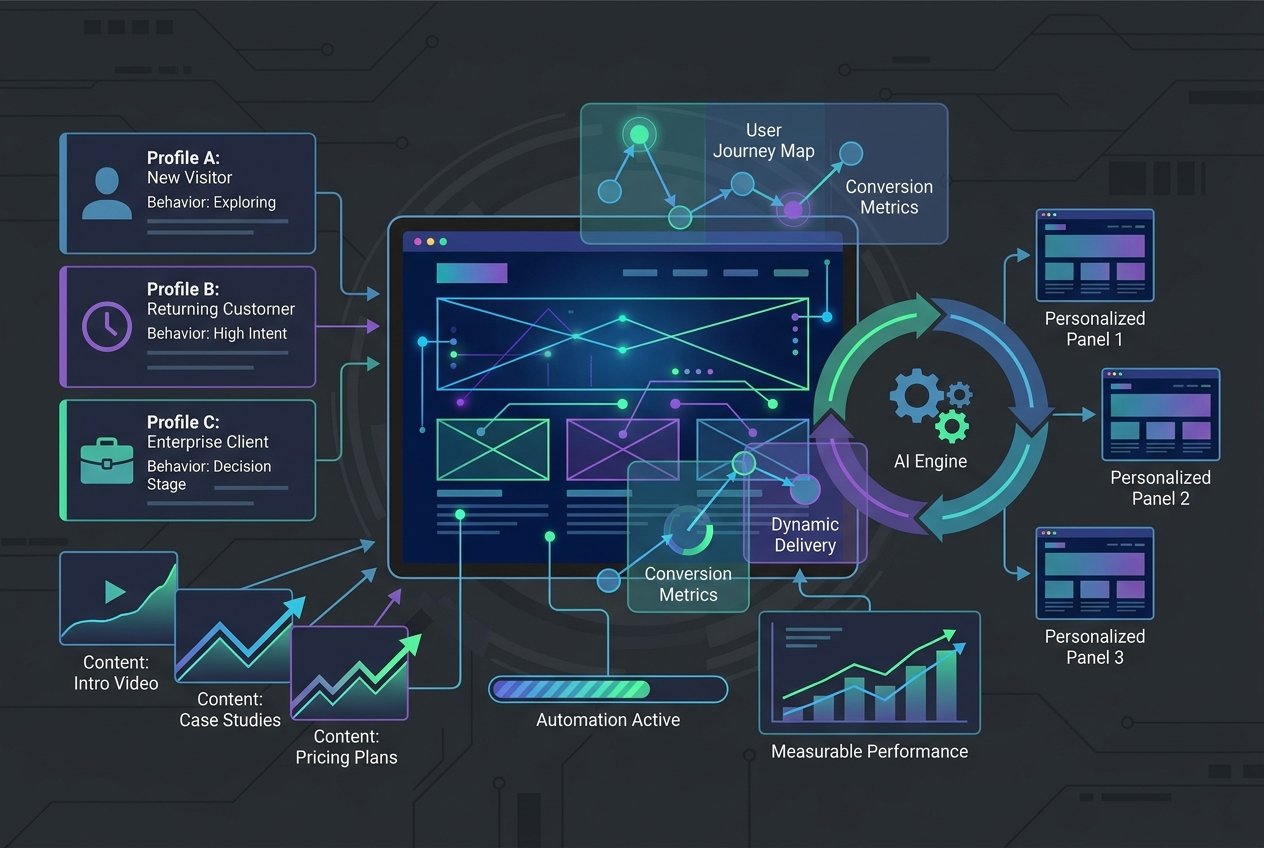
AI website personalisation is the process of using machine learning algorithms and real-time data to automatically adapt the content, layout, offers, and messaging that each visitor encounters on your website. Rather than every user seeing the same homepage, the same hero banner, or the same calls-to-action, an AI-powered system analyses a range of signals, including browsing behaviour, referral source, location, device type, time of day, and previous interactions, to serve content that is uniquely relevant to that individual.
This is not simply swapping out a first name in an email subject line. True AI website personalisation means dynamically surfacing the right product recommendations, the right case studies, the right offers, and even the right tone of messaging for each visitor in real time. It is the difference between a shop assistant who ignores every customer and one who greets each person, understands their needs, and guides them directly to what they are looking for.
Why Static Websites Are Losing Ground in 2026
Consumer expectations have shifted dramatically. UK shoppers and B2B buyers alike now expect experiences that feel relevant and tailored to them. According to Emarsys (2026), 79% of marketers are already using AI to personalise content and campaigns. Meanwhile, research from SQ Magazine (2026) reveals that 86% of brands report AI has significantly improved their personalisation capabilities, with AI-powered recommendation engines driving 31% of e-commerce revenue.
The data on visitor behaviour is equally compelling. Businesses using AI-personalised landing pages have reported a 33% decrease in bounce rate, while companies that have integrated predictive AI into their marketing funnels are seeing conversion rates rise by 20 to 30%, according to Sopro (2026). Furthermore, the Website Personalisation AI Market Report (2026) values the global market for AI website personalisation at USD 3.26 billion in 2026, projected to reach USD 8.37 billion by 2030, reflecting a compound annual growth rate of 26.6%.
For UK businesses, the message is clear: a static, non-personalised website is no longer competitive. Visitors expect relevance, and businesses that fail to deliver it are handing conversions to competitors who do.
How AI Visitor Targeting Works in Practice
Modern visitor targeting AI works by collecting and processing multiple data points simultaneously. Here is how a typical AI personalisation engine operates on a UK business website:
1. Data Collection and Signal Processing
The moment a visitor lands on your site, the AI system begins gathering signals. These include the referral source (did they come from a Google search, a LinkedIn advert, or a direct email campaign?), the device they are using, their geographic location, the time and day of their visit, and any previous interactions with your brand. For returning visitors, browsing history, past purchases, and content engagement patterns are also factored in.
2. Audience Segmentation Beyond Demographics
Traditional website targeting relied on broad demographic segments such as age, gender, or region. AI-powered segmentation goes far deeper. According to SQ Magazine (2026), 74% of marketers now use AI algorithms to segment audiences based on behavioural signals including purchase intent, product affinity, session depth, and cart state. This enables a level of granularity that was simply not possible with manual segmentation.
3. Dynamic Content Delivery
Based on the segment and signals identified, the AI system serves dynamic content in real time. This can include personalised hero banners and headlines, recommended products or services based on browsing behaviour, tailored case studies or testimonials relevant to the visitor’s industry, location-specific offers or messaging, and adjusted calls-to-action based on where the visitor sits in the buying journey.
4. Continuous Learning and Optimisation
Unlike a static A/B test that runs for a defined period, AI personalisation systems learn continuously. Every interaction provides new data that refines the model further, meaning the system becomes progressively more accurate and effective over time. This self-improving loop is one of the key reasons why businesses that invest in AI personalisation tend to see compounding returns.
The Impact on Conversion Optimisation
Conversion optimisation is where AI website personalisation delivers its most measurable returns. When a visitor lands on a page that feels immediately relevant to their needs, they are significantly more likely to engage, explore further, and ultimately convert. Real-time product suggestions informed by browsing behaviour have been shown to produce a 29% higher conversion rate, and AI-enabled dynamic pricing and offers have contributed to a 12% lift in sales for e-commerce businesses, according to SQ Magazine (2026).
For B2B organisations, the impact extends beyond immediate conversions. A personalised web experience that serves the right thought leadership content, the right product comparisons, and the right social proof to a decision-maker researching a purchase can dramatically shorten the sales cycle. Research from Whitehat SEO (2026) highlights that AI-driven personalisation is delivering 41% revenue increases and 48% faster deal velocity in B2B marketing contexts, further underlining the commercial case for investment in this technology.
At Kaizen AI Consulting, we work with UK businesses to identify the right personalisation strategy for their specific website, audience, and commercial goals. Whether you are running an e-commerce store, a professional services firm, or a SaaS platform, the principles of AI-driven visitor targeting apply and the results are measurable.
Practical Applications for UK Businesses
AI website personalisation is not the exclusive domain of large enterprises with vast technology budgets. In 2026, accessible tools and platforms have brought these capabilities within reach of UK SMEs. Here are the most impactful applications to consider:
Personalised Homepage Experiences
Your homepage is often the first impression a visitor has of your brand. AI personalisation allows you to adjust the headline, hero image, featured content, and primary call-to-action based on who is visiting. A prospective enterprise client arriving via a LinkedIn campaign should not see the same homepage as a consumer who found you through a product-specific Google search.
Intelligent Product and Content Recommendations
For e-commerce businesses, AI-powered recommendation engines are among the highest-ROI investments available. By analysing browsing and purchase history, these systems surface the products most likely to be relevant to each individual visitor. For content-driven businesses, the same logic applies to blog posts, whitepapers, case studies, and service pages.
Geo-Targeted and Location-Specific Content
For UK businesses with regional presence or location-specific offerings, AI personalisation can serve content relevant to a visitor’s location. A visitor from Manchester might see different featured case studies, local office contact details, or region-specific offers compared to a visitor from London or Edinburgh.
Behaviour-Triggered Messaging
AI systems can identify specific behavioural patterns that indicate purchase intent or the risk of abandonment. A visitor who has viewed your pricing page three times but has not yet made contact can be shown a targeted message, an offer, or an invitation to speak with a consultant, precisely the kind of high-intent moment that a static website simply cannot respond to.
Returning Visitor Recognition
Recognising and rewarding returning visitors is one of the simplest and most effective forms of AI personalisation. A returning customer should be welcomed back, shown their previous interactions, and presented with content that reflects their known preferences, rather than being treated as a complete stranger every time they visit.
Addressing the Privacy and Trust Balance
Any discussion of AI website personalisation in a UK context must acknowledge the importance of data privacy and compliance. The UK GDPR and the Data Protection Act 2018 place clear obligations on businesses collecting and processing personal data. Effective AI personalisation can and must be delivered within these legal frameworks.
The good news is that much of the most powerful AI personalisation does not rely on personally identifiable information at all. Behavioural signals, session data, and contextual information such as referral source and device type can drive highly effective personalisation without any need for personal data, provided your consent and data handling frameworks are correctly configured.
Transparency with users about how their data is used, combined with clear and accessible opt-out mechanisms, is also good practice that tends to build rather than erode trust. Research from Mintel (2026) indicates that 45% of UK consumers find products with AI features more appealing, but trust remains a consideration, making transparency and compliance non-negotiable elements of any personalisation strategy.
Getting Started with AI Website Personalisation
For businesses considering their first steps into AI-driven personalisation, the process does not need to be overwhelming. A structured approach typically follows these stages:
Audit Your Current Visitor Data
Before deploying any personalisation technology, it is essential to understand who your visitors currently are, where they come from, what they do on your site, and where they drop off. Tools such as Google Analytics 4, heatmapping software, and your existing CRM data are all valuable starting points.
Define Your Personalisation Goals
What do you want AI personalisation to achieve? Reducing bounce rate? Increasing time on site? Improving add-to-cart rates? Generating more qualified leads? Having clear, measurable goals from the outset ensures that your personalisation investment is directed towards outcomes that matter to your business.
Select the Right Technology Platform
The technology landscape for AI website personalisation includes a range of solutions, from enterprise platforms such as Adobe Target, Optimizely, and Dynamic Yield, to more accessible tools suited to UK SMEs. The right choice depends on your website platform, the complexity of your personalisation requirements, your budget, and your team’s technical capacity.
Test, Measure, and Iterate
Effective personalisation is never a one-time implementation. It requires ongoing testing, measurement, and refinement. Begin with high-impact, low-complexity personalisation scenarios, measure the results rigorously, and use those insights to inform the next stage of development.
This is where working with experienced consultants can significantly accelerate your progress. The team at Kaizen AI Consulting helps UK businesses navigate the full personalisation journey, from initial strategy and technology selection through to implementation, testing, and ongoing optimisation. If you are ready to transform your website from a static brochure into an intelligent, conversion-focused experience, get in touch with our team today to discuss how AI website personalisation could work for your business.
The Competitive Imperative
According to Reboot Online (2026), 93% of e-commerce brands now see AI as a competitive advantage. With the AI website personalisation market growing at 26.6% annually, the gap between businesses that have embraced this technology and those that have not will only widen.
The question for UK business owners and marketers is no longer whether AI website personalisation is worth exploring. The question is how quickly you can implement it before your competitors do. A personalised web experience is not a luxury feature reserved for global brands. It is a practical, measurable tool that is helping UK businesses of all sizes improve engagement, reduce bounce rates, and convert more of the traffic they are already paying to attract.
Your website visitors are telling you what they need through every click, scroll, and search they perform. AI website personalisation is the technology that allows you to listen, respond, and convert. The businesses that learn to use it effectively in 2026 will be the ones setting the benchmark for their industries in the years ahead.