If you run a small business in the UK and you have noticed your website traffic shifting or your enquiries coming from unexpected places, you are not imagining things. The way people search for products and services is undergoing one of its biggest transformations since the birth of Google. Two terms you need to understand right now are Generative Engine Optimisation (GEO) and Answer Engine Optimisation (AEO). Together, they represent the new frontier of digital visibility, and getting to grips with them could be the difference between your business being discovered or being invisible online.
What Is GEO and AEO? Understanding the Difference
Before diving into strategy, it helps to understand what these terms actually mean and how they differ from traditional SEO.
Search Engine Optimisation (SEO) is the practice most UK business owners are familiar with. It is about getting your website to rank on Google and other search engines so people click through to your site. SEO remains important, but it is no longer the whole picture.
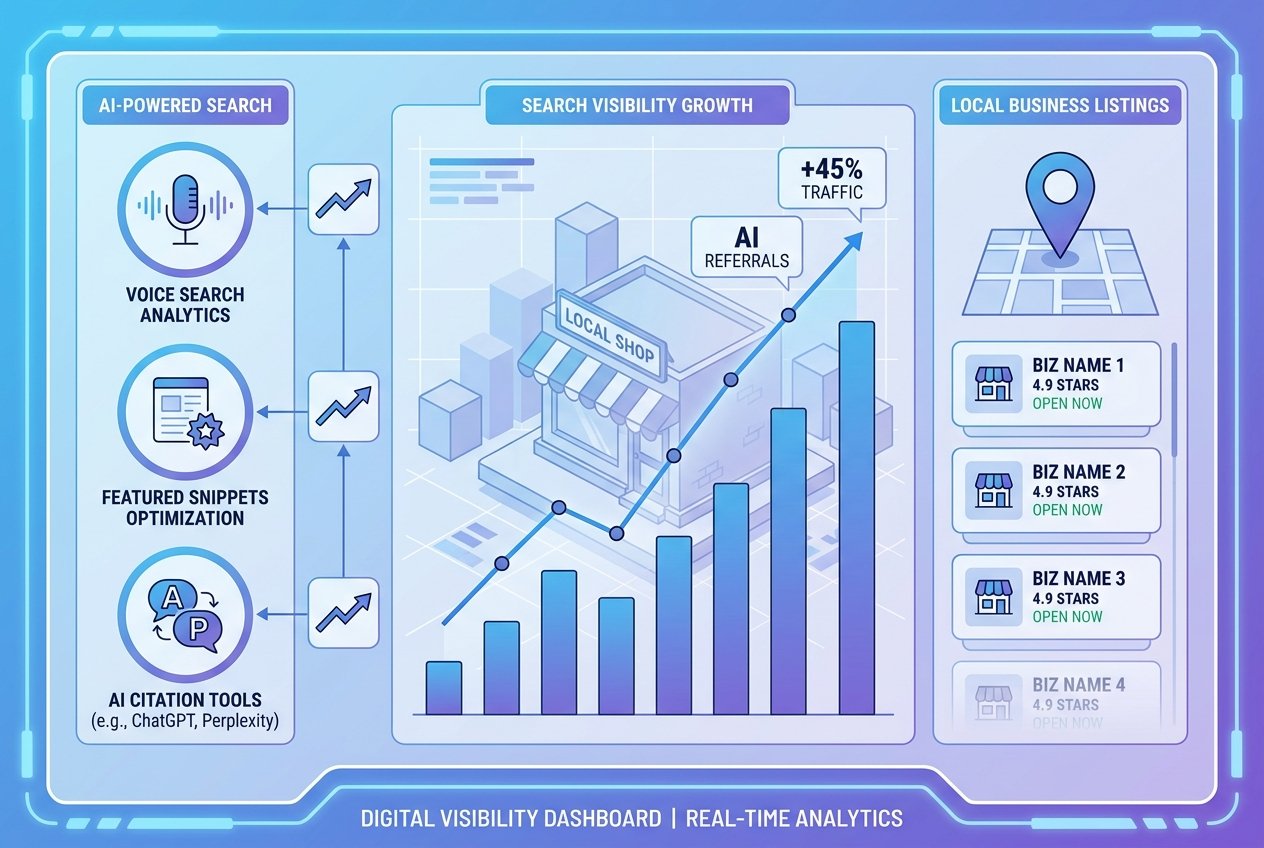
Answer Engine Optimisation (AEO) focuses on getting your content surfaced as a direct answer. Think of Google’s featured snippets, People Also Ask boxes, and voice search responses. When someone asks a question and Google displays a direct answer without them needing to click a link, that is AEO territory. The goal is to be the answer, not just a result.
Generative Engine Optimisation (GEO) takes things a step further. GEO is the practice of optimising your online presence so that AI-powered tools like ChatGPT, Google AI Overviews, Perplexity, Microsoft Copilot, and Gemini cite, mention, or recommend your business when generating answers for users. Rather than ranking in a list of blue links, the aim is to be woven into the AI’s synthesised response as a trusted, credible source.
A simple way to think about the three pillars:
- SEO = rank in search results
- AEO = become the direct answer
- GEO = get cited by AI systems
According to eMarketer, GEO and AEO entered the mainstream marketing conversation in 2025 and have rapidly become essential considerations for any business serious about digital visibility in 2026.
Why UK Small Businesses Cannot Afford to Ignore This Shift
The scale of AI search adoption in the UK is remarkable. According to IAB UK, over 20.2 million people in the UK were using AI tools in July 2025, rising to 21.1 million by September 2025, a year-on-year growth of more than 112%. ChatGPT alone reached 16 million monthly users in the UK by autumn 2025.
Perhaps even more striking is data from a UK government survey published in January 2026, which found that 73% of the British public had used AI at least once in the past month, with 35% specifically using generative AI tools. These are not just tech enthusiasts. These are your potential customers.
Meanwhile, Google AI Overviews now trigger on approximately 48% of all tracked search queries, a 58% year-on-year increase. And when AI Overviews appear, zero-click behaviour increases significantly. Research cited by Exposure Ninja suggests that 43% of searches featuring AI Overviews end without any click to a website at all, compared to 34% without them. For small businesses whose website traffic is a primary source of leads, this is a critical data point.
The traditional model of “rank high, get clicks” is being disrupted. UK small businesses that adapt to GEO and AEO small business strategies now will be far better placed to compete in this new landscape.
The Opportunity Hidden Within the Challenge
Here is the good news that many business owners miss: AI search does not automatically favour large corporations with enormous marketing budgets. In fact, AI systems tend to reward clarity, specificity, expertise, and trustworthiness. A well-optimised independent plumber in Leeds or a specialist accountant in Bristol can compete with national chains if they position themselves correctly.
AI tools frequently try to answer hyper-local queries such as:
- “Best independent financial adviser in Sheffield”
- “How much does a kitchen extension cost in Birmingham?”
- “Emergency electrician in South London available weekends”
- “Accountant for freelancers in Manchester”
If your business is well-represented across trusted platforms, review sites, directories, and your own website with structured, helpful content, AI systems are far more likely to include you in their responses. This is precisely why GEO for small business is one of the most exciting digital marketing opportunities of 2026.
Core GEO and AEO Strategies for UK Small Businesses
1. Build on Strong SEO Foundations
GEO and AEO do not replace traditional SEO. They build on top of it. If your website is slow, poorly structured, or lacks clear content, AI systems will struggle to understand and trust your business. You still need fast, mobile-friendly pages, a well-maintained Google Business Profile, accurate metadata, and a logical site structure. These remain the bedrock of any AI search optimisation strategy.
2. Write Answer-First Content
AEO rewards pages that lead with a direct, concise answer before expanding into detail. When someone searches “How much does a loft conversion cost in the UK?”, an AI system is looking for a page that answers that question immediately and clearly. Structure your key service and resource pages with a direct answer in the first one or two sentences, followed by supporting detail, bullet points, and FAQs. This format works across featured snippets, Google AI Overviews, ChatGPT search, and Perplexity citations.
3. Strengthen Your Entity Authority
AI systems are trying to understand not just what your content says, but who you are as a business entity. This means ensuring your name, address, and phone number are consistent across every platform. Build out an About page with real team member profiles, credentials, and experience. Get listed in reputable UK directories such as Yell, Thomson Local, and your relevant trade association directories. Earn mentions in local press. The more trusted signals that point to your business, the more likely AI systems are to consider you a credible source.
4. Use Schema Markup
Structured data, or schema markup, is the language that helps search engines and AI systems understand your content at a granular level. For UK small businesses, the most valuable schema types include LocalBusiness, FAQPage, Service, Review, and Person. Adding these to your website makes it significantly easier for AI tools to extract and use your information accurately. If this sounds technical, it is worth knowing that tools and consultants can implement this for you without requiring you to write a single line of code yourself.
5. Create Content Around Real Questions Your Customers Ask
One of the most powerful AEO strategies is deceptively simple: write content that answers the actual questions your customers ask. Review your enquiries, your sales conversations, and your customer service logs. Turn those questions into dedicated pages or blog posts with clear, factual answers. Examples for UK small businesses might include pricing guides, comparison articles, process explainers, and local service area pages. This is the type of content that AI systems can lift directly into answers, putting your business name in front of potential customers even before they visit your website.
6. Earn Third-Party Mentions and Citations
Research highlighted by Dojo AI shows that AI models frequently draw on sources such as review platforms, forums, niche directories, YouTube, and authoritative third-party publications. For UK businesses, this means actively encouraging genuine customer reviews on Google, Trustpilot, and relevant industry platforms. It also means contributing to local community discussions, appearing in trade publications, and earning local PR coverage where possible. Your digital reputation across the wider web matters as much as your own website content when it comes to AI search optimisation.
7. Keep Content Fresh and Locally Relevant
AI systems tend to prefer content that is current and specific. Outdated pages that have not been refreshed in years are less likely to be cited. For UK small businesses, this means regularly updating key service pages with current pricing ranges, relevant legislation or regulatory changes, and timely local references. It also means creating content that speaks specifically to your geographic service area, whether that is a London borough, a Yorkshire market town, or the wider South West region.
How Kaizen AI Consulting Can Help Your Business Adapt
Navigating the intersection of SEO, AEO, and GEO requires both strategic understanding and practical implementation skills. The good news is that you do not have to figure it out alone. At Kaizen AI Consulting, we work with UK small businesses to develop tailored AI search optimisation strategies that go beyond traditional SEO and position your brand where your customers are increasingly looking: inside AI-generated answers. Whether you need a full audit of your current digital presence, help creating answer-first content, or guidance on building your entity authority, our team can provide the expertise to move your business forward. You can also explore how we approach business growth strategy for small UK businesses to see how our joined-up thinking delivers results across multiple channels.
What Does Success Look Like? Measuring GEO and AEO Performance
One of the challenges of GEO and AEO for small businesses is that traditional metrics like keyword rankings do not tell the full story. Forward-thinking businesses in 2026 are beginning to track:
- AI mention frequency: How often does your brand appear in AI-generated responses for relevant queries?
- Citation diversity: Are you being referenced across multiple AI platforms, or just one?
- Share of voice in AI answers: How does your visibility compare to competitors within AI-generated content?
- Referral sources: Are you seeing traffic arriving from AI tools like Perplexity or ChatGPT?
Tools such as Semrush’s AI Visibility Toolkit, Scrunch, and Profound are emerging to help businesses track their presence in AI-generated answers. While these tools are still maturing, keeping a manual eye on how AI tools respond to queries related to your services and location is a practical first step any business can take today.
A Practical 30-Day Action Plan for UK Small Businesses
If you are ready to begin improving your GEO and AEO performance, here is a focused starting point:
- Audit your top ten website pages for answer-first structure and update them to lead with direct, clear responses to common customer questions
- Add FAQ sections to your key service pages using real questions your customers ask
- Ensure your business name, address, and phone number are identical across your website, Google Business Profile, Bing Places, Yell, and any other directories you appear in
- Implement LocalBusiness and FAQPage schema markup on your most important pages
- Request five to ten new reviews from recent satisfied customers on Google and Trustpilot
- Identify the top ten questions your customers ask and plan content pages to answer each one
- Manually test how AI tools like ChatGPT and Perplexity respond to queries about your service and location to establish a baseline
The Bottom Line: Visibility Is Evolving, and So Must Your Strategy
The rise of AI search is not a passing trend. With ChatGPT now boasting over 845 million registered users globally according to First Page Sage, and with 56% of UK AI users engaging with these tools daily according to Mintel, the way your customers find you is fundamentally changing. GEO and AEO are not optional extras for UK small businesses. They are becoming essential components of any credible digital marketing strategy.
The businesses that act now, building authority, answering questions clearly, and earning trust across the digital ecosystem, will be the ones that AI systems recommend when your next customer asks for exactly what you offer. The opportunity is real and the window to gain an early advantage is open. If you are ready to explore what a tailored AI search optimisation strategy could look like for your business, get in touch with the team at Kaizen AI Consulting today and take the first step towards being found where it matters most.