Pricing jobs accurately has always been one of the biggest challenges facing trades businesses across the United Kingdom. Whether you are an electrician in Manchester, a plumber in Birmingham, or a building contractor in London, getting your quotes right can mean the difference between a profitable project and a costly loss. In 2026, AI pricing trades technology is transforming how small and medium-sized contractors approach estimating, offering a level of speed and precision that was previously available only to large construction firms.
With labour shortages, rising material costs, and increasing client expectations, tradespeople can no longer rely on gut feeling and rough calculations. According to the Construction Industry Training Board (CITB), the UK construction sector needs an additional 47,860 workers every year between 2025 and 2029 just to meet current demand. This workforce pressure, combined with business confidence remaining in contraction for ten consecutive months according to Tokio Marine HCC, means trades businesses must operate more efficiently than ever before. Job pricing automation offers a practical solution.
The Pricing Challenge Facing UK Trades Businesses
Labour Shortages and Rising Costs
The UK construction industry has shed approximately 10% of its workforce since the pandemic, equivalent to roughly 250,000 jobs. Bar2 reports that there were 38,000 construction job vacancies in early 2025, with an ageing workforce and low youth entry exacerbating the skills gap. When skilled labour is scarce, wages rise. The Autumn Budget added further pressure through higher minimum wage requirements and increased National Insurance contributions, making labour costs the main inflation driver on many projects.
Material pricing, whilst stabilising relative to the volatility of previous years, remains elevated. Freemont Building estimates average construction cost inflation at 3.5% in 2026. For trades businesses working on tight margins, these combined pressures make accurate estimating absolutely critical.
The Cost of Inaccurate Quotes
Underpricing a job leads to squeezed profits, cash flow problems, and potentially damaging disputes with clients. Overpricing, on the other hand, means losing work to competitors. Many tradespeople still rely on spreadsheets, manual takeoffs, and experience-based guesses. These methods are not only time-consuming but also prone to human error. A missed measurement, an outdated material price, or a forgotten labour allowance can easily turn a promising project into a financial headache.
This is where quote accuracy AI enters the picture. By automating the repetitive and complex aspects of estimating, artificial intelligence helps trades businesses produce consistent, competitive, and profitable quotes in a fraction of the time.
How AI Pricing Trades Technology Works
Automated Takeoffs and Measurements
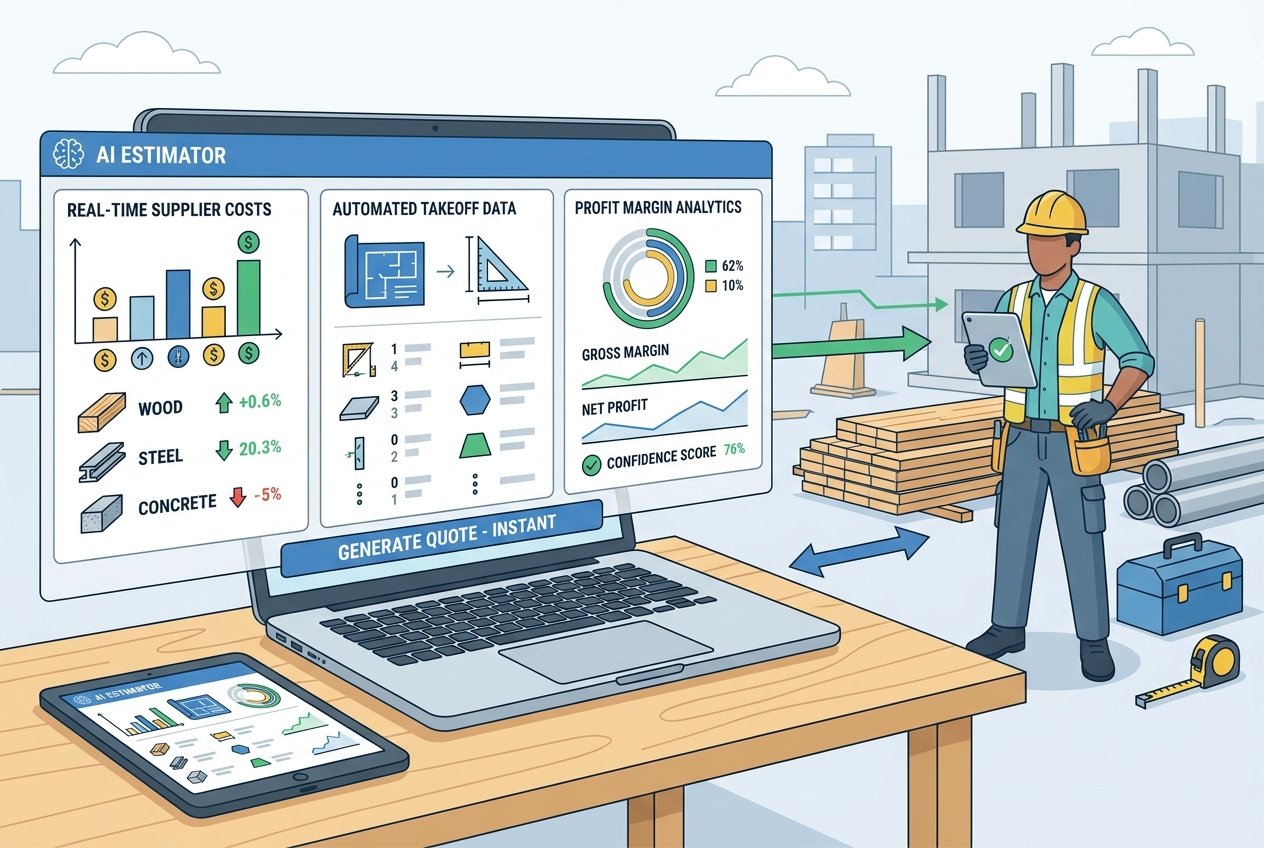
One of the most labour-intensive parts of any construction estimate is the takeoff, the process of measuring and quantifying materials from drawings and specifications. AI construction estimating software can now scan 2D and 3D plans, automatically detect building components, measure areas and volumes, and generate detailed quantities. This eliminates the need for manual scale rules and calculators, reducing the risk of measurement errors that plague traditional methods.
Advanced AI tools can cut takeoff time by 70 to 90% whilst achieving accuracy rates of 95% or higher. For a busy trades business, this means estimators can process more quotes per week without working longer hours.
Real-Time Cost Database Integration
Material prices fluctuate constantly. Copper, timber, steel, and specialist products all move with market conditions. AI-powered construction pricing tools connect directly to live supplier databases and price indices, ensuring that every quote reflects current market rates. This is particularly valuable in 2026, with selective pressure still evident on specialist products despite broader material price stabilisation.
Instead of relying on price lists that are months out of date, trades businesses can quote with confidence knowing their material costs are accurate. Some systems even flag when a particular item has experienced significant price movement, prompting the estimator to review and adjust accordingly.
Pattern Recognition from Historical Data
Machine learning algorithms analyse past projects to identify patterns in costs, durations, and resource requirements. Over time, the system learns what a typical kitchen renovation, bathroom installation, or electrical rewire should cost based on your company’s actual performance data. This historical intelligence helps identify when a current quote deviates significantly from similar past jobs, flagging potential errors or omissions before the quote is sent.
Varseno reports that AI construction estimating can reduce bid preparation time by 40 to 60% whilst simultaneously improving accuracy and reducing costly errors. For trades businesses competing in a crowded market, this efficiency advantage can be transformative.
Key Benefits of Job Pricing Automation
Faster Quote Turnaround
In the trades sector, speed matters. Clients often request multiple quotes and award work to the contractor who responds first. Job pricing automation enables trades businesses to generate professional, detailed quotes within hours rather than days. This responsiveness improves win rates and keeps your pipeline full.
Improved Profit Margins
Accurate pricing means you are neither leaving money on the table nor absorbing unexpected costs. AI tools help ensure that every labour hour, material unit, and overhead expense is properly accounted for. The SBE Council found that 97% of small businesses using AI-supported pricing tools reported positive revenue impacts, and 94% said the tools made them more competitive.
Reduced Administrative Burden
Tradespeople typically did not enter their profession to spend evenings doing paperwork. Automating the estimating process frees up valuable time that can be better spent on site, managing teams, or pursuing new business opportunities. Salesforce UK notes that AI tools help small businesses by automating repetitive tasks such as data entry and scheduling, which directly applies to automated quoting workflows.
Professional Client Presentation
Modern AI estimating platforms generate polished, itemised quotes that present your business as organised and professional. Detailed breakdowns build client trust and reduce disputes by making exactly what is included transparent from the outset. This professionalism can justify premium pricing and helps differentiate your business from competitors still using handwritten estimates.
Construction Pricing Tools in Action
The practical applications of AI estimating technology extend across virtually every trade. Electricians can use AI to count fixtures, calculate cable runs, and price distribution boards automatically. Plumbers can generate quantities for pipework, fittings, and sanitaryware directly from floor plans. Builders and renovators can produce comprehensive material lists and labour schedules for extensions, loft conversions, and refurbishment projects.
Elecosoft highlights that 2026 is seeing a decisive move away from spreadsheet-driven estimating toward advanced take-off and estimating tools linked to building information modelling and common data environments. This shift is enabling faster quantity extraction, better audit trails, and more collaborative workflows between trades, architects, and clients.
For smaller trades businesses that may not have dedicated estimators, AI levels the playing field. You no longer need years of estimating experience or expensive software licences to produce accurate, competitive quotes. Cloud-based construction pricing tools are increasingly affordable and accessible, with many offering pay-as-you-go models suited to the project-based nature of trades work.
Overcoming Common Concerns
Will AI Replace Skilled Estimators?
This is perhaps the most frequent concern raised by trades business owners. The short answer is no. AI is a tool that augments human expertise rather than replacing it. Experienced estimators still need to review AI-generated outputs, apply professional judgement, and manage client relationships. What AI does is eliminate the tedious, repetitive aspects of estimating, allowing skilled professionals to focus on higher-value activities.
Is the Technology Too Complex for Small Businesses?
Modern AI estimating platforms are designed with usability in mind. Many offer intuitive interfaces, video tutorials, and customer support to help tradespeople get up and running quickly. The learning curve is typically far shorter than mastering complex spreadsheet formulas or traditional estimating software. Given that 25% of UK businesses adopted AI in late 2025, the technology is becoming mainstream rather than niche.
What About Data Security?
Reputable AI estimating providers use enterprise-grade encryption and security protocols to protect your project data and client information. When evaluating platforms, look for UK-based data storage, GDPR compliance, and clear privacy policies. Your commercial data is valuable, and trustworthy vendors treat it accordingly.
Getting Started with Quote Accuracy AI
Adopting AI-powered estimating does not require a complete overhaul of your business overnight. Most trades businesses benefit from a phased approach. Start by identifying your biggest estimating pain points. Is it takeoff accuracy? Material price updates? Labour scheduling? Different AI tools specialise in different areas, so understanding your priorities helps you choose the right solution.
Next, evaluate platforms that integrate with your existing workflows. The best quote accuracy AI tools connect seamlessly with your accounting software, customer relationship management system, and project management platforms. This integration prevents double data entry and ensures consistency across your business systems.
Training is essential. Even the most sophisticated AI tool delivers poor results if your team does not understand how to use it properly. Invest time in onboarding and encourage feedback from estimators and site managers who will be working with the system daily.
At Kaizen AI Consulting, we specialise in helping UK trades businesses implement AI solutions that deliver measurable results. Our team understands the unique challenges facing contractors, from cash flow management to project scheduling, and we tailor job pricing automation strategies to your specific trade and business size. Whether you are looking to streamline your quoting process or build a fully integrated digital workflow, we can guide you through every step of the transformation.
The Future of Trades Estimating
The UK construction software market is projected to grow significantly, reaching approximately USD 850 million by 2035 according to Market Research Future. AI software solutions are expected to dominate with an estimated 63.5% revenue share in 2026, reflecting strong demand for predictive project tools. Trades businesses that embrace this technology now will be well positioned to thrive as the industry continues its digital evolution.
Looking ahead, we can expect AI estimating tools to become even more sophisticated. Voice-activated input, mobile app integration for on-site adjustments, and predictive analytics that forecast project risks before they materialise are all on the horizon. The trades businesses that invest in these capabilities today will enjoy a sustained competitive advantage.
Accurate job pricing is not just about winning more work. It is about building a sustainable, profitable business that can weather market fluctuations and grow with confidence. AI pricing trades technology provides the precision, speed, and consistency that modern contractors need to succeed in an increasingly demanding marketplace.
If you are ready to explore how artificial intelligence can transform your quoting process and boost your bottom line, contact Kaizen AI Consulting today. Our experts will assess your current workflows, recommend the right construction pricing tools for your trade, and support you through implementation and beyond. Do not let outdated estimating methods hold your business back. Embrace the future of trades pricing and start winning more profitable work.
For more insights on building a successful trades business, read our article on growing from startup to success with the right business strategies.