When Mark first picked up a trowel as a self-employed tiler in Sheffield, he never imagined that artificial intelligence would one day help him build a thriving four-person team. Yet that is exactly the journey this South Yorkshire tradesperson took between 2024 and 2026. This tiler AI case study explores how one solo operator transformed scattered admin, missed enquiries, and quote chaos into a streamlined, scalable tiling business, and what it means for the wider world of Sheffield trades.
The Starting Point: One Man, Endless Admin
Like thousands of solo tradespeople across the UK, Mark was brilliant at his craft but buried in paperwork. Evenings were swallowed by writing quotes, chasing invoices, and replying to enquiries that had often gone cold by the time he picked up his phone. He estimated he was losing two to three jobs every month simply because he could not respond quickly enough.
This is a familiar story in the trades. The UK construction sector continues to face a critical workforce shortage, with industry analysis suggesting the country needs around 266,000 additional workers by 2026 to meet demand. With shortages especially acute in specialist trades like tiling, the opportunity for solo tradesperson growth has never been greater. The challenge is capacity, not demand.
Why Sheffield Was the Perfect Testing Ground
Sheffield and the wider South Yorkshire region present an interesting picture for any UK tiling business. According to the Office for National Statistics, total UK construction output grew 1.6% in the three months to April 2026, with repair and maintenance work up a healthy 3.4%. For a tiler, that repair and refurbishment activity is gold, as bathrooms, kitchens, and renovation projects keep enquiries flowing steadily.
Mark realised the demand was there. What he lacked was the ability to capture and convert it. That realisation became the turning point for his trades scaling AI strategy.
Phase One: Stopping the Leak of Lost Enquiries
The first problem Mark tackled was lead response. Research consistently shows that the business that replies first usually wins the job. Mark introduced an AI-powered website assistant and an automated enquiry system that could answer common questions, capture contact details, and book consultations around the clock, even while he was up a ladder grouting a wet room.
Within the first three months, his enquiry-to-quote conversion rate improved dramatically. Leads that previously slipped away during working hours were now captured automatically and followed up with friendly, branded messages. This kind of intelligent lead capture is precisely the area where Kaizen AI Consulting helps small trades businesses turn missed calls into booked work.
The Tools That Made the Difference
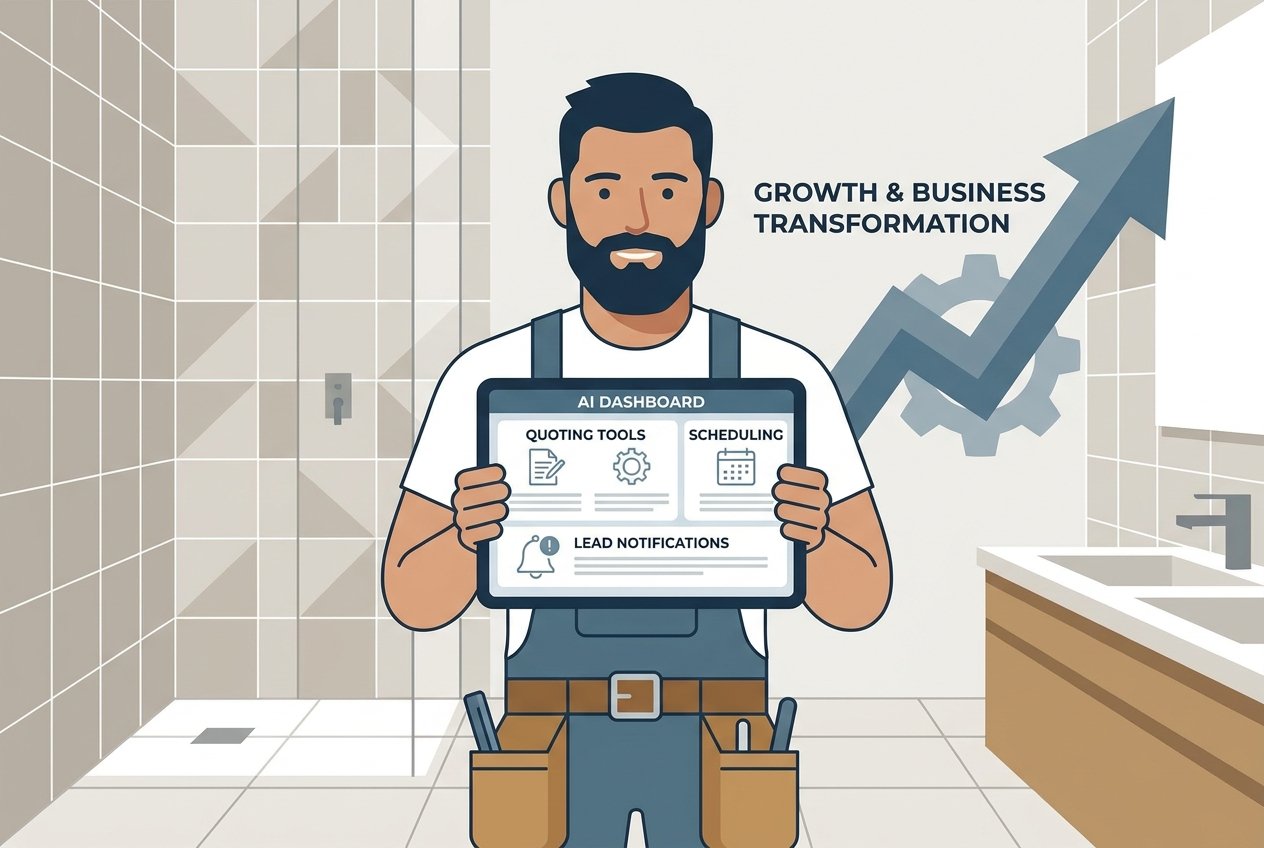
Mark did not need a computer science degree. He needed practical, affordable tools that worked together. His early toolkit included AI chat assistants for his website, automated quoting templates, and an AI note-taker that transcribed site visits so he never forgot a measurement or client request again.
This mirrors the wider trend across UK trades in 2026, where tradespeople are increasingly using AI for lead capture, quoting, job management, and customer communications. The common thread is simple: reduce the time spent on admin so more time can be spent on the tools and on growth.
Phase Two: Faster Quotes, More Wins
Quoting was Mark’s biggest bottleneck. Each detailed estimate could take an hour or more in the evening. By introducing AI-assisted quoting, he cut that time to roughly fifteen minutes per quote. The AI helped draft professional, consistent estimates from his site notes, which he then reviewed and personalised.
The result was twofold. First, he sent quotes within hours rather than days, dramatically improving his win rate. Second, his quotes looked far more polished, building trust with homeowners comparing several tradespeople. Professionalism, it turned out, was a competitive advantage that AI made effortless.
Phase Three: From Solo to a Team of Four
With his pipeline now full and predictable, Mark faced the good problem of having more work than he could complete alone. This is where many solo tradespeople stall, because hiring feels risky without consistent income. But because AI had given Mark clear visibility of his enquiry volume and booked work, he could confidently bring on his first employee.
Over eighteen months, he scaled to a four-person team: two additional tilers and a part-time apprentice, supported by AI handling the back office. His automated systems managed scheduling, sent appointment reminders to reduce no-shows, and kept invoicing on track. The admin that once consumed his evenings now ran quietly in the background.
Crucially, AI also helped with onboarding. Mark used AI to create standard operating procedures, checklists, and training notes, ensuring every job met the same high standard regardless of who was on site. This consistency protected his reputation as the team grew, a vital factor in any Sheffield trades business built on word of mouth.
The Results in Numbers
By mid-2026, Mark’s business had transformed in measurable ways. His average quote turnaround dropped from three days to under four hours. His monthly enquiry conversion improved by an estimated 40%. Revenue tripled compared to his solo years, and perhaps most importantly, he reclaimed his evenings and weekends.
These outcomes reflect what AI adoption can deliver across small businesses. Salesforce research notes that a significant share of small and medium enterprises already use AI for customer operations and productivity gains. For trades specifically, that means less chaos and more controlled, sustainable growth.
Lessons for Other Tradespeople
Mark’s story offers clear takeaways for anyone considering trades scaling AI. First, start with your biggest bottleneck, whether that is missed enquiries, slow quotes, or admin overload. Second, choose tools that integrate rather than adding complexity. Third, treat AI as an assistant that frees you to do skilled work, not a replacement for your expertise.
Most importantly, you do not have to navigate this alone. Many tradespeople feel overwhelmed by the sheer number of AI tools available. This is where expert guidance proves invaluable. Kaizen AI Consulting specialises in helping small businesses and solo tradespeople across the UK identify, implement, and optimise the right AI systems for their specific trade, removing the guesswork entirely.
Why Professional Guidance Accelerates Results
Mark admits his progress would have been slower without expert input. Choosing the wrong tool, or setting it up poorly, can waste months and money. A consultant who understands both AI and the realities of running a trades business can compress that learning curve from years into weeks.
If you run a UK tiling business, or any trade, and you recognise yourself in Mark’s early struggles, now is the time to act. The demand is strong, the tools are proven, and the path from solo to scaled is clearer than ever. To explore how AI could help your own solo tradesperson growth journey, get in touch with Kaizen AI Consulting today for a friendly, no-obligation conversation about your goals.
The Future of Sheffield Trades
Mark’s journey is not unique to him, it is a blueprint. As more Sheffield trades adopt these tools, the businesses that thrive will be those that combine craftsmanship with smart systems. AI will not replace the skilled hands of a tiler, but it will give those hands the freedom, capacity, and confidence to build something far bigger than a one-person operation.
The future of the trades is not about working harder. It is about working smarter, and Mark’s four-person team is living proof that the technology to do exactly that is already here.