Using AI to Write Job Descriptions and Screen CVs: A Practical Guide for UK Businesses
Hiring has never been more competitive. With the UK labour market shifting rapidly and skills shortages deepening across almost every sector, businesses are under pressure to attract the right talent quickly and efficiently. AI recruitment tools are no longer the preserve of large corporations with deep pockets. In 2026, they are becoming standard practice for businesses of all sizes, fundamentally changing how job descriptions are written and how CVs are screened.
If you have been wondering whether AI hiring automation is right for your business, this guide walks you through how it works, what the data says, and the compliance considerations every UK employer must understand before diving in.
The State of AI Recruitment in the UK
The numbers tell a compelling story. According to the latest data from StandOut CV, the use of AI in UK recruitment has tripled in the last year, with 3 in 10 UK employers now implementing AI in their hiring processes. Amongst larger organisations, that figure jumps significantly, with 43% of large UK companies already using AI for candidate interviews.
Meanwhile, Indeed Hiring Lab’s March 2026 analysis revealed something striking: while overall UK job postings sit 27% below their pre-pandemic baseline, postings that mention AI skills are 127% above pre-pandemic levels. This divergence signals a fundamental reshaping of talent demand, and it starts with how job descriptions are written.
From a productivity standpoint, AI is delivering. UK businesses report that time savings (54%), productivity efficiencies (42%), and cost savings are the most widely recognised advantages of adopting AI in their operations, according to research cited in the British Chambers of Commerce Powering Productivity report. In recruitment specifically, AI is reported to reduce hiring costs by up to 71% and save recruiters an average of 4.5 hours per week.
How AI Transforms the Writing of Job Descriptions
A poorly written job description is one of the most costly mistakes a business can make. It attracts the wrong candidates, wastes interview time, and signals a lack of clarity about the role itself. AI job description tools are changing this, helping employers produce clearer, more inclusive, and more effective postings in a fraction of the time.
What AI Job Description Tools Actually Do
Modern AI tools for writing job descriptions use natural language processing (NLP) and machine learning to draft roles from scratch based on inputs such as job title, key responsibilities, and required skills. The best tools go further by:
- Eliminating biased language that can deter applicants from underrepresented groups
- Suggesting inclusive phrasing proven to attract more diverse candidate pools
- Incorporating real-time labour market data to ensure descriptions align with current expectations
- Standardising descriptions across teams and departments for consistency
- Recommending role-specific skills based on market benchmarks
Research from Navero found that AI-generated job descriptions attract 29% more qualified candidates compared to traditionally written postings. That is a significant competitive advantage in a market where talent acquisition has become a strategic priority for boards and leadership teams alike.
Step-by-Step: Best Practices for UK Businesses
To get the most from AI job description tools, UK businesses should follow a structured approach:
- Define the core problem the role solves: Before prompting any AI tool, be clear about whether the role is stabilising an existing process, building something new, or scaling operations. Vague inputs produce vague outputs.
- Separate ambition from execution: Focus on practical day-to-day outcomes rather than aspirational language. Candidates respond to clarity about what the work actually looks like.
- Incorporate AI and digital skills explicitly: According to an Oxford University study cited by Employment Hero, candidates who list AI skills receive 8 to 15% more interview callbacks. Ensuring your descriptions attract these candidates starts with clearly signalling that AI literacy is valued.
- Human-edit for tone and compliance: AI drafts should always be reviewed by a human. Check for UK spelling, industry-specific terminology, and alignment with your Equality Act obligations before publishing.
- Iterate based on data: Track application quality, time-to-shortlist, and offer acceptance rates. Use this data to refine your prompts and improve future descriptions.
AI CV Screening: Speed Without Sacrificing Quality
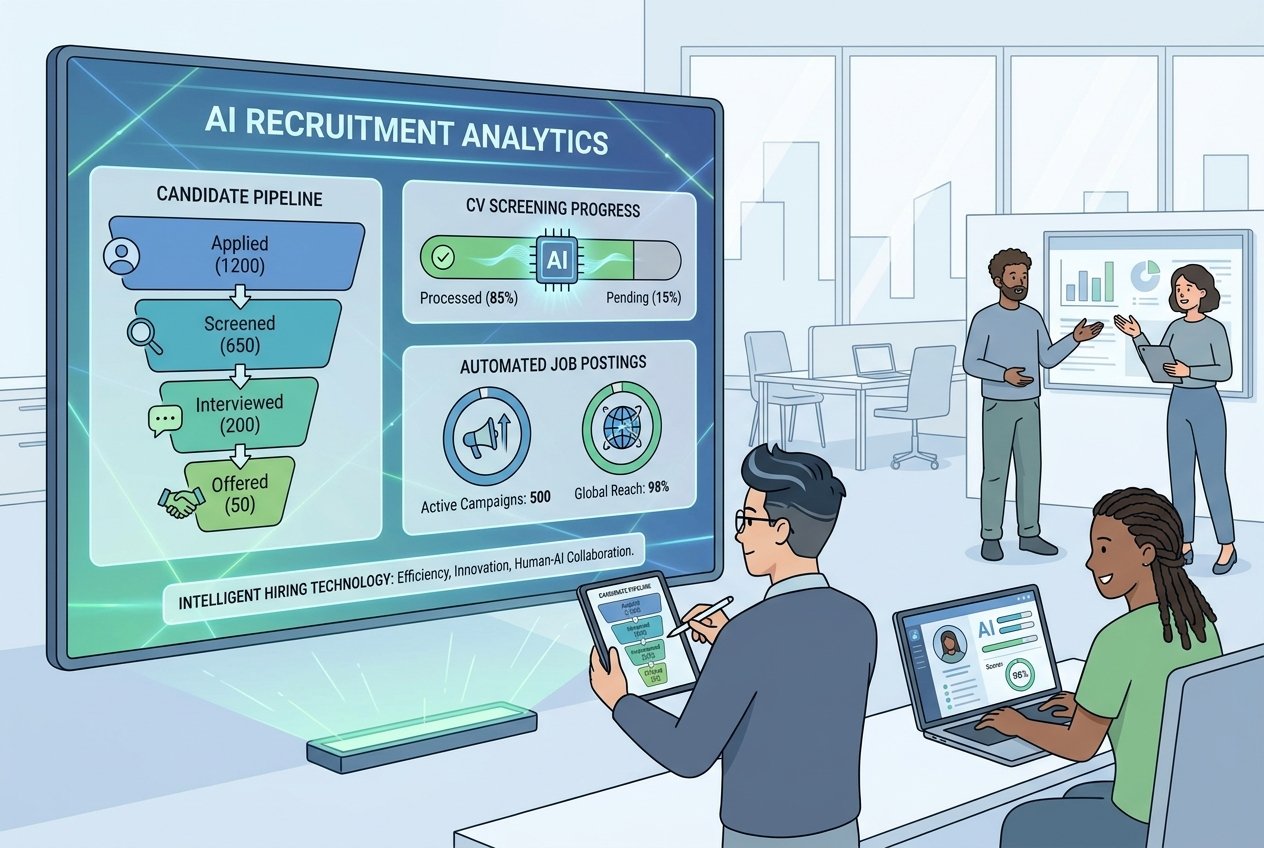
Alongside job description generation, CV screening is the other area where AI is delivering the most immediate value for UK recruiters. When a role attracts hundreds of applications, manually reviewing every CV is simply not feasible. AI screening tools allow hiring teams to process large volumes of applications in minutes, ranking candidates based on relevance to the role requirements.
As the British Chambers of Commerce notes in their 2026 productivity report, “AI systems are used to quickly screen candidate profiles and match them to job descriptions, reducing the requirement for a person to manually sift through large numbers of CVs.” For growing UK businesses, this capability is transformational, freeing up HR professionals and business owners to focus on what truly matters: getting the right people in the room.
The Benefits of AI-Powered CV Screening
- Speed: What previously took days can now be completed in minutes, significantly compressing time-to-hire
- Consistency: AI applies the same criteria to every application, reducing unconscious bias in initial shortlisting
- Scalability: Businesses can manage high-volume recruitment campaigns without proportionally increasing headcount
- Data-driven insights: AI tools surface patterns in your applicant pool, helping you refine your sourcing strategy over time
It is worth noting that the global AI recruitment market is projected to reach $5.4 billion by 2030, growing at a compound annual growth rate of 17.9%, according to market analysis cited by Homans AI. This trajectory reflects a broader shift in how organisations think about talent acquisition as a strategic function rather than an administrative one.
At Kaizen AI Consulting, we work with UK businesses to identify where AI automation can deliver the highest return in their operations, including recruitment workflows. If you are unsure which tools are right for your hiring process or how to integrate them effectively, our team can guide you through a structured assessment tailored to your business needs.
UK Compliance: What Every Employer Must Know
This is where many businesses trip up. The efficiency gains from AI hiring automation are real, but they come with significant legal and regulatory responsibilities that cannot be ignored. UK employers using AI in recruitment must navigate a framework that is actively evolving.
The ICO’s Recruitment Rewired Report (March 2026)
On 31 March 2026, the Information Commissioner’s Office (ICO) published its landmark Recruitment Rewired report and draft guidance on automated decision-making (ADM) in recruitment. This is the most important regulatory development in UK AI recruitment compliance to date, and all businesses using or considering AI hiring tools should be aware of its key findings.
The report, which drew on engagement with more than 30 UK employers, identified significant compliance gaps. Key requirements for businesses include:
- Genuine human involvement: Solely automated decisions (such as CV screening with no meaningful human review) require a lawful basis under UK GDPR. Critically, the ICO is clear that human involvement must be genuine, with the authority and competence to actually alter an outcome. A perfunctory rubber-stamp review does not satisfy this requirement.
- Transparency with candidates: Employers must proactively inform candidates when AI is being used in their hiring process, what data is being processed, and what safeguards are in place. Generic privacy notices are insufficient.
- Data Protection Impact Assessments (DPIAs): Full DPIAs are required for automated recruitment processes, and many current ones lack the necessary detail.
- Ongoing monitoring and bias testing: Employers are expected to test their AI tools regularly for bias, maintain clear governance, and document their processes.
Furthermore, the ICO is now required to produce a formal AI Code of Practice, following new regulations laid before Parliament in April 2026. This will introduce even more structured requirements for businesses using AI tools that affect individuals.
The Equality Act 2010 and Bias in AI Screening
Beyond data protection, UK employers must also consider the Equality Act 2010. AI screening tools trained on historical hiring data risk perpetuating existing biases, potentially leading to indirect discrimination against candidates with protected characteristics such as age, gender, ethnicity, or disability. This is not a theoretical risk: it is one the ICO explicitly flags in its 2026 guidance.
Practical steps to mitigate this include:
- Auditing your chosen AI tools for bias before deployment
- Ensuring the data used to train or configure screening algorithms is representative and relevant
- Documenting your bias testing and monitoring processes
- Reviewing shortlisting outcomes regularly to identify any patterns that may indicate disparate impact
Making AI Recruitment Work for Your Business
The opportunity that AI recruitment tools represent for UK businesses is substantial. With the UK government projecting that AI-related jobs could grow from 158,000 in 2024 to 3.9 million by 2035, the ability to hire effectively in an AI-driven economy is becoming a core business competency. The organisations that master AI-assisted recruitment now will have a genuine competitive edge in sourcing, assessing, and securing the talent they need to grow.
However, as with any powerful tool, the results depend entirely on how it is implemented. Businesses that rush into hiring automation without a clear strategy, proper compliance frameworks, and an understanding of their tools’ limitations are likely to encounter problems, from poor candidate experiences to regulatory scrutiny.
This is where expert guidance makes all the difference. The team at Kaizen AI Consulting specialises in helping UK businesses adopt AI in a way that is practical, compliant, and genuinely impactful. Whether you are exploring AI for the first time or looking to optimise an existing recruitment workflow, we can help you build a robust approach that delivers results without the risk. Get in touch with our team today for a no-obligation conversation about how AI recruitment automation could work for your business.
Key Takeaways
- AI recruitment adoption in the UK has tripled in the past year, with clear efficiency and quality benefits for businesses that implement it thoughtfully
- AI job description tools can attract up to 29% more qualified candidates by improving clarity, inclusivity, and market relevance
- CV screening automation dramatically reduces time-to-hire and allows HR teams to focus on high-value work
- The ICO’s March 2026 Recruitment Rewired report sets out clear compliance obligations for businesses using automated decision-making in hiring
- The Equality Act 2010 requires employers to actively test for and mitigate bias in AI screening tools
- A structured, expert-led implementation approach is the most reliable path to sustainable ROI from AI recruitment automation