As artificial intelligence continues to reshape the business landscape, UK small businesses find themselves navigating an increasingly complex regulatory environment. With 2025 bringing new developments in AI regulation UK frameworks, understanding your compliance requirements has never been more critical. This comprehensive guide will help you understand the legal framework, stay ahead of regulatory trends, and ensure your business remains compliant whilst leveraging AI’s transformative potential.
The Current State of AI Regulation in the UK
The United Kingdom has taken a distinctive approach to AI regulation, favouring a principles-based framework rather than rigid, prescriptive rules. Unlike the European Union’s comprehensive AI Act, the UK government has opted for a more flexible regulatory model that adapts to different sectors and use cases.
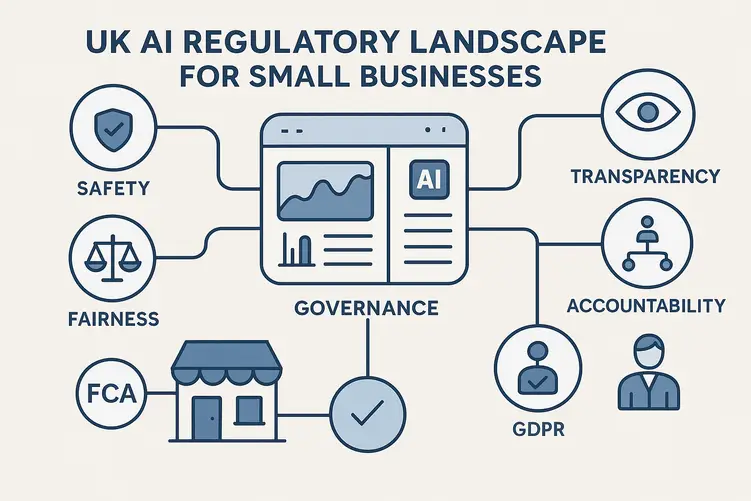
According to the UK Government’s AI White Paper, published in March 2023, the framework is built around five key principles: safety, security and robustness; appropriate transparency and explainability; fairness; accountability and governance; and contestability and redress. These principles guide how existing regulators like the Information Commissioner’s Office (ICO), the Financial Conduct Authority (FCA), and the Competition and Markets Authority (CMA) approach AI oversight within their respective domains.
As of 2025, whilst the UK hasn’t enacted standalone AI legislation comparable to the EU AI Act, the regulatory landscape continues to evolve rapidly. The Department for Science, Innovation and Technology has indicated that statutory legislation may follow if the current approach proves insufficient, making it essential for small businesses to stay informed about regulatory trends.
Understanding Compliance Requirements for Small Businesses
For small businesses implementing AI technologies, compliance requirements primarily stem from existing legislation that now applies to AI systems. The most significant of these is the UK General Data Protection Regulation (UK GDPR), which remains the cornerstone of data protection and privacy law.
Data Protection and Privacy
When your AI systems process personal data, you must comply with UK GDPR requirements. This includes conducting Data Protection Impact Assessments (DPIAs) for high-risk processing activities. The ICO reports that approximately 73% of businesses using AI technologies process some form of personal data, making GDPR compliance a priority for most organisations.
Key compliance requirements include obtaining appropriate consent where necessary, ensuring data minimisation, implementing privacy by design principles, and maintaining transparency about how AI systems use personal information. Small businesses must also ensure they can explain automated decision-making processes that significantly affect individuals, as required under Article 22 of UK GDPR.
Sector-Specific Regulations
Depending on your industry, additional compliance requirements may apply. Financial services firms must consider FCA guidance on AI and machine learning, whilst healthcare organisations need to adhere to MHRA regulations for AI-enabled medical devices. Retail businesses using AI for customer analytics must comply with consumer protection laws and the Consumer Rights Act 2015.
The FCA has noted that firms using AI for financial decision-making must ensure systems are transparent, explainable, and free from bias. Similarly, businesses using AI in recruitment must comply with the Equality Act 2010, ensuring algorithms don’t discriminate based on protected characteristics.
Navigating the Legal Framework in 2025
The legal framework governing AI in the UK comprises multiple layers of legislation, common law principles, and regulatory guidance. Understanding how these elements interact is crucial for maintaining compliance whilst innovating with AI technologies.
Intellectual Property Considerations
AI raises unique intellectual property questions. The UK Intellectual Property Office has addressed concerns about AI-generated content and copyright protection. Businesses must consider who owns the output of AI systems and whether training AI models on copyrighted material constitutes infringement.
Current UK law generally requires human authorship for copyright protection, though this remains an evolving area. Small businesses should document their AI development processes, clarify ownership in contracts with developers and vendors, and seek legal advice when commercialising AI-generated content.
Liability and Consumer Protection
Questions of liability when AI systems cause harm continue to develop through case law and regulatory interpretation. Under the Consumer Protection Act 1987, businesses may be liable for defective products, including software containing AI components. The Law Commission’s 2022 report on automated vehicles provides insights into how liability frameworks might adapt to AI technologies.
Small businesses should ensure they have appropriate insurance coverage, maintain detailed documentation of AI system testing and validation, and implement robust governance frameworks. Clear terms of service and user agreements that address AI functionality can also help manage liability risks.
Key Regulatory Trends Shaping 2025
Several regulatory trends are defining the AI compliance landscape in 2025, and small businesses must prepare for continued evolution in this space.
Enhanced Transparency Requirements
Regulators are increasingly demanding transparency about AI usage. The ICO’s guidance on explaining AI decisions to individuals has become more detailed, requiring businesses to provide meaningful information about algorithmic logic. Research from the Alan Turing Institute suggests that 68% of consumers want to know when they’re interacting with AI systems.
Small businesses should implement clear labelling practices, develop plain-language explanations of their AI systems, and establish processes for responding to individual requests for information about automated decision-making. This transparency builds trust whilst ensuring compliance with emerging expectations.
Focus on Algorithmic Fairness
Preventing bias and discrimination in AI systems has become a regulatory priority. The Equality and Human Rights Commission has published guidance on AI and equality law, emphasising that businesses remain responsible for discriminatory outcomes even when using third-party AI tools.
Testing AI systems for bias, conducting regular audits, and implementing human oversight for significant decisions are now considered best practices. Small businesses should document their fairness assessments and be prepared to demonstrate that their AI systems don’t perpetuate discrimination.
International Alignment and Brexit Implications
Whilst the UK has diverged from EU approaches to AI regulation, businesses operating internationally must consider multiple regulatory frameworks. The EU AI Act, which classifies AI systems by risk level and imposes corresponding obligations, affects UK businesses selling into European markets or working with EU-based partners.
Understanding how different regulatory approaches interact is increasingly complex. For small businesses with international ambitions, navigating these requirements whilst maintaining cost-effective compliance programmes presents a significant challenge.
Practical Steps for Small Business Compliance
Given this complex landscape, what practical steps should small businesses take to ensure compliance with AI regulation UK requirements in 2025?
Conduct an AI Audit
Begin by cataloguing all AI systems your business uses, whether developed in-house, purchased from vendors, or embedded in third-party platforms. Document what each system does, what data it processes, and what decisions it influences. This inventory forms the foundation of your compliance programme.
For each AI system, assess the associated risks, including privacy impacts, potential for bias, and consequences of errors. Prioritise high-risk systems for more rigorous compliance measures and oversight.
Implement Governance Frameworks
Establish clear governance structures for AI development and deployment. This includes defining roles and responsibilities, creating approval processes for new AI implementations, and setting up monitoring mechanisms to detect issues early.
The Government Office for AI provides guidance on responsible AI governance that small businesses can adapt to their scale and resources. Key elements include board-level oversight, ethical guidelines, and regular review cycles.
Invest in Staff Training
Your team needs to understand both the opportunities and risks associated with AI. Provide training on compliance requirements, ethical AI principles, and how to identify potential issues. According to the CIPD, only 32% of UK businesses currently provide AI-specific training, creating both a compliance risk and a competitive disadvantage.
Establish Vendor Due Diligence
When using third-party AI solutions, you remain responsible for compliance. Conduct thorough due diligence on vendors, reviewing their data protection practices, security measures, and compliance documentation. Include appropriate contractual protections that address data processing, intellectual property, and liability allocation.
How Kaizen AI Consulting Can Support Your Compliance Journey
Navigating AI regulation UK requirements whilst running a small business can feel overwhelming. This is where expert guidance makes a transformative difference. At Kaizen AI Consulting, we specialise in helping small and medium-sized businesses implement AI technologies in a compliant, ethical, and strategically sound manner.
Our team stays current with evolving regulatory trends and translates complex legal frameworks into practical, actionable guidance tailored to your specific business context. Whether you need help conducting AI audits, developing governance frameworks, or ensuring your AI implementations meet compliance requirements, we provide the expertise you need without the overhead of an in-house compliance team.
We recognise that small businesses need cost-effective solutions that don’t compromise on quality or compliance. Our consulting services are designed to scale with your needs, providing targeted support exactly where you need it most. From initial compliance assessments to ongoing monitoring and regulatory updates, we serve as your trusted partner in the AI compliance journey.
Looking Ahead: Preparing for Future Regulatory Changes
The AI regulatory landscape will continue evolving throughout 2025 and beyond. The UK government has signalled potential statutory legislation if voluntary approaches prove insufficient, whilst international developments like the EU AI Act will influence UK regulatory thinking.
Small businesses should adopt a proactive rather than reactive approach to compliance. Building strong foundations now including robust governance, thorough documentation, and ethical AI principles will make adapting to future requirements significantly easier and less costly.
Stay informed by monitoring publications from relevant regulators, joining industry associations, and engaging with AI ethics discussions. The Centre for Data Ethics and Innovation regularly publishes insights on emerging issues, whilst sector-specific regulators provide targeted guidance for different industries.
Conclusion: Compliance as Competitive Advantage
Understanding and meeting compliance requirements for AI regulation UK frameworks isn’t just about avoiding penalties; it’s about building trust with customers, partners, and stakeholders whilst positioning your business for sustainable growth. The legal framework may seem complex, but with the right approach and support, small businesses can navigate these requirements effectively.
By staying informed about regulatory trends, implementing robust governance frameworks, and seeking expert guidance when needed, your business can leverage AI’s transformative potential whilst maintaining full compliance with evolving business law requirements.
Don’t navigate the complex world of AI regulation alone. Contact Kaizen AI Consulting today for a complimentary compliance assessment and discover how we can help your business implement AI technologies confidently and compliantly. Our team of experts is ready to provide the guidance and support you need to thrive in the AI-powered economy whilst meeting all regulatory requirements.
The future of business is intelligent, automated, and data-driven. Ensure your business is prepared to succeed in this landscape by building compliance into your AI strategy from the start. With the right expertise and approach, regulatory compliance becomes not a burden but a foundation for sustainable competitive advantage.