If you have ever delivered a project that spiralled over budget, ran weeks past its deadline, or suffered the slow creep of ever-expanding requirements, you are far from alone. Globally, only 29% of projects are completed on time and within budget, and a staggering 70% experience scope creep at some point during delivery. For UK agencies, consultancies, and freelancers, inaccurate scoping and poor time estimation are not just inconveniences, they are profit killers.
The good news is that artificial intelligence is rapidly changing the way project-based businesses approach scoping, estimation, and proposal creation. From intelligent work breakdown structures to predictive risk analysis, AI-powered project planning tools are helping teams produce more accurate quotes, win better clients, and protect their margins. This guide explores exactly how to harness AI for smarter project scoping and more reliable time estimates in 2026.
Why Accurate Project Scoping Still Fails
Before exploring the AI solution, it is worth understanding the root of the problem. Poor project scoping is rarely the result of laziness or incompetence. It is almost always a structural challenge rooted in incomplete information, optimism bias, and the pressure to win business at the proposal stage.
According to Apollo Technical, 39% of projects fail due to a lack of clear goals and milestones, and 37% fail because of inaccurate requirements gathering. Meanwhile, scope creep was cited as the top challenge by 58.7% of managed service providers in 2025, up from 46% in 2024. Projects without formal change management are 35% more likely to experience cost overruns and missed deadlines.
The financial consequences are severe. Organisations waste an average of 11.4% of their total investment due to poor project performance, and globally, an estimated $48,000 is lost per minute as a result of underperforming projects. For UK businesses operating on tight margins, these numbers represent an existential threat to profitability.
Traditional estimation methods, such as gut-feel hours, spreadsheet templates, and analogous estimates from memory, simply cannot keep pace with the complexity of modern digital projects. This is where project scoping AI steps in as a genuine game-changer.
How AI Transforms Project Scoping
AI does not replace the experienced project manager or consultant. Instead, it gives them a significantly more powerful set of tools to work with. Here is how AI is reshaping the project scoping process from the ground up.
Intelligent Work Breakdown from Natural Language
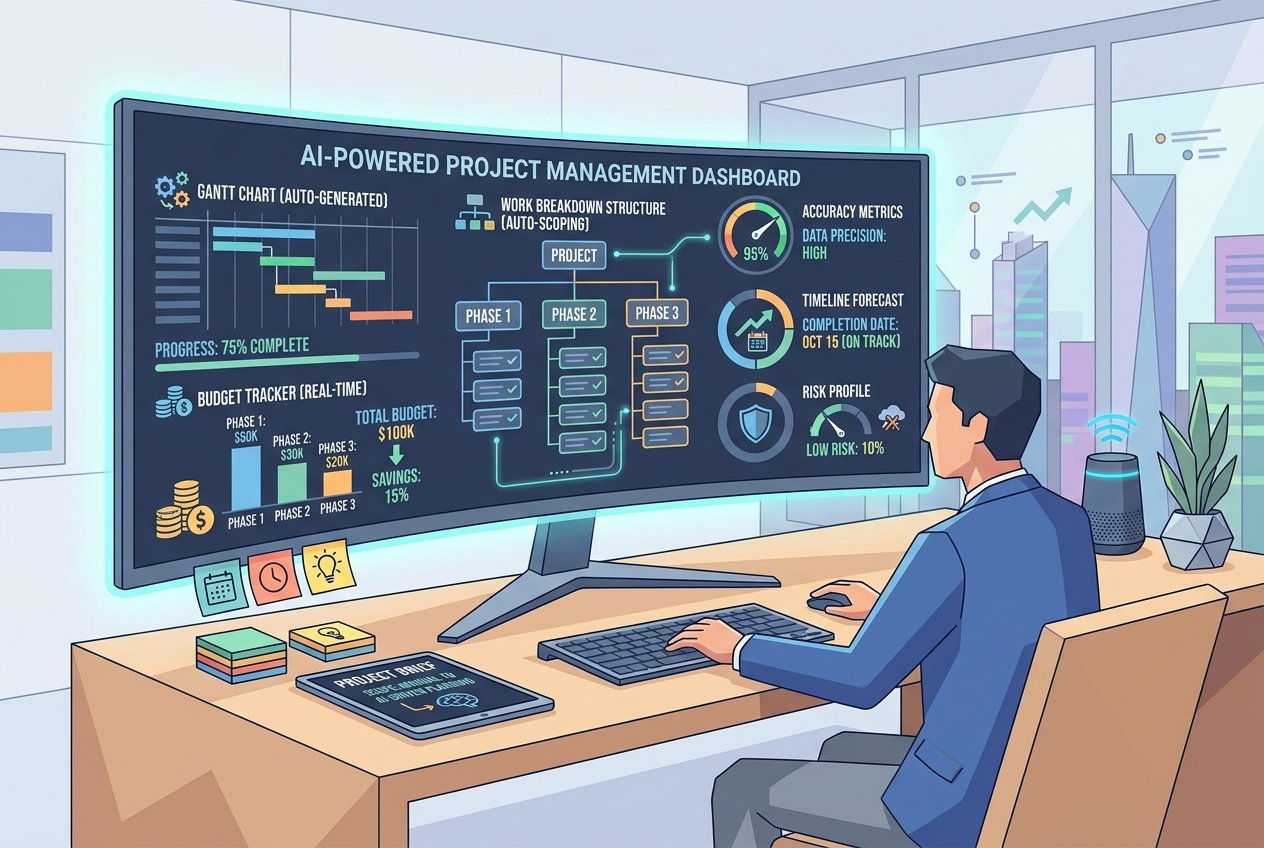
One of the most immediately useful applications of AI in scoping is the ability to convert a brief, a client conversation, or a high-level objective into a granular work breakdown structure within seconds. Tools such as ClickUp AI, Hive, and Asana Intelligence can analyse a project description provided in plain English and automatically generate task lists, dependencies, milestones, and suggested time allocations.
For a UK digital agency receiving a new website build brief, for example, AI can instantly decompose the project into discovery, UX design, development sprints, content population, testing, and deployment phases, each with suggested task-level estimates drawn from patterns in similar past projects. What might previously have taken a senior project manager two to three hours now takes minutes, with greater consistency and fewer blind spots.
Historical Data Analysis for Time Estimation
Human estimators are inherently optimistic. We tend to remember the projects that went well and underestimate the tail risks that derailed others. AI has no such cognitive bias. By analysing historical project data, including actual hours logged, team velocity, rework rates, and delay patterns, AI can generate time estimation benchmarks that are grounded in reality rather than aspiration.
According to research cited by Harvest, AI in project management can improve time estimate accuracy by up to 25%. When multiplied across dozens of projects per year, this improvement has a transformational effect on profitability and client satisfaction.
Platforms like Mosaic and Productive use machine learning to track how long specific task types actually take across your team, then feed this intelligence back into future estimates. The system gets smarter with every project you complete, compounding its value over time.
Predictive Risk Identification
Perhaps the most powerful application of AI in project scoping is its ability to identify risk before a project begins. Rather than discovering mid-delivery that a dependency was missed or that a particular task type consistently overruns, AI tools like Wrike can surface these patterns proactively at the scoping stage.
For instance, if your historical data shows that API integration tasks consistently take 40% longer than estimated, an AI system can flag this automatically when it appears in a new project scope, prompting the estimator to apply a more accurate buffer. This moves risk management from a reactive process to a proactive one, fundamentally changing how teams protect their project margins.
This capability is particularly valuable for UK consultancies and agencies producing accurate quotes for competitive tenders, where underpricing due to unidentified risks is a chronic and costly problem.
AI-Powered Project Planning Tools Worth Knowing in 2026
The market for AI-enhanced project planning tools has matured significantly. Here are the leading platforms UK teams are adopting in 2026:
- Wrike: Best known for predictive risk analysis, Wrike surfaces potential delays and dependency conflicts before they occur. Its AI analyses project structures and team capacity to generate risk-adjusted timelines, making it particularly effective for complex, multi-phase technical projects.
- ClickUp AI: Enables natural-language project scoping, converting briefs and meeting notes into structured task lists with AI-suggested time estimates. Excellent for agencies and small teams wanting rapid proposal generation.
- Asana Intelligence: Provides AI-powered workflow recommendations and risk surfacing for complex, interdependent project structures. Automates task breakdowns from high-level scope documents.
- Mosaic: A resource and project forecasting tool that uses AI to match team capacity against project demands, producing more accurate revenue and delivery forecasts. Particularly well-suited to professional services firms.
- Productive: An all-in-one agency management platform with AI-powered time estimation, smart project templates, and profitability tracking. Designed specifically for agencies managing multiple client projects simultaneously.
The project management software market is projected to grow from $10.56 billion in 2026 to $39.16 billion by 2035, reflecting the scale of investment businesses are making in smarter planning infrastructure. Choosing the right tool for your business model and workflows is critical to realising a return on that investment.
Building a Smarter Scoping Process with AI
Adopting AI tools is only part of the equation. To truly benefit from project scoping AI, businesses need to redesign their scoping process to take advantage of what AI does best. Here is a practical framework for UK teams looking to get started.
Step 1: Centralise Your Historical Project Data
AI is only as good as the data it learns from. The first priority is ensuring that all historical project data, including planned versus actual hours, task-level breakdowns, change requests, and client type, is captured in a centralised system. Many UK agencies are still running projects across a mix of spreadsheets, email threads, and disconnected tools, which makes it impossible for AI to generate meaningful insights.
Step 2: Standardise Your Scope Templates
AI performs best when it has consistent input structures to work with. Develop standardised scope templates for your most common project types, whether that is a branding project, a software sprint, a marketing campaign, or a consultancy engagement. These templates become the training ground for your AI estimation system and ensure comparable outputs across your team.
Step 3: Use AI to Generate and Pressure-Test Estimates
Once your AI tool has been configured with historical data and scope templates, use it to generate initial estimates for every new project. Critically, do not stop there. Use the AI to pressure-test your estimates by running scenario analyses, adjusting for team composition, complexity levels, and known risks. Tools like Wrike and Asana allow you to model multiple delivery scenarios and compare their outputs before committing to a client quote.
Step 4: Build Contingency Intelligently
Rather than applying a blanket percentage contingency to every project, AI enables you to build contingency that is proportionate to identified risk. A straightforward content migration project with a familiar technology stack warrants far less contingency than a bespoke software build with third-party integrations. AI can distinguish between these risk profiles and recommend appropriate buffers, producing accurate quotes that are competitive without being reckless.
Step 5: Review and Refine After Every Project
The final, and most often overlooked, step is feeding post-project data back into your AI system. After every project closes, conduct a structured retrospective comparing planned estimates to actual delivery. Feed this data back into your AI platform so it can refine its models for the next project. Over time, this creates a compounding improvement in estimation accuracy that becomes a genuine competitive advantage.
The UK Adoption Landscape
UK businesses are increasingly recognising the value of AI in their operations. According to a Deltek report published in April 2026, nearly half of UK organisations now report moderate productivity or cost improvements from AI, with a growing group of 12% already seeing significant measurable ROI. In project-based firms specifically, 29% are prioritising the operationalisation of AI for project forecasting, planning, reporting, and resource management.
Among UK SMEs, 35% are now actively using AI in some capacity, up from 25% in 2024, and the proportion with no plans to use AI has fallen sharply from 43% to 33%. The direction of travel is clear. Businesses that delay AI adoption in their project management workflows risk falling behind competitors who are already delivering faster, more accurately scoped projects at lower internal cost.
At Kaizen AI Consulting, we work with UK businesses to identify the right AI tools for their specific project workflows and implement them in a way that delivers measurable improvements in scoping accuracy, estimation reliability, and proposal quality. Whether you are a growing agency, a consultancy, or a project-based business looking to protect your margins, our team can help you move from manual estimation to intelligent, data-driven project planning. Explore our AI consulting services to find out how we can support your team.
Turning Better Estimates into a Sales Advantage
There is a dimension to accurate project scoping that is often overlooked: its impact on winning new business. When a potential client receives two proposals for the same project, one with a vague breakdown and a rough total, and another with a detailed, task-level scope, clear assumptions, and a transparent risk allowance, the latter wins trust every time. AI-powered scoping gives you the ability to produce the second type of proposal without spending hours on manual estimation.
Detailed, AI-assisted proposals also reduce the likelihood of disputes later in the project. When the scope is clearly defined from the outset, both the client and the delivery team share a common understanding of what is, and is not, included. This clarity is the single most effective tool for preventing scope creep, protecting your revenue, and building long-term client relationships built on trust.
For UK businesses wanting to understand how AI can be practically embedded into their sales and delivery processes, our article on building a business with AI at its core offers a helpful strategic perspective.
Getting Started: Practical Next Steps
If you are ready to improve your project scoping and time estimation processes with AI, here is where to begin:
- Audit your current scoping process to identify where estimates most commonly go wrong and where the largest margin losses occur.
- Evaluate two or three AI project planning tools against your specific workflow needs, starting with free trials of ClickUp, Wrike, or Asana.
- Invest in data quality by ensuring all current and future project data is captured consistently, as this is the foundation that makes AI estimation valuable.
- Pilot the approach on a low-risk project before rolling it out across your full project portfolio.
- Get expert support to accelerate implementation. Configuring AI tools for project-specific workflows can be complex, and getting it right from the outset saves significant time and frustration.
If you would like to explore how AI can transform your project scoping and estimation process, the team at Kaizen AI Consulting would love to hear from you. We offer tailored consultations for UK businesses looking to implement AI-powered project planning tools that deliver real, measurable results. Get in touch today and let us help you turn smarter scoping into a genuine competitive advantage.