Building an AI-Powered Knowledge Base for Your Team
Picture this: a new team member spends their first week bouncing between colleagues, email threads, and shared drives trying to piece together how your business actually operates. Meanwhile, your senior staff lose hours each week answering the same questions repeatedly. Sound familiar? For many UK businesses, this is the daily reality of poor team knowledge management — and it is quietly costing a fortune.
The good news is that knowledge base AI technology has matured significantly, and in 2026 it offers a genuinely practical solution for businesses of all sizes. Whether you run a growing SME or manage a large enterprise team, building an AI-powered knowledge base can transform how your organisation captures, shares, and retrieves critical information.
Why Traditional Internal Documentation Falls Short
Before exploring the solution, it is worth understanding the scale of the problem. According to UK Government AI Adoption Research, around 1 in 6 UK businesses are currently using at least one AI technology, yet the majority still rely on outdated document management practices: static PDFs, fragmented SharePoint folders, and tribal knowledge locked inside people’s heads.
Research consistently shows that employees spend between 20 and 30 per cent of their working week simply searching for information they need to do their jobs. In a 40-hour working week, that equates to up to 12 hours lost per person — not to productive work, but to searching through disorganised internal documentation. For a team of ten, that is 120 hours of productive capacity lost every single week.
Traditional knowledge bases suffer from several chronic problems:
- Information decay: Documents go out of date quickly, but nobody flags or updates them.
- Poor discoverability: Staff cannot find what they need because search tools are too literal and rigid.
- Siloed expertise: Knowledge lives with individuals rather than being embedded into systems.
- Inconsistency: Different teams maintain separate documentation, leading to conflicting guidance.
This is precisely where knowledge base AI changes the equation entirely.
What Is an AI-Powered Knowledge Base?
An AI-powered knowledge base is a centralised, intelligent repository that uses artificial intelligence to organise, surface, and continuously improve your team’s collective knowledge. Unlike traditional wikis or document libraries, an AI wiki does not simply store information — it understands it.
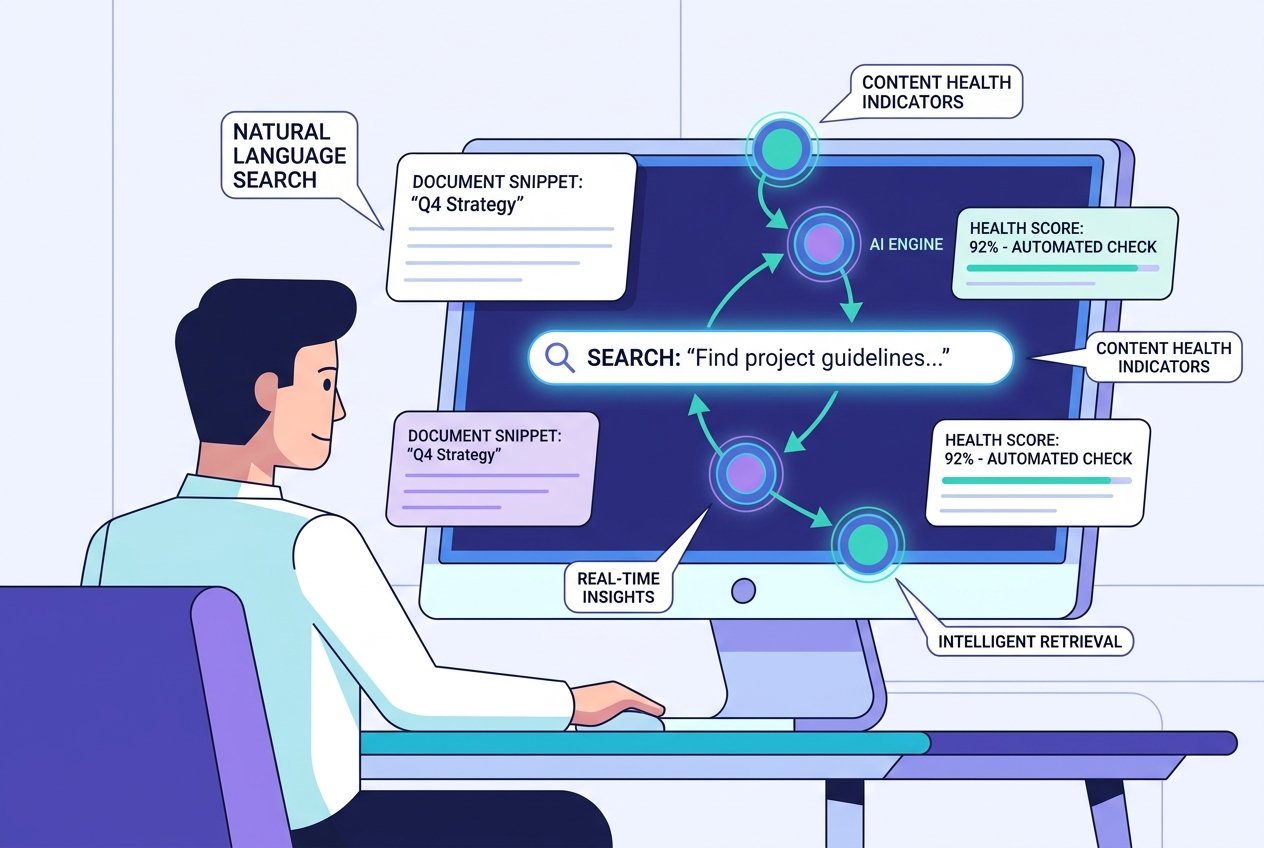
Modern AI knowledge management platforms use natural language processing (NLP) to interpret the intent behind a search query, rather than just matching keywords. Ask it a question in plain English and it synthesises an answer from across your documentation, citing the relevant sources. It is the difference between Googling a topic and having an expert colleague brief you directly.
According to Glitter AI’s 2026 Knowledge Management Report, 70% of organisations are expected to use AI-powered knowledge management systems to streamline information retrieval, with 38% of KM teams already using AI to recommend content and knowledge assets to their teams.
The Business Case: Key Benefits for UK Teams
1. Faster Onboarding and Training
One of the most immediate returns on investment comes from onboarding. When new hires can query an intelligent, always-updated knowledge base in natural language, they reach productivity significantly faster. eGain’s enterprise platform, for example, reports a 40% improvement in agent training speed following AI knowledge base implementation. For UK businesses dealing with staff turnover or rapid growth, this alone can justify the investment.
2. Reduced Repetitive Interruptions
When your knowledge base can answer common questions instantly, senior team members are freed up for higher-value work. Studies cited by eGain show up to 70% call and query deflection in organisations that deploy AI-guided knowledge systems, meaning fewer repetitive interruptions and more focused, deep work across the team.
3. Self-Healing Documentation
One of the most powerful features of modern knowledge base AI is automated content health monitoring. The system can flag outdated or potentially incorrect information and suggest updates, effectively creating a self-healing knowledge base that stays current without constant manual maintenance. According to Bloomfire’s 2026 Knowledge Management Trends report, this capability is among the six most significant trends reshaping how teams manage knowledge this year.
4. Competitive Productivity Gains
The UK’s AI market was valued at £72.3 billion in 2026, making it the third largest AI market in the world. Meanwhile, research into UK SME AI adoption estimates that full AI integration could boost UK productivity by 1.5% annually — equivalent to £47 billion over a decade. Businesses that implement AI knowledge management now are building a meaningful competitive advantage over those that delay.
5. Better Decision-Making Across the Organisation
When everyone in your team has instant access to accurate, up-to-date information, decisions get made faster and with greater confidence. Junior team members are empowered to act autonomously. Managers spend less time being consulted on routine questions. And your business develops a stronger, more consistent culture of informed decision-making.
Top AI Knowledge Base Tools to Consider in 2026
The market for AI wiki and knowledge management tools has grown rapidly. Here are some of the leading platforms worth evaluating for your team:
- Guru: Excellent for internal knowledge management, with AI search that works across your existing apps including Slack, Microsoft Teams, and Google Drive. Particularly strong for remote and hybrid teams.
- Notion AI: A flexible all-in-one workspace popular with UK startups and agencies. Its AI assistant can draft, summarise, and query content across your workspace.
- Confluence with AI: Ideal for businesses already within the Atlassian ecosystem. Enterprise-grade collaboration with AI-powered search and page summarisation.
- Document360: Focused on structured documentation, with its Synapse Conversational AI delivering plain-language answers with cited source responses and automatic detection of outdated content.
- Slite: Designed specifically for team documentation, with a clean interface and AI-powered search built from the ground up for knowledge management rather than general project management.
- eesel AI: A powerful AI layer that sits on top of your existing tools, connecting to over 100 knowledge sources with flat monthly pricing and no per-resolution fees.
The right choice depends on your team size, existing tech stack, budget, and the complexity of your knowledge management needs. This is an area where getting expert guidance early can save considerable time and money — something the team at Kaizen AI Consulting helps UK businesses navigate every day, matching the right tools to each organisation’s specific requirements.
How to Build Your AI-Powered Knowledge Base: A Step-by-Step Approach
Step 1: Audit Your Existing Knowledge
Before selecting any platform, map out what knowledge your business currently holds and where it lives. This includes process documents, training materials, FAQs, policy guides, product information, and institutional knowledge held by individuals. Identify gaps, redundancies, and the most frequently asked questions your team fields internally.
Step 2: Define Your Use Cases
Who will use the knowledge base, and for what purpose? Will it primarily serve customer-facing staff needing quick answers? Will it support onboarding? Will it be a central repository for all internal documentation? Clarity on use cases drives better platform selection and content architecture decisions.
Step 3: Choose the Right Platform
Evaluate platforms based on your use cases, team size, integration requirements, and budget. Pay particular attention to the quality of AI search, ease of content creation and maintenance, and how the platform handles outdated or conflicting information. Most platforms offer free trials — use them with real content from your business, not dummy data.
Step 4: Structure Your Content Architecture
An AI tool is only as good as the content it has access to. Invest time in creating a logical, well-structured content hierarchy. Use consistent naming conventions, clear categories, and standardised templates. As Glitter AI’s research highlights, poor data quality undermines AI performance — clean, well-organised content is foundational to success.
Step 5: Migrate and Enrich Your Existing Content
Begin migrating your most critical existing documentation into the new platform, reviewing and updating each piece as you go. This is also an opportunity to retire outdated content and identify knowledge gaps that need new documentation created.
Step 6: Train Your Team and Drive Adoption
The most sophisticated AI knowledge base delivers zero value if your team does not use it. Invest in proper onboarding, make the knowledge base the first place people look for answers, and actively discourage workarounds like asking colleagues before checking the knowledge base. Celebrate contributions and create a culture where knowledge sharing is valued.
Step 7: Monitor, Measure, and Improve
Track key metrics including search success rates, unanswered queries, most frequently accessed content, and team adoption rates. Use these insights to continuously improve your content, fill gaps, and refine how your knowledge base is structured and used.
Common Pitfalls to Avoid
Many team knowledge management projects stall or fail not because of technology, but because of people and process issues. Watch out for these common mistakes:
- Treating it as a one-time project: A knowledge base requires ongoing curation and maintenance. Assign clear ownership and schedule regular reviews.
- Migrating everything uncritically: Quantity is not quality. Migrating years of outdated, contradictory documentation creates confusion rather than clarity.
- Underestimating change management: Getting people to change where they look for information is a cultural challenge as much as a technical one. Leadership buy-in is essential.
- Neglecting governance: Without clear standards for who can create, edit, and approve content, quality deteriorates quickly.
The Role of AI Consulting in Successful Implementation
Whilst the tools themselves have become increasingly user-friendly, the strategy behind a successful AI knowledge management implementation — from platform selection and content architecture through to change management and ongoing governance — remains genuinely complex. Many UK businesses find that working with an experienced AI consultancy accelerates results and avoids costly mistakes.
At Kaizen AI Consulting, we work with UK businesses to design, implement, and optimise AI-powered knowledge management systems that genuinely embed into how teams work. From identifying the right platform for your specific needs to building the content frameworks and governance structures that make it sustainable, we bring the strategic and technical expertise to get it right from the start. If you are ready to transform how your team captures and accesses knowledge, get in touch with our team today for a no-obligation conversation about how we can help.
The Future of Team Knowledge Management
Looking ahead, the capabilities of knowledge base AI will only continue to advance. The next frontier includes proactive knowledge surfacing — where the system anticipates what information you need before you ask — and deeper integration with agentic AI systems that can act on knowledge, not just retrieve it. Microsoft’s 2026 AI trends report highlights AI as an increasingly collaborative partner in team workflows, with knowledge management sitting at the heart of this shift.
For UK businesses, the window to gain a first-mover advantage in AI-powered knowledge management is narrowing. With nearly two-thirds of UK organisations now using AI in some form, those still relying on static wikis and disorganised shared drives are falling further behind each month.
The question is no longer whether to build an AI-powered knowledge base, but how quickly you can do it well. The businesses that act now will compound the benefits of better, faster, more consistent knowledge management across their teams — and that is a competitive advantage that is very difficult to replicate once it is embedded in a culture.