For many small business owners across the UK, cybersecurity feels like a problem reserved for multinational corporations with dedicated IT departments and million-pound budgets. Yet the data tells a very different story. According to the UK Government’s Cyber Security Breaches Survey 2025/2026, 43 per cent of UK businesses experienced a cyber breach or attack in the last 12 months. That translates to roughly 612,000 businesses nationwide. Among micro businesses, a staggering 70 per cent identified phishing as their most disruptive incident.
The reality is clear: small business cyber threats are not only real, they are escalating. The good news? AI security tools have matured to the point where even businesses without a single IT professional on staff can implement robust, enterprise-grade protection.
Why Small Businesses Have Become Prime Targets
Cybercriminals are rational actors. They go where the defences are weakest and the returns are most reliable. Unfortunately, that often means targeting small and medium enterprises (SMEs). The World Economic Forum’s Global Cybersecurity Outlook 2026 reports that 46 per cent of small organisations lack the cybersecurity skills and expertise needed to defend themselves effectively.
The Financial Impact of Cyber Attacks on SMEs
When a small business suffers a breach, the consequences extend far beyond a temporary website outage. Recent figures indicate that the average cost of a successful breach for smaller UK businesses exceeds £25,000. For a business operating on tight margins, a single incident can threaten cash flow, customer trust, and regulatory compliance. The UK Government survey notes that the mean cost of cyber crime stands at £1,970 per incident, with firms employing fewer than 50 people facing average losses closer to £3,398. Ransomware attacks now account for 37 per cent of all cyber incidents.
Why Traditional Security Approaches Fail for SMEs
Historically, effective cybersecurity required layered defences: firewalls, intrusion detection systems, security information and event management (SIEM) platforms, and 24/7 monitoring. Implementing and maintaining this technology demanded specialists. Most UK SMEs simply cannot justify a full-time cybersecurity analyst. This gap between need and resource has created a vast population of underprotected businesses. That is precisely why cyber protection SME solutions powered by artificial intelligence are transforming the market.
The Rise of AI-Powered Threats
Artacks are no longer the work of lone hackers in basements. Modern adversaries use artificial intelligence to scale and refine their operations. The National Cyber Security Centre (NCSC) warns that AI is likely to make cyber intrusion operations more effective and efficient, increasing both the frequency and intensity of threats. In the first half of 2025 alone, approximately £100 million was lost to investment scams driven by deepfake videos.
AI-powered phishing represents one of the fastest-growing dangers. Generative AI can craft grammatically perfect, contextually convincing emails that mimic senior executives, suppliers, or HMRC. These messages bypass traditional spam filters because they do not contain the broken English or suspicious links that older systems were designed to catch. IBM’s latest security research confirms that attackers now use AI not only to generate content but also to exploit AI systems themselves through prompt injection attacks.
How AI Levels the Playing Field
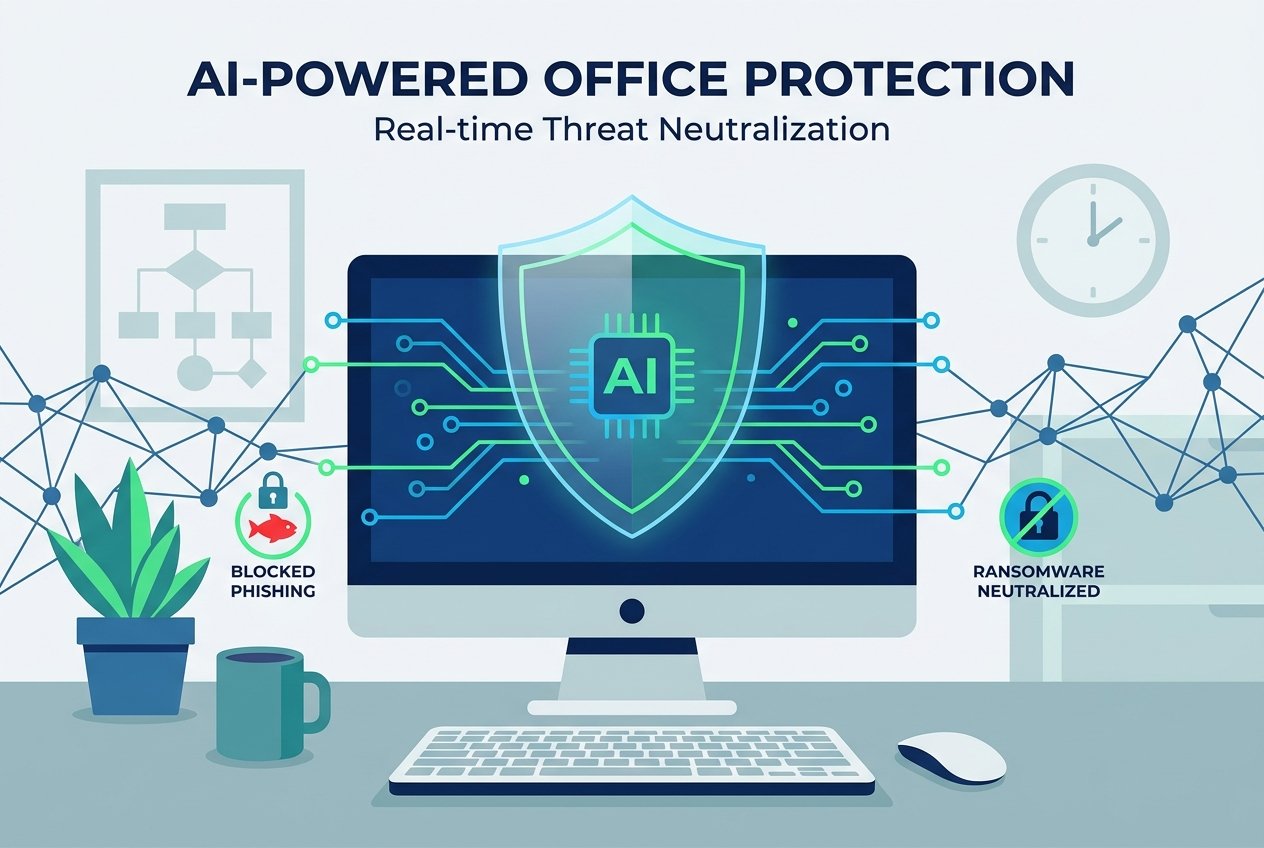
Just as criminals have weaponised AI, defenders have done the same. AI cybersecurity small business solutions are specifically designed to automate the tasks that once required human specialists. Machine learning algorithms analyse patterns across millions of data points to detect anomalies in real time. They identify suspicious login attempts, flag unusual file transfers, and quarantine malware before it spreads.
For businesses without an IT team, automation is everything. AI security tools operate continuously, never take holidays, and learn from every attack they encounter. Industry data shows that automated threat detection systems reduced incident response time by 31 per cent on average. For a small business facing a ransomware attack, that reduction can mean the difference between a minor disruption and a catastrophic shutdown.
Essential AI Security Tools for UK Small Businesses
Implementing AI cybersecurity does not require a forklift upgrade of your entire technology stack. Many solutions integrate seamlessly with platforms you already use. Here are the most practical, UK-available options for SMEs without dedicated IT staff.
Endpoint Protection and Response
Microsoft Defender for Business offers AI-powered threat detection and automated response built directly into the Microsoft ecosystem. For businesses already using Microsoft 365, this represents the lowest-friction entry point into AI cybersecurity small business protection. It monitors endpoints for suspicious behaviour, isolates compromised devices automatically, and provides a centralised dashboard that requires minimal technical expertise to interpret.
Bitdefender GravityZone Business Security Premium provides an all-in-one endpoint protection suite with proactive prevention and forensic capabilities. It is specifically designed for smaller teams that want simplified centralised management without sacrificing depth of protection.
Email and Collaboration Security
Since phishing remains the dominant threat vector, email security deserves particular attention. Google Workspace Security bundles AI-powered phishing and malware blocking into Gmail and the wider Workspace suite. It analyses sender reputation, message context, and link safety in real time, quarantining dangerous content before it reaches employees.
For businesses that handle sensitive client data or operate under sector-specific regulations, CrowdStrike Falcon offers enterprise-grade endpoint detection with AI-driven analysis. While it leans toward larger SMEs, its automated response capabilities significantly reduce the manual oversight required.
Cloud and Identity Protection
As more small businesses migrate operations to the cloud, securing cloud environments becomes essential. SentinelOne Singularity Complete delivers unified AI-driven detection and automated response across endpoints, cloud workloads, and identity systems. This convergence is particularly valuable for SMEs using a mix of on-premises and cloud services.
For businesses developing software or managing digital products, Snyk uses AI to scan code, open-source libraries, and containers for vulnerabilities. Even small development teams can integrate it into existing workflows without prolonged setup.
Building Your Cybersecurity Foundation: A Practical Roadmap
Technology alone cannot protect your business. A robust defence requires policy, training, and procedure working in tandem with AI tools. Here is a practical framework for implementation.
Step One: Audit Your Current Exposure
Begin by cataloguing your digital assets. What data do you hold? Where is it stored? Who has access? This audit should cover laptops, mobile devices, cloud storage, email accounts, and any customer databases. Understanding your attack surface is the prerequisite for choosing the right tools.
Step Two: Prioritise Email and Endpoint Protection
With 70 per cent of micro businesses citing phishing as their most disruptive threat, email security should be your first investment. Layer this with endpoint protection on every device that accesses company data. These two controls alone will eliminate the vast majority of common attacks.
Step Three: Implement Multi-Factor Authentication
No AI cybersecurity small business strategy is complete without multi-factor authentication (MFA). MFA adds a critical second layer of verification, rendering stolen passwords largely useless. Enable it on every cloud service, email account, and administrative panel your business uses.
Step Four: Automate Backups and Updates
Ransomware succeeds because victims lack clean backups. Implement automated, encrypted backups to an offline or segregated location. Similarly, enable automatic software updates. Unpatched vulnerabilities remain one of the easiest entry points for attackers, and AI-driven patching tools can handle this without human intervention.
Step Five: Train Your People
Even the most sophisticated AI security tools cannot stop an employee from voluntarily transferring funds to a fraudster. Regular, concise training sessions on recognising phishing, social engineering, and deepfake scams are essential. Modern AI training platforms can simulate attacks and provide personalised coaching based on individual performance.
How Kaizen AI Consulting Can Help
Selecting, configuring, and maintaining the right security stack can feel overwhelming when you are already managing every other aspect of your business. At Kaizen AI Consulting, we specialise in helping UK small businesses navigate the AI and cyber protection SME landscape without jargon or unnecessary complexity.
Our team can assess your current infrastructure, recommend AI security tools suited to your budget and risk profile, and manage implementation so your operations continue uninterrupted. Whether you need guidance on Microsoft Defender deployment, cloud security configuration, or staff training programmes, we bring enterprise-level expertise to organisations that do not have enterprise-level resources. Get in touch with our team to discuss a tailored cybersecurity assessment for your business.
Conclusion: Protection Is Within Reach
UK cybersecurity is no longer the exclusive domain of large corporations. The democratisation of AI security tools means that small businesses can now access intelligent, automated defences that were unavailable even five years ago. With 43 per cent of UK businesses experiencing breaches annually, doing nothing is no longer a viable strategy.
By investing in the right tools, following a clear implementation roadmap, and partnering with specialists when needed, you can protect your business, your customers, and your reputation without hiring a single IT professional. The question is not whether you can afford to implement AI cybersecurity. Given the cost of a breach, the question is whether you can afford not to.
Ready to secure your business with intelligent, affordable AI protection? Contact Kaizen AI Consulting today for a free consultation and discover how we can help you build a resilient digital defence.