How to Optimise Your Website for ChatGPT, Gemini, and Perplexity in 2026
The way people search for information has changed fundamentally. Where once your entire digital strategy revolved around climbing Google’s blue-link results pages, 2026 demands something far more sophisticated. AI-powered answer engines including ChatGPT, Google Gemini, and Perplexity are rapidly reshaping how consumers and businesses discover content online, and if your website is not optimised for these platforms, you are already falling behind.
According to McKinsey, half of all consumers are now using AI-powered search, a shift that could impact up to $750 billion in revenue by 2028. Meanwhile, Wix’s AI Search Lab reports that AI search visits grew 42.8% year-on-year in Q1 2026, with 27.4 billion visits to AI search platforms in that quarter alone. For UK businesses, this is not a future trend to plan for. It is an active commercial reality happening right now.
This guide walks through the most effective strategies for achieving strong visibility across the leading AI search platforms in 2026, from technical fundamentals to content strategy and off-page authority building.
Understanding the New Search Landscape: SEO vs GEO vs AEO
Before diving into tactics, it helps to understand the terminology shaping AI search optimisation today.
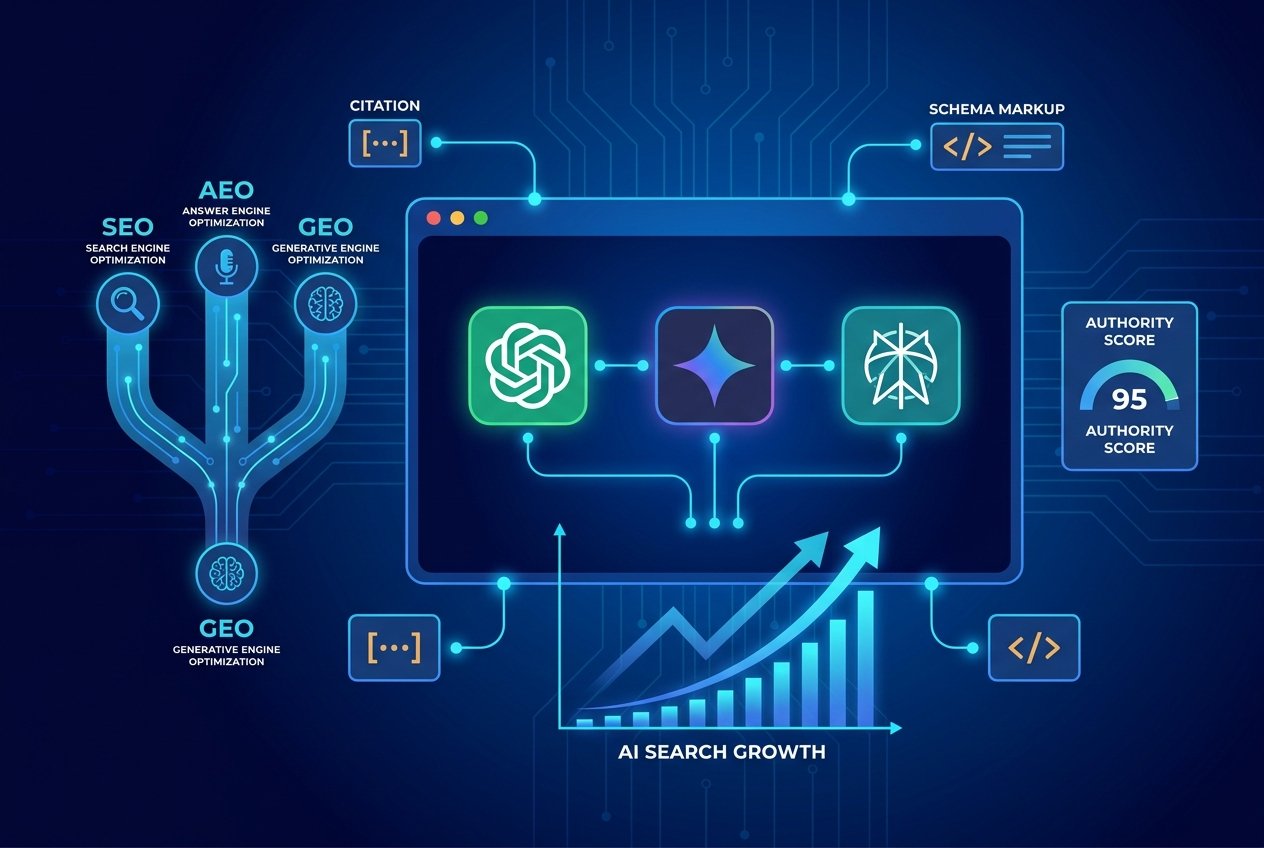
Traditional SEO focuses on earning rankings in search result pages. Answer Engine Optimisation (AEO) is the practice of ensuring your content appears as a direct answer to specific queries, such as Google’s featured snippets or People Also Ask boxes. Generative Engine Optimisation (GEO) takes this further: it is the discipline of structuring your content and digital presence so that AI systems like ChatGPT, Gemini, and Perplexity actively cite, quote, and recommend your brand within their generated responses.
According to Search Engine Land, 2026 is being described as the tipping point for GEO, with brands that invest in generative search visibility now positioned to dominate their categories as adoption accelerates. Gartner has predicted that traditional search engine volume could drop by as much as 25% as users continue shifting towards conversational AI interfaces.
For businesses seeking to navigate this landscape, working with specialists who understand both the technical and strategic dimensions of AI search can make all the difference. At Kaizen AI Consulting, our team helps UK businesses develop robust GEO and AI search strategies tailored to their sector and audience.
1. Write Answer-First Content That AI Wants to Cite
The single most important shift you can make is to structure your content so that AI systems can easily extract, quote, and cite it. Generative AI models are trained to synthesise information and provide direct answers. Pages that lead with clear, concise, well-supported responses to questions are significantly more likely to be included in AI-generated answers.
Key principles for answer-first content:
- Place the core answer or definition in the opening paragraph of each page or section
- Use descriptive H2 and H3 headings that mirror the way users phrase questions
- Keep paragraphs short and self-contained so individual passages can be extracted without losing meaning
- Include comparison tables, bullet-pointed lists, and numbered steps wherever the content supports it
- Add FAQ sections that directly address common questions in your niche
ROI Revolution identifies this modular, extractable formatting as one of the highest-impact changes a site can make for AI search visibility. Research cited by Digital Applied from Princeton’s GEO studies suggests that adding citations, statistics, and quotations can improve AI visibility by 30 to 40% compared to unoptimised content.
2. Implement Structured Data and Schema Markup
Schema markup remains one of the most powerful tools for improving AI citations visibility. When you add structured data to your pages, you provide machine-readable context that helps AI systems understand exactly what your content is, who produced it, and what it covers.
The most valuable schema types for AI search optimisation in 2026 include:
- Article and BlogPosting for editorial and informational content
- FAQPage for question-and-answer sections that AI systems frequently extract
- HowTo for step-by-step guides and instructional content
- Organization and Person to establish entity identity and author authority
- LocalBusiness for UK companies with physical locations or service areas
- BreadcrumbList to clarify site structure and content hierarchy
- Product and Review for e-commerce and service-based businesses
For UK businesses specifically, ensuring your LocalBusiness schema includes accurate UK address details, telephone numbers in the correct format, and GBP pricing where relevant helps AI systems confirm your geographical relevance and trust signals. Consistency between on-page content and schema data is critical, as discrepancies can undermine credibility with both AI systems and traditional search engines.
Google’s own guidance on succeeding in AI search reinforces that technical accessibility and structured data remain foundational requirements for appearing in generative search responses.
3. Strengthen E-E-A-T Signals Across Your Site
Experience, Expertise, Authoritativeness, and Trustworthiness (E-E-A-T) are no longer just Google ranking factors. They are the signals that all major AI systems use to assess whether content is credible enough to cite. ChatGPT’s web browsing, Perplexity’s real-time citations, and Gemini’s sourcing all rely on trust indicators that map closely to E-E-A-T principles.
Practical steps to strengthen E-E-A-T for LLM SEO:
- Add detailed author biographies that include professional credentials, industry experience, and links to social profiles or publications
- Publish an editorial policy or about page that explains how content is researched, reviewed, and updated
- Back every factual claim with a linked, reputable source
- Display visible publication and last-updated dates on all content
- Include original research, case studies, or first-hand experience where possible
- Ensure your About, Contact, and Privacy pages are thorough and easy to find
Perplexity in particular is citation-oriented by design. It displays its sources transparently to users, which means pages from brands with strong authority signals are more likely to be surfaced. SE Ranking’s research found that sites receiving more than 190,000 monthly visitors are more likely to be selected as sources in ChatGPT results, and sites with over 134,000 visitors are 2.3 times more likely to be cited in Google’s AI Mode. Authority and traffic are deeply connected in the AI citation ecosystem.
4. Build Topical Authority Through Content Clusters
AI search systems favour brands that cover topics comprehensively. A single optimised page is rarely sufficient. What drives genuine LLM SEO performance is a content cluster strategy: a hub page on a core topic supported by a network of related, interlinked pages that explore subtopics, address specific questions, and cover different audience intents.
For example, a UK accountancy firm seeking AI citations visibility in 2026 would benefit not just from a single page about corporation tax, but from a cluster that includes guides on making tax digital, small business allowances, VAT registration thresholds, and R&D tax credits, all tightly interlinked and referencing one another.
This approach signals to AI systems that your brand is a genuine authority on a subject rather than a source of isolated, thin content. The Rank Masters highlights topical depth and hub-and-spoke internal linking as core differentiators for AI visibility in 2026.
Strong internal linking also helps ensure that AI crawlers and traditional search bots can navigate your site efficiently, distributing authority across your most important pages. Our Kaizen AI Consulting blog explores content strategy and AI marketing in depth, with practical guidance for UK businesses looking to build authority in their sector.
5. Optimise for Freshness and AI Crawlability
Recency is a significant trust signal for AI search systems. Perplexity, ChatGPT’s browsing mode, and Gemini all weight freshness when selecting sources for time-sensitive queries. Pages that carry a clear, accurate last-updated date, that are regularly refreshed with current statistics, and that reflect recent developments in their field will consistently outperform stale content.
Practical freshness optimisation steps:
- Add a visible last-updated date to every key page and include
dateModifiedin your Article schema - Set quarterly content review cycles for your top-performing pages and highest-traffic blog posts
- Update statistics, examples, screenshots, and external links as sources change
- Avoid blocking AI crawlers in your robots.txt file unless there is a specific reason to do so
- Ensure key content is rendered in the initial HTML rather than depending entirely on JavaScript loading, as some AI crawlers struggle with JS-only content
- Maintain fast page speeds and a mobile-friendly experience, as technical performance remains part of overall site trust
According to Local Falcon’s 2026 update, visible update dates and dateModified schema are among the most consistently recommended trust signals for AI search optimisation across all major platforms.
6. Earn Off-Page Authority and AI Citations Through Digital PR
On-page optimisation can only take you so far. AI systems, particularly ChatGPT and Perplexity, draw on the broader web ecosystem to determine which sources are trustworthy enough to cite. This means that digital PR, third-party mentions, and off-page authority building are now core components of any serious AI search visibility strategy.
High-impact off-page tactics for AI citations:
- Pursue editorial coverage in authoritative UK publications relevant to your sector, from trade press to national media
- Contribute expert commentary, guest articles, and thought leadership pieces to respected industry platforms
- Ensure your business is listed accurately across UK directories including Companies House records, industry associations, and relevant review platforms
- Collect and display genuine customer reviews on trusted platforms such as Google Business Profile, Trustpilot, and relevant industry review sites
- Publish original research, surveys, or benchmarking reports that other sites will naturally reference and link to
- Maintain consistent entity data (business name, address, contact details) across all external platforms, as inconsistency creates ambiguity for AI systems
Exposure Ninja reports that AI platforms generated 1.13 billion referral visits in June 2025 alone, representing a 357% increase from June 2024. The brands capturing the majority of that traffic are those that have invested in both on-page optimisation and off-page authority. Yotpo’s 2026 guide identifies citation authority through digital PR as one of the defining competitive advantages in generative search.
7. Treat AI Search as a Branding Channel, Not Just a Traffic Source
Perhaps the most important mindset shift for 2026 is recognising that AI search visibility is primarily a brand-building exercise. When ChatGPT recommends your business in response to a query, or when Perplexity cites your article as a source, users see your brand name in a context of authority and trust. This brand exposure is valuable even when users do not click through to your site immediately.
eMarketer’s 2026 report on generative engine optimisation concludes that brands which treat AI as a branding channel and manage GEO separately from traditional SEO will be best positioned to adapt as the landscape evolves. SE Ranking notes that users click only once for every 20 AI search prompts, underscoring that impressions and citations matter independently of direct click-through traffic.
For UK businesses ready to develop a structured approach to AI search optimisation, ChatGPT visibility, and LLM SEO, the team at Kaizen AI Consulting is here to help. From technical schema implementation to content cluster strategy and digital PR planning, we work with organisations across the UK to build meaningful, measurable AI search visibility that drives long-term commercial results.
AI Search Optimisation Checklist for 2026
Use this quick reference checklist to audit your current position:
- Content leads with direct answers and clear definitions
- Pages use descriptive H2/H3 headings that match user queries
- FAQPage, Article, HowTo, and Organization schema are implemented
- Author bios include professional credentials and are linked to external profiles
- Last-updated dates are visible on key pages and included in schema
- Key content pages are part of a linked topic cluster
- Core content is rendered in HTML, not purely JavaScript
- AI crawlers are permitted in robots.txt
- Business entity data is consistent across all external platforms
- A digital PR strategy is in place to earn third-party mentions and citations
- UK-specific schema includes local address, phone, and GBP pricing details
Final Thoughts
The shift to AI-powered search is not slowing down. With 904 million average monthly users of AI search platforms in Q1 2026 and AI search visits growing at nearly 43% year-on-year, the brands that invest in AI search optimisation today will hold a significant advantage over those that delay. The good news is that many of the foundational principles of good content and technical SEO remain relevant. What is new is the emphasis on structured extractability, topical depth, entity authority, and off-page citation building that together define successful generative search visibility.
Whether you are starting from scratch or looking to refine an existing strategy, the framework above provides a clear path to improving your visibility in ChatGPT, Gemini, Perplexity, and Google’s AI Overviews. The businesses that act now will be the ones that AI systems recommend tomorrow.