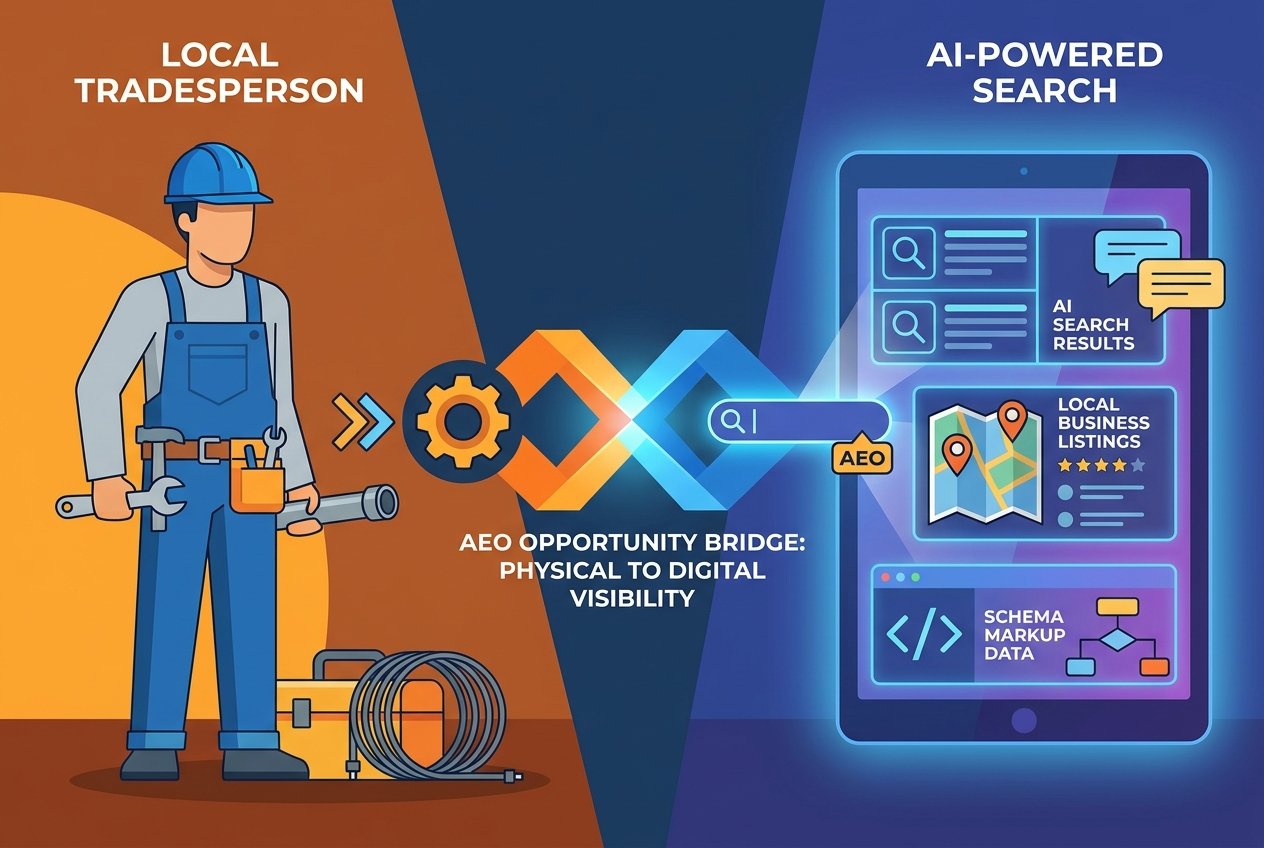
UK consumers conducted over 580,000 online searches for local tradespeople in a single five-month period in 2025, yet only 34% of independent tradespeople currently have an effective digital presence. Now, a new layer of complexity is reshaping that landscape: AI search. If you run a plumbing, electrical, roofing, building, or any other trades business in the UK, understanding local AEO (Answer Engine Optimisation) could be the competitive edge that separates you from every other van on the road.
This guide explains what local AEO and GEO (Generative Engine Optimisation) actually mean for trades businesses, why being cited in AI search results matters, and the practical steps you can take right now to improve your AI visibility as a local business.
What Is Local AEO and Why Does It Matter for Trades Businesses?
Answer Engine Optimisation (AEO) is the practice of structuring your online content so that AI-powered search tools, such as Google AI Overviews, ChatGPT, Perplexity, and Microsoft Copilot, can extract and cite your business as the authoritative answer to a user’s query. GEO local SEO, or Generative Engine Optimisation with a local focus, takes this a step further by ensuring your business appears in AI-generated responses that include geographic intent, such as “best emergency plumber in Birmingham” or “recommended electrician near me.”
According to a 2026 CMO Investment Report by Conductor, 97% of marketing leaders reported a positive impact from AEO in 2025, and 94% planned to increase their AEO investment in 2026. Meanwhile, research from SEO Works found that nearly 48% of UK adults now use AI-assisted tools to find information, up roughly 22 percentage points year on year. For tradespeople, these are not abstract marketing trends; they are changes to how your next customer will find you.
The shift is already measurable. An analysis cited by Whitehat SEO found that only 12% of URLs cited by AI assistants also rank in Google’s traditional top 10 for the same queries, which means your standard Google ranking alone is no longer sufficient for full AI visibility as a local business. Equally significant: AI-referred traffic converts at 5 to 9 times the rate of standard organic search clicks. For a trades business, fewer but higher-intent leads can mean a meaningfully better pipeline.
How AI Search Tools Decide Who Gets Cited
Understanding how tools like Google AI Overviews, ChatGPT, and Perplexity select their sources is the foundation of any effective local AEO strategy for trades. These systems do not pick results at random. They draw on several trust and relevance signals:
Credibility and Entity Recognition
AI systems look for businesses that appear as consistent, recognisable entities across the web. If your business name, address, phone number (NAP), and service descriptions are uniform across your website, Google Business Profile, trade directories, and local citations, AI tools are far more likely to recognise and cite you. Research from Searchlab indicates that 86% of AI citations come from brand-managed sources such as websites and verified listings, meaning you have significant control over your own AI visibility.
Structured, Answer-Ready Content
AI tools prefer content that directly answers specific questions. A page that opens with a clear, concise answer to “how much does a boiler service cost in Manchester?” is far more likely to be extracted and cited than a general homepage. For trades AI search, this means investing in service pages, FAQ sections, and location-specific content that mirrors the questions your customers are already asking.
Schema Markup and Structured Data
Schema markup is the technical language that tells search engines and AI systems exactly what your content is about. For trades businesses, the most valuable schema types include LocalBusiness (with specific subtypes such as Plumber, Electrician, or RoofingContractor), FAQPage, Service, and HowTo schema. Adding these to your website makes it significantly easier for AI systems to extract accurate information and present your business as a confident, verified answer.
E-E-A-T Signals: Experience, Expertise, Authority, Trust
Google’s quality guidelines and AI training models both place enormous weight on E-E-A-T. For a trades business, this means demonstrating genuine expertise through named and accredited staff, real project photos and case studies, trade body memberships (Gas Safe, NICEIC, NAPIT, FMB, and similar), customer reviews, and transparent business information. A boilerplate website with no credentials will struggle to compete in AI citations against a business that clearly demonstrates its real-world experience and qualifications.
A Practical Local AEO Checklist for UK Tradespeople
Getting started with trades AI search optimisation does not require a complete website rebuild. Below is a focused checklist that any plumber, electrician, builder, roofer, or heating engineer can begin working through today.
1. Optimise Your Google Business Profile for AI
Your Google Business Profile (GBP) is one of the most powerful local trust signals available to any trade business. Keep every field fully completed and up to date: business name, address, phone number, opening hours, emergency availability, service areas, primary and secondary categories, and booking links. Upload regular photos of your work, your team, and your certificates. Collect fresh reviews consistently, ideally with language that mentions the specific job, your trade, and your location. AI systems draw heavily on GBP data when constructing local answers, so a poorly maintained profile is a direct barrier to AI visibility for local business.
2. Create Dedicated Service and Location Pages
A single homepage cannot cover the breadth of trade queries that AI tools receive. Build separate, well-written pages for each core service you offer, such as boiler installation, emergency callouts, fuse board upgrades, roof repairs, or damp proofing, and for each key location or area you serve. Each page should open with a direct, concise answer to the most common question a customer would ask, then expand into detail, pricing guidance, credentials, and a clear call to action. This structure is precisely what AI Overviews and similar tools need to extract a confident, cited response.
3. Add FAQ Sections to Every Key Page
FAQ sections are among the highest-value content investments for local AEO. Questions like “How much does a full rewire cost in Leeds?”, “Is my roofer required to be registered?”, “How quickly can an emergency plumber arrive?”, or “What does a Gas Safe certificate cover?” map directly to the voice and text queries people put into AI tools. Write answers that are concise, specific, and genuine. Mark them up with FAQPage schema for maximum machine readability and AI extractability.
4. Implement LocalBusiness Schema Markup
Add structured data to your website using the appropriate LocalBusiness schema subtype for your trade. Include your NAP details, service area, opening hours, accreditations, and links to your Google Business Profile and trade body listings using the sameAs property. If your website platform does not support this natively, a developer or an experienced digital agency can implement it quickly. This markup is a foundational element of GEO local SEO that many trades websites still lack entirely, giving those who act now a meaningful first-mover advantage.
5. Build Consistent Local Citations
Local citations, meaning mentions of your business name, address, and phone number on third-party directories and websites, strengthen your entity recognition in both traditional search and AI search systems. Prioritise high-quality, UK-relevant sources: Checkatrade, TrustATrader, Rated People, Yell, local council supplier registers, chambers of commerce, and your relevant trade association directories. Consistency is more important than volume; mismatched details across listings actively undermine your AI citation potential.
6. Demonstrate E-E-A-T Across Your Website
Add an About page that names the business owner, lists qualifications, trade body memberships, and years of experience. Create a dedicated accreditations page or section. Publish project case studies with before-and-after photographs. Link your Gas Safe, NICEIC, FMB, or other registration numbers directly. The more clearly your website reads as the profile of a real, qualified, insured, and trustworthy tradesperson, the more confidently AI tools will cite it in response to local queries.
GEO Local SEO: Going Beyond Traditional Rankings
The distinction between traditional local SEO and GEO local SEO is becoming increasingly important in 2026. Traditional local SEO focuses on ranking in the Google Map Pack and organic blue links. GEO local SEO encompasses all of those signals, plus the additional layers needed for AI-generated answer inclusion: topical depth, conversational content structure, entity authority, and cross-platform consistency.
A key insight from Exposure Ninja’s 2026 AI search statistics report is that Google AI Overviews are increasingly appearing for commercial queries, rising from 8% of commercial searches in early 2025 to 18% by the end of the year. For trades businesses, this means customers searching for a quote, a recommendation, or a comparison are now encountering AI-generated answers before they even reach standard search results. If your business is not structured to be cited in those answers, you are effectively invisible to a growing segment of your prospective customers.
This is an area where expert guidance can make a significant difference. The team at Kaizen AI Consulting works specifically with UK businesses to improve their AI search visibility, combining technical SEO, structured data implementation, content strategy, and GEO local SEO to help trades businesses get found in the places their customers are increasingly looking. Whether you are starting from scratch or looking to refine an existing digital presence, a tailored strategy built around local AEO principles can deliver measurable results.
Common Mistakes Trades Businesses Make with AI Visibility
The gap between trades businesses that are being cited in AI results and those that are not often comes down to a handful of avoidable mistakes:
Treating the website as a brochure, not a resource. AI tools look for pages that answer questions and demonstrate depth of knowledge. A five-page brochure site with minimal copy will not compete against a business that has built out service pages, FAQs, case studies, and location content.
Neglecting the Google Business Profile. An incomplete, photo-free, or sporadically reviewed GBP is one of the most common barriers to local AI citations. AI tools rely heavily on GBP data for local business information, and gaps in that profile translate directly into gaps in AI citations.
Ignoring structured data entirely. Schema markup remains underutilised by the vast majority of trades websites in the UK. Adding even basic LocalBusiness and FAQPage schema can give your site a meaningful technical advantage in AI search visibility almost immediately.
Inconsistent NAP across the web. If your phone number, address, or business name appears differently across your website, Checkatrade profile, Yell listing, and trade association page, AI systems struggle to confirm your business as a trustworthy, verifiable entity. Audit all your citations and standardise them.
No proof of expertise or credentials on the website. Homeowners and AI tools alike want to see evidence. Trade certificates, registration numbers, insurance confirmation, project photos, and genuine customer reviews are not optional extras; they are core components of your AI citation potential.
What to Prioritise First: A 90-Day Action Plan
If you are a plumber, electrician, builder, roofer, or other UK tradesperson looking to build your AI citations from the ground up, focus your first 90 days on these priorities:
Days 1 to 30: Audit and complete your Google Business Profile. Standardise your NAP across all existing citations. Add or update your LocalBusiness schema markup. Review your existing service pages and rewrite any that lack direct, answer-led content.
Days 31 to 60: Build out missing service and location pages. Add FAQ sections with structured FAQPage schema to all key pages. Create or update your About page with full credentials, trade body memberships, and a named business owner profile. Begin a structured review collection campaign.
Days 61 to 90: Publish at least two case studies or project write-ups with photographs. Audit your citation consistency across UK trade directories. Review your site speed and mobile usability. Begin tracking AI citation mentions using tools such as Perplexity searches, ChatGPT queries for your trade and location, and Google AI Overviews monitoring.
The Competitive Opportunity for Trades Businesses Right Now
The reality facing UK tradespeople in 2026 is both a challenge and an opportunity. The UK faces a shortage of nearly one million skilled tradespeople by 2032, meaning demand for quality, trustworthy trades businesses is robust. At the same time, only a fraction of independent tradespeople have invested meaningfully in their digital presence or AI visibility. The businesses that act now to build strong local AEO foundations will establish a citation advantage that compounds over time as AI search usage continues to grow.
Getting into AI search results is not about gaming a system; it is about being genuinely, verifiably, and clearly the best answer to the questions your customers are asking. The businesses that earn those citations will win more of the high-intent enquiries that AI search increasingly delivers.
If you are ready to take your trades business’s AI visibility seriously, the specialists at Kaizen AI Consulting can help you build a structured, evidence-led local AEO strategy tailored to your specific trade and location. From technical schema implementation to content strategy and GEO local SEO, we work with UK trades businesses to ensure you are the one being cited when it matters most. Get in touch today for a free consultation and find out exactly where your business stands in AI search results.